Get Full Government Meeting Transcripts, Videos, & Alerts Forever!
Get email alerts on the Land Use Coastal Management topic
No spam. Unsubscribe anytime.
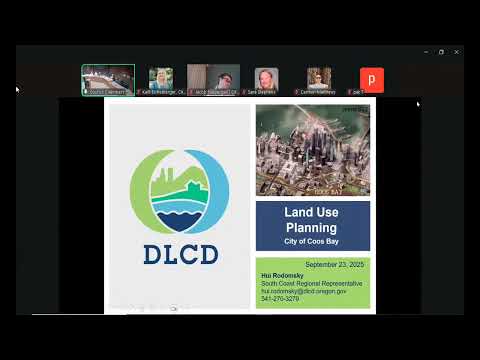
DLCD presents Oregon land‑use system, coastal rules and appeals process to Coos Bay work session
Summary
Huey Radomski of the Oregon Department of Land Conservation and Development briefed the Coos Bay work session on Senate Bill 100, statewide planning goals, urban growth boundaries, coastal management rules and how local decisions are reviewed and appealed.
Huey Radomski, the South Coast regional representative for the Oregon Department of Land Conservation and Development, told the Coos Bay City Council work session on Oct. 9 that Oregon’s land‑use system centers on locally adopted comprehensive plans that must comply with statewide goals set under Senate Bill 100.
Radomski said the state program balances development and conservation by requiring cities and counties to adopt plans and zoning consistent with the statewide planning goals and warned that failures in process can lead to court remands. “If the process is not followed, adhered to properly, it's a very easy appeal,” Radomski said.
Radomski summarized key elements councilors and staff will confront when updating local plans: comprehensive plans are the controlling policy document (zoning must conform to the comp plan); urban growth boundaries (UGBs) define where land can be urbanized; and sewer service typically determines whether land is urban or rural for development intensity. He explained that land outside a UGB often must meet minimum lot sizes and septic repair‑area requirements, while lots inside cities can be built at higher densities.
The presentation reviewed the state’s coastal program, approved under the federal Coastal Zone Management Act and administered in Oregon by DLCD with NOAA concurrence. Radomski explained that because the program includes enforceable policies across 11 state agencies and coastal jurisdictions, federal actions that touch the coastal zone require a state consistency review; he cited the recent offshore wind and wave energy reviews as examples of where federal permits triggered state review.
Radomski discussed the exception process that allows jurisdictions to seek relief from particular statewide goals in narrowly defined situations. He used Goal 18 (beaches and dunes) and riprap for Highway 101 as an example: earlier rules originally prevented some riprap, and the state later developed an exception process so ODOT and counties could apply to protect eroding stretches of the highway.
On appeals and legal review, Radomski outlined the sequence for quasi‑judicial land‑use decisions: administrative (staff) decisions are appealed to the planning commission, commission decisions go to the governing body, and further appeals can proceed to the Land Use Board of Appeals (LUBA). He said a complete record — application materials, testimony, staff reports, findings and final orders — is essential if a decision is later reviewed.
Radomski said DLCD offers technical assistance and works with local staff on grants and plan amendments. “I am also a resource,” he said, and added that he and city staff were working on a grant related to UGB work.
Councilors and residents asked for clarifications about nonconforming ("grandfathered") uses, how UGBs account for sewered unincorporated communities such as Charleston and Bar View, and whether state rules meant farmland was being lost to development. Radomski said local plans ultimately determine allowable uses and that some lands had been previously treated as “exception lands” during earlier implementation of the statewide program.
The session included a detailed explanation of the four types of decisions local governments make (ministerial, two quasi‑judicial types, and legislative), plus guidance for hearing officers and elected officials on avoiding ex parte contacts, conflicts of interest and appearances of bias.
Radomski briefly described the state’s involvement in offshore renewable energy reviews — noting federal leasing and permitting (BOEM, FERC) create the federal nexus that triggers state consistency review — and said the state had used a pause in leasing activity to develop a roadmap and identify conditions under which it would concur with federal actions.
Radomski closed by offering further training and technical assistance to the council and staff and invited officials to contact DLCD with questions about plan amendments, exceptions and coastal coordination.
Less urgent details: the presentation included historical background on SB 100 and Oregon governors who championed the program, references to local examples (UGB work, riprap exceptions), and a recommendation that officials rely on the written record when making quasi‑judicial decisions.