Get Full Government Meeting Transcripts, Videos, & Alerts Forever!
Get email alerts on the Civic Housing Amendment topic
No spam. Unsubscribe anytime.
Board backs zoning change to allow affordable housing on religious and civic institutional land
Summary
The board recommended approval, 5‑2, of a text amendment aligned with recent Florida legislation that permits co‑living and multifamily housing on parcels owned by religious institutions, with requirements that a portion of units be workforce housing under city programs.
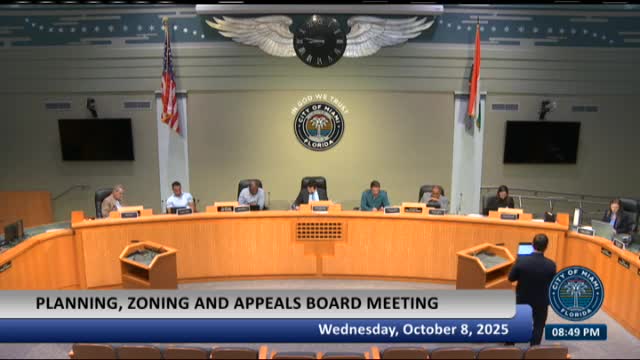
MIAMI — The Planning, Zoning and Appeals Board on Oct. 8 recommended approval, by a 5‑2 vote, of a city zoning text amendment to allow co‑living and multifamily housing on land owned by religious institutions and certain nonprofit civic properties subject to workforce housing requirements.
Planning staff said the change aligns City of Miami code with Florida Senate Bill 1730 (passed in the 2025 legislative session), which allows municipalities to approve affordable housing on parcels owned by religious institutions regardless of underlying zoning, provided a minimum share of the units are designated affordable.
Under the amendment recommended by the board, residential uses including co‑living and multifamily housing can be allowed on civic institution (CI) parcels when the parcel is owned by a religious organization (as defined in state law), a not‑for‑profit, or contains an elementary, middle, or high school. When a CI parcel abuts existing residential transect zoning that allows dwelling units, the amendment defers residential density to the most restrictive adjacent transect; where no abutting residential transect exists, the code establishes a fallback density equivalent to the T4 maximum (36 dwelling units per acre).
The amendment also requires that residential developments on CI parcels provide workforce housing consistent with the city’s Section 3.16 programs: a minimum of 25 percent of units must serve households between 60% and 80% of area median income (AMI), and remaining affordable units must serve households above 60% and at or below 100% AMI (city workforce categories as described in the zoning text).
Board members who supported the change said it provides a lawful local implementation pathway for the state statute and could unlock additional, site‑controlled affordable units. Those opposed raised concerns about unintended neighborhood impacts and asked staff to clarify safeguards, including how the city will ensure projects meet workforce‑housing commitments and how CI parcels in different contexts will be treated.
The board voted 5‑2 to forward a recommendation of approval to the City Commission.