Get Full Government Meeting Transcripts, Videos, & Alerts Forever!
Get email alerts on the Education Public Benefits topic
No spam. Unsubscribe anytime.
Planning board endorses zoning changes to encourage on‑site educational space, offer height bonus for donated space
Summary
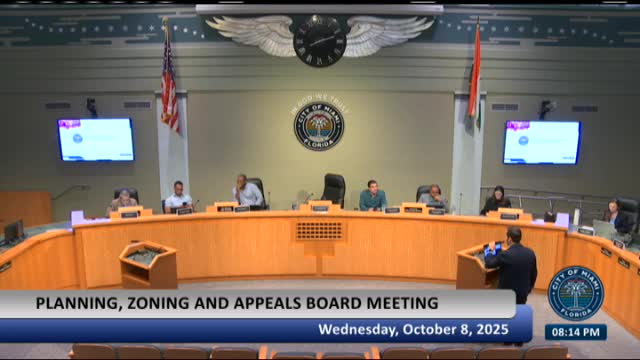
The Miami Planning, Zoning and Appeals Board on Oct. 8 unanimously recommended changes to the zoning code that streamline educational entitlements in transit zones and create a public‑benefit bonus for projects dedicating on‑site educational space.
MIAMI — The Miami Planning, Zoning and Appeals Board unanimously recommended approval Oct. 8 of a package of zoning text amendments aimed at making it easier to site private and charter educational facilities in transit zones and at creating a new public‑benefit incentive to secure on‑site early‑childhood or K‑12 space.
Planning staff said the amendments streamline the land‑use entitlement process so certain educational uses in T5 and T6 transit zones can be processed with fewer discretionary steps, while preserving county and state classroom‑size and recreational‑space requirements that apply to schools. The changes also add a new public‑benefit option: eligible T6 projects that dedicate on‑site space for educational use would be eligible for a bonus of up to two additional stories (not to exceed 30 feet above the maximum podium height).
Under the proposal recommended by the board, a developer that requests the T6 bonus must dedicate at least 15 percent of the total square footage gained through the bonus to educational use. The conveyance must be for childhood education facilities, public schools, public agencies or nonprofit organizations whose primary mission is preschool‑to‑grade‑12 education. The amendments say designated schools operated by Miami‑Dade County Public Schools will have the highest priority to receive available educational spaces.
Efren Nunez of the city planning department described the genesis of the change: a pilot program in 2023 to streamline educational entitlements in urban core transit zones produced only a small net gain of school sites and some displacement of schools as neighborhoods gentrified. Staff and the board said the new public‑benefit option is meant to make on‑site space more financially feasible and to keep class space proximate to growing, dense neighborhoods.
Lourdes Diaz, chief academic officer for Miami‑Dade County Public Schools, told the board the school district strongly supports the amendments and would prioritize use of any city‑provided space. The district said it serves nearly 10,000 children in early‑learning programs countywide and described its recent classroom‑quality results as part of the record.
The board asked about implementation details and a possible later phase to create a dedicated education trust fund; planning staff said subsequent work will define operational criteria, management, and any potential funding mechanisms modeled on programs such as Boston’s that require developer contributions or fees when off‑site provision is used.
The board voted unanimously to recommend approval; the amendments will proceed to the City Commission.