
Council hears data on steep foreclosure rates in Prince George’s County, adopts resolution urging state action
Get AI-powered insights, summaries, and transcripts
Subscribe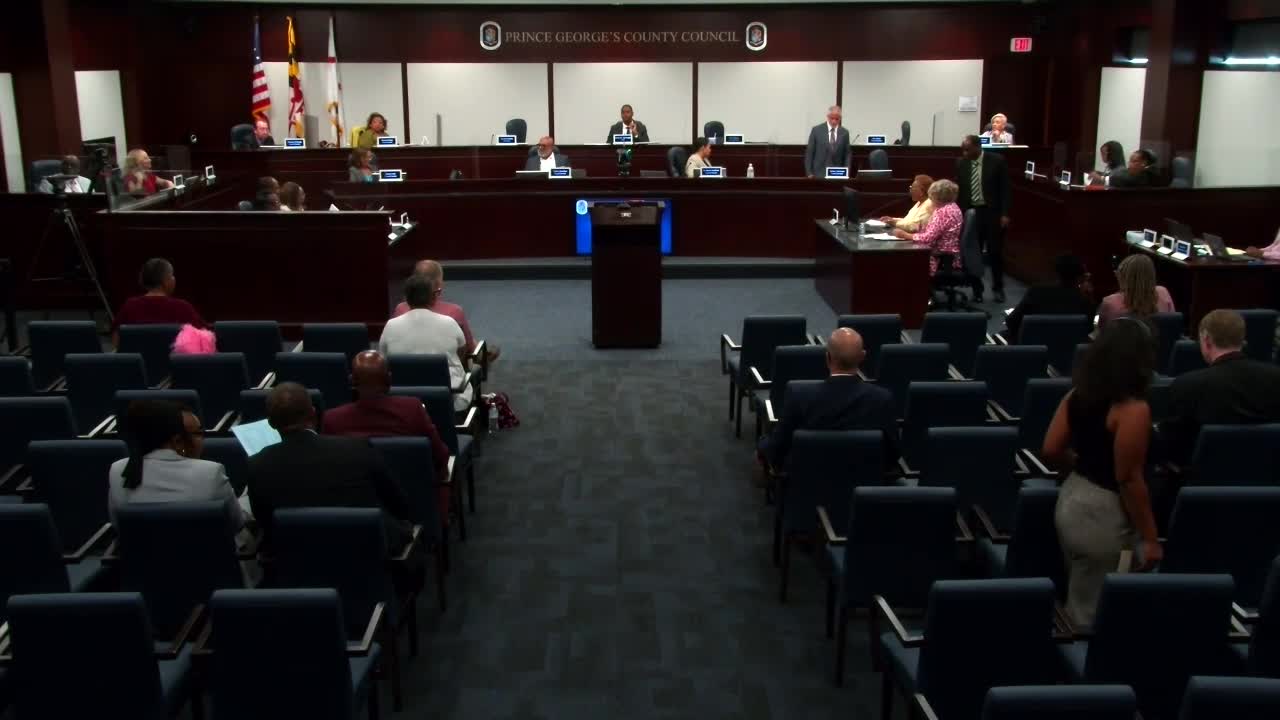
Summary
A pair from Strategic Housing Solutions told the council that Prince George’s County remains Maryland’s foreclosure epicenter; the council introduced and then adopted a resolution urging the Maryland General Assembly, attorney general and governor to act on mediation, servicing and statute-of-limitations reforms.
Prince George’s County officials heard an extended briefing Oct. 7 on a surge of residential foreclosure filings and later adopted a county resolution urging state action to protect community wealth and housing stability.
Housing advocates Liz Johnson and Beth Jacobson of Strategic Housing Solutions told the council that Prince George’s County records the largest share of Maryland foreclosure filings and called for changes including stronger enforcement of mediation rules, limits on sale of long-dormant second liens and a state statute of limitations on foreclosure claims.
Jacobson, who detailed mortgage-industry practices and enforcement gaps, told the council that “Prince George’s County recorded the most foreclosure filings in the state” and identified ZIP codes with particularly high activity. She described “zombie second mortgages” — aged second liens sold to debt buyers — and said such liens can surface decades later to threaten homeowners who were current on their first mortgage. She warned that foreclosure cases that proceed without required servicing documents should be dismissed and urged stronger enforcement and training for administrative law judges who oversee mediation.
Councilmember Harrison asked how mediation law and administrative processes should change. Jacobson suggested that mediation should not proceed until a borrower’s loss-mitigation application has been fully reviewed and that administrative law judges be granted and train to use broader authority to extend mediation and to enforce document production by servicers. She also recommended pursuing a statute of limitations so very old second liens cannot be revived after long dormancy.
Chair Burrows and other council members said the county must press the state for reforms. The council introduced CR 102, a resolution urging the Maryland General Assembly, the attorney general and the governor to take immediate action to address residential foreclosures and to protect homeowners and community wealth. The council subsequently suspended the rules and adopted CR 102 by a recorded vote of 8-0.
Presenters provided several quantitative points the council flagged for follow-up: Strategic Housing Solutions said Maryland’s July 2025 data showed roughly one in 2,566 homes had a foreclosure filing and that over 25 percent of the state’s filings were in Prince George’s County; the presenters also said Prince George’s County ZIP codes such as Capitol Heights, District Heights and Oxon Hill were among the most affected. The presenters estimated county costs of completed foreclosures at roughly $20,000 per case versus about $5,000 to prevent a foreclosure, figures used to argue for a prevention-first approach.
The resolution asks state officials to act on (1) mediation and loss-mitigation procedures, (2) oversight and enforcement of servicer practices and debt buyers, and (3) a statutory limit on revived claims from aged second liens. Council members asked county staff to prepare legislative priorities and to coordinate with the county’s delegation to the General Assembly and the state Attorney General’s office.
The council’s action was procedural and advisory; CR 102 urges state and regulatory reforms rather than changing county law. Council members said they will continue work with judges, the county delegation and the General Assembly to translate the recommendations into enforceable changes at the state level.