Get Full Government Meeting Transcripts, Videos, & Alerts Forever!
Get email alerts on the Building Codes topic
No spam. Unsubscribe anytime.
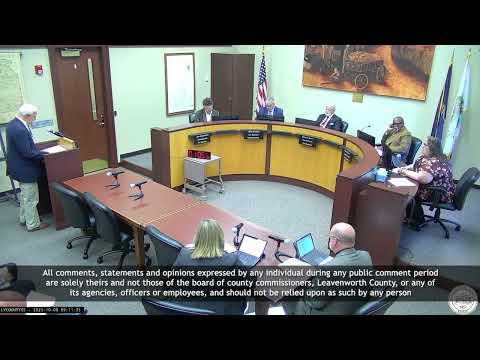
Commission votes 3-2 to extend county building-code adoption to two northern townships; raises storm-shelter questions
Summary
The commission directed staff to proceed with a public hearing to adopt an updated building code (2012 IRC/IBC) and voted 3-2 to include Kickapoo and Easton townships under the county code update, amid commissioner concerns about slab homes and storm-shelter policy.
Leavenworth County commissioners considered a staff recommendation and a code-appeals board review of updated building codes and voted to include Kickapoo and Easton townships in a countywide building-code adoption that moves from the 2006 code to the 2012 IRC and IBC standards.
Staff said the county’s code-appeals board recommended the 2012 International Residential Code (IRC) and International Building Code (IBC) and asked commissioners to set a public hearing to adopt the updates. Commissioners debated both the scope of coverage and storm-safety issues for slab-on-grade homes.
Key points: - Code change: Staff said the proposal is a code update from the county’s current 2006 code to the 2012 IRC/IBC. The county’s code-appeals board recommended the 2012 versions and staff returned with draft amendments. - Geographic scope: Commissioners voted 3-2 to include Kickapoo and Easton townships — two northern townships that previously were not subject to the county’s voluntary code adoption — and directed staff to set a public hearing for formal adoption. - Storm-shelter question: Multiple commissioners raised safety concerns tied to the proliferation of slab houses (houses without basements). Staff provided a permitting statistic: since July 2020, the county had issued 569 single-family permits in unincorporated areas; 246 (about 43%) were slab-on-grade with no basement. Commissioners debated whether larger subdivisions should require safe rooms or other shelter options as a public-safety matter, and staff said that surrounding counties queried did not require storm shelters as a condition of subdivisions.
Why it matters: adopting a more recent code changes minimum construction standards and can affect build costs, inspections and insurance. Extending the code more widely in the county raises enforcement and inspection questions; staff noted inspections and a formal building department would entail additional costs.
Outcome and next steps: The commission approved adding Kickapoo and Easton townships to the code-update process by a 3-2 vote and asked staff to set a date for the public hearing to adopt the 2012 codes; staff recommended revisiting inspection capacity and long-term enforcement options during implementation planning.
Ending: Commissioners signaled urgency on completing the code update that has been under consideration for several years but differed on enforcement mechanisms and storm-safety requirements for dense, slab-based subdivisions.