
City outlines cleanup, funding plan for Champion Mill brownfield site
Get AI-powered insights, summaries, and transcripts
Subscribe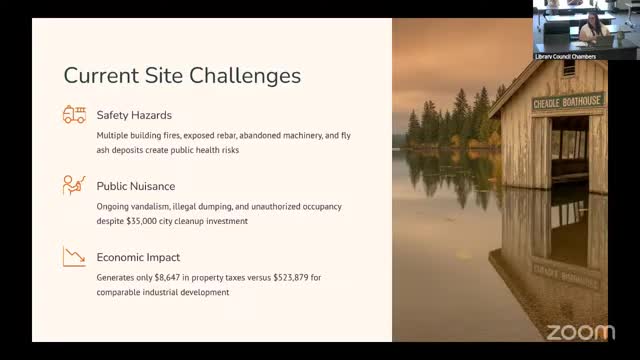
Summary
City staff reported on multi-year environmental assessments and grant efforts for the 50‑acre Champion Mill property, describing contamination hot spots, remaining data gaps, potential cleanup costs and next steps including finishing phase 2 work, designating a project lead and pursuing stacked grants or public–private partnerships.
Lebanon’s Community Development Director Kelly Hart told the City Council on Sept. 10 that the city has completed multiple rounds of environmental assessment and secured grant funding as it pursues cleanup and redevelopment of the 50‑acre Champion Mill site.
Hart said the site’s industrial history — including plywood, paper and lumber operations — left contaminant hot spots; recent testing identified human‑health risk exceedances (including formaldehyde and PAHs) in concentrated areas and ecological risks along portions of the site adjacent to Cheadle Lake. “It is a big site and it is a complicated site,” Hart said.
The report said the city has completed a Phase 1 and a preliminary Phase 2 work with Stantec, and has received an EPA coalition grant (about $1 million shared across Linn and Benton counties) that funded additional Phase 2 rounds and a market analysis. Hart said Round 3 Phase 2 work, under review by the Oregon Department of Environmental Quality (DEQ), will focus on soil‑vapor testing for methane, a Tier 1 ecological assessment and sediment testing along the portion of the property that is part of Cheadle Lake.
Hart flagged a separate 5.28‑acre parcel that is under separate ownership; the county previously sold that parcel after tax default under an Oregon Revised Statutes provision that allows direct sale of industrial parcels. The county completed a Phase 2 on that parcel as part of the sale, but Hart said the city must submit that Phase 2 report to DEQ to determine whether it meets the standards required for residential‑level characterization if the city wants to assume a mixed‑use redevelopment that might include housing.
Hart said the city has been assessing the larger parcel to residential standards because future land use could include mixed uses. She told councilors that tests done to an industrial standard may not include all analytes required under residential screening and may need retesting, which raises costs: “It is expensive to test,” she said, explaining why the city is relying on grants.
Hart described several redevelopment constraints and cost drivers beyond contamination: only one legal access point exists (off Gilbert Street), roughly 8 acres of the property are within Cheadle Lake, wetlands lie along the northern parcel, significant concrete pads remain (and removal may not be eligible for brownfield funding), three septic tanks and a decommissioned underground storage tank exist on site, and an on‑site water tower will need repair.
To inform future public outreach and realistic development expectations, Hart said the city is funding a transportation/secondary‑access analysis and a sewer capacity study (using a $100,000 state infrastructure planning grant). The market analysis funded by the EPA grant will evaluate commercial viability influenced by nearby developments such as a Tractor Supply store.
On cleanup process and liability, Hart summarized DEQ’s voluntary cleanup pathway and the prospective purchaser agreement (PPA) options the city could use if it chose to buy the property. She said PPAs provide varying degrees of liability protection and require specialist legal counsel and payment for DEQ review. Estimated implementation costs remain highly uncertain; Hart gave a wide range of “rough” cleanup estimates and said implementation could run in the low‑millions to multiple millions depending on the feasibility study agreed with DEQ.
Hart recommended finishing the remaining Phase 2 work this fall, designating a city project lead, forming a citizen/staff committee to shepherd the project, engaging consultants for any PPA work and pursuing a strategy of grant stacking and piecemeal funding (for example, using Business Oregon, EPA brownfield grants, EDA, parks or arts grants for site‑specific elements such as the water tower restoration). She said with substantial staffing and consultant support the project could complete in three to five years; with minimal staffing it could extend much longer.
Next steps identified in the staff presentation were completion of the Phase 2 round now under DEQ review, designation of a project lead, formation of a project committee, targeted grant work and consideration of whether to pursue a PPA if the city contemplates acquiring the parcel. Hart said public engagement will be integral if the city moves into land‑use planning for redevelopment.