
Utah Court of Appeals hears challenge to denial of directed verdict in Spencer case; court takes matter under advisement
Get AI-powered insights, summaries, and transcripts
Subscribe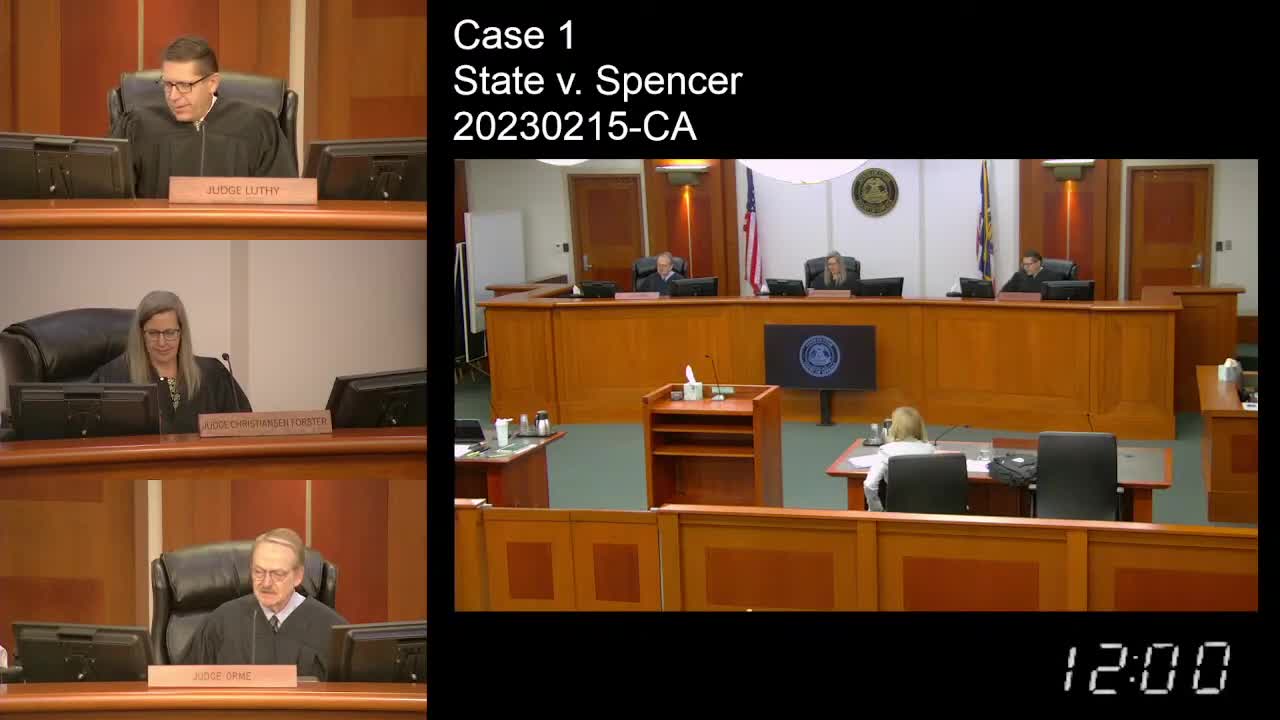
Summary
The Utah Court of Appeals heard argument in State of Utah v. Spencer over whether evidence was sufficient to show the victim was under 14 when the conduct occurred and whether defense counsel provided ineffective assistance. The panel took the case under advisement and will issue a written decision.
SALT LAKE CITY — The Utah Court of Appeals on Thursday heard oral argument in State of Utah v. Spencer over whether the trial court should have granted a directed verdict because the record was insufficient to establish the victim’s age at the time of the charged conduct, and whether the defendant received ineffective assistance of counsel.
Melissa Jo Townsend, attorney for appellant Derek Spencer, told the three-judge panel that “Derek Spencer’s motion for a directed verdict should have been granted,” arguing that the record was too inconclusive about the victim Casey’s age to allow a reasonable jury to find beyond a reasonable doubt that she was younger than 14 when the events occurred.
Townsend pointed to the trial record’s chronology: Casey testified she was 18 at the time of trial on Aug. 30, 2022; she visited a doctor on May 25, 2018; and the doctor visit followed the charged encounter. Townsend said Casey also testified that a birthday was “around the time” of the doctor visit but that the record does not identify whether that was her 14th or 15th birthday. “We are moving beyond the realm of inference and into the realm of speculation,” Townsend argued, saying the absence of a clear date created a gap in the chain of logic that required reversal or a remand for further factfinding on an ineffective-assistance claim.
Marion Decker, representing the State, urged the court to uphold the jury’s verdict and the denial of the directed-verdict motion. Decker said the appellate standard requires viewing evidence in the light most favorable to the verdict and that jurors could reasonably infer from the testimony that Casey was 13 at the time of the events. “We view the evidence now in the light most favorable to the verdict,” Decker said, summarizing the State’s timeline and arguing that the jury was competent to resolve ambiguities.
Townsend also pressed the court on a separate Rule 23(b) motion seeking a remand to supplement the record on an ineffective-assistance claim. That motion included a declaration by Spencer’s mother describing an alleged affair she said was relevant to defense investigation. The parties debated whether counsel’s decision not to call the mother — and whether the mother’s declaration alone could support an ineffective-assistance claim on appeal — warranted remand for additional evidence.
During argument, Townsend flagged a sentencing-hearing passage in the record in which the trial court stated, “there is no doubt in my mind this event actually happened,” then added the doubt related to when it happened. Townsend said that passage and the jury’s own question to the court about the victim’s birthday reflected that the jury identified a missing fact crucial to determining the victim’s age.
The State countered that circumstantial evidence and the chronology the jury could draw from trial testimony were sufficient and cited the trial court’s evaluation of witness credibility. Decker also noted that a demonstrative exhibit containing a January 2018 date had been stricken from evidence and that jurors were instructed to decide only on the evidence before them.
After roughly 35 minutes of argument, the presiding judge, Michelle Christiansen Forster, told counsel the court would take the matter under advisement and issue a written decision. The panel did not announce a timetable for that decision.
The court heard the argument sitting en banc with Judges Gregory Orme and John Lindsay joining Forster on the oral-argument panel. No immediate ruling was issued; the appeals court’s written opinion will determine whether the directed-verdict denial stands and whether a remand is required to develop the record on the ineffective-assistance claim.