State updates Rural and Family Lands easement program; aims to start about 75 projects this year
Summary
The Florida Department of Agriculture updated the Senate Committee on Agriculture on the Rural and Family Lands Protection Program, reporting expanded acreage protected via easements, a $250 million appropriation for 2025 and plans to begin roughly 50–75 new projects annually, while stressing enrollment in agricultural best management practices.
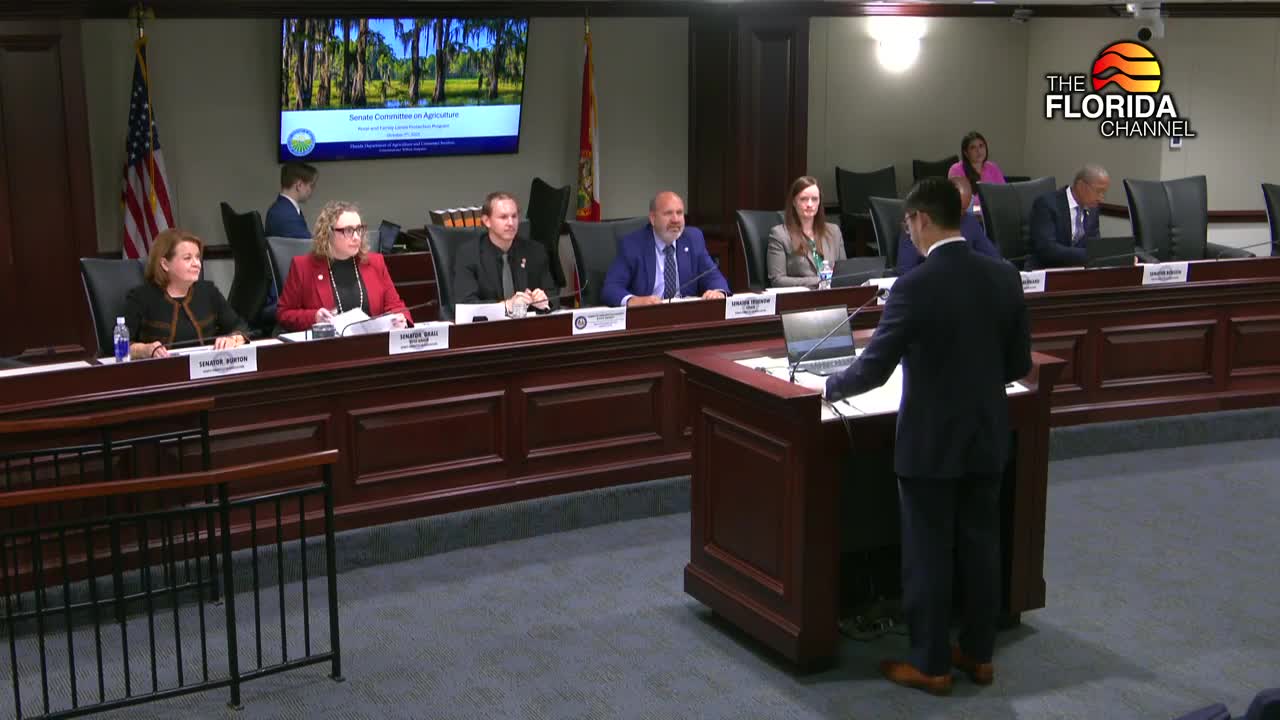
John Paul Freitas, director of the Rural and Family Lands Protection Program at the Florida Department of Agriculture and Consumer Services, told the Senate Committee on Agriculture that the program is expanding its use of conservation easements to preserve working agricultural land.
"The Rural and Family Lands Protection Program is an agricultural land preservation program and it's designed to protect lands from being developed into uses incompatible with agriculture and the natural habitat," Freitas said during his presentation.
Freitas said the program acquires development rights through permanent rural land protection easements rather than buying land in fee, which lets landowners retain ownership and maintain the property's taxable status for local governments. He told senators the program requires participating landowners to be actively producing agriculture with an agricultural tax classification and to enroll in agricultural best management practices (BMPs), including verification and post-closing monitoring.
Freitas and his slides said the program protected about 66,000 acres from 2001 to 2022 and has added about 161,000 acres since the current commissioner took office in 2023. He cited a current appropriation of $250 million for the program in 2025 and said the program's 2025 ranked acquisition list contains 428 projects.
"With the consistent funding, we anticipate about 75, anywhere between 50 and 75 projects every year," Freitas said when asked how many projects the program expects to start this year.
Freitas described partnership funding as a major multiplier. He said 23 project partnerships on the 2025 ranked list have already increased the appropriation by roughly $62.8 million and that additional partnerships are in development with USDA programs (RCPP, ALE), the Department of Defense (REPI), land trusts, counties, water management districts and the U.S. Fish and Wildlife Service.
Program materials shown to the committee explained the selection process: a 45-day application window, technical review against criteria (agricultural economic value, sustainability, natural resource value, landscape context, condition of the property and proximity to military installations), public hearing for initial rankings, and final approval by the board of trustees or by statutory authority for acquisitions under $5,000,000. Freitas said the program negotiates easement terms, maps significant natural areas, completes due diligence and conducts ongoing monitoring after closing.
Freitas also noted that easement landowners who enroll in BMPs may be eligible for BMP cost-share support for implementation, ranging from about 65% to 90% of eligible costs.
The presentation included short applicant videos. One applicant, VC Hollingsworth III, introduced his multi‑generation cattle and citrus operation in Pine Level and framed the easement program as a way to protect water, wildlife habitat and family legacy. Another speaker identified only as a fifth‑generation dairy farmer described milking 1,600 cows and said program funds would be reinvested into the business to manage volatility.
Senators asked about eligibility and how many applicants on the ranked list will receive funding. Freitas said the vast majority of applicants meet eligibility criteria (active agricultural production, ag tax classification and at least one of the public-purpose factors) and that applicants placed on the ranked list are eligible for funding. He added that the program reranks the list yearly and that recent application increases are tied to both process efficiencies and steady legislative funding.
Freitas concluded by thanking the committee for support and answering questions about county partnerships and outreach.
Ending
The department framed the program as a demand-driven easement program that depends on sustained legislative appropriations and partnerships to convert a growing ranked list of projects into executed easements. No committee votes or formal actions were taken during the presentation.