
Planning commission advances draft changes to discretionary demolition permit rules; seeks exhibits for fire hardening and postwar homes
Get AI-powered insights, summaries, and transcripts
Subscribe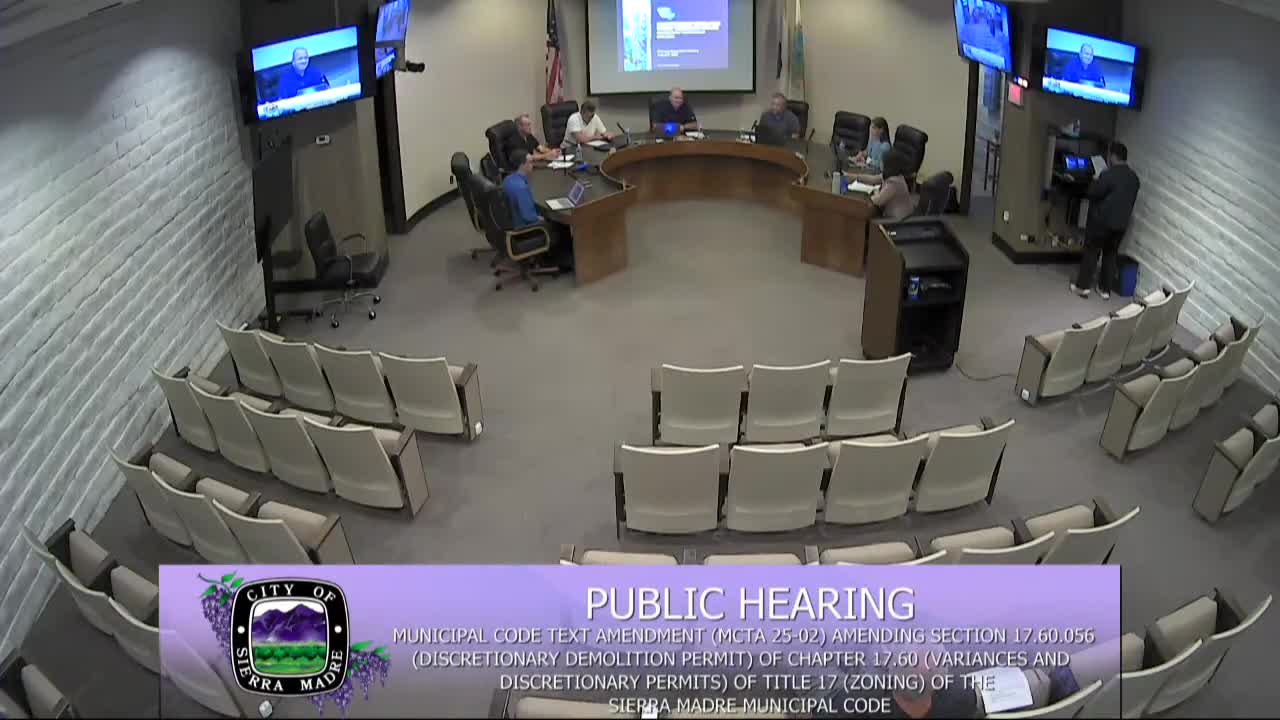
Summary
The Sierra Madre City Planning Commission on Aug. 7 held a public hearing on Municipal Code Text Amendment MCTA 25‑02, a staff‑proposed revision to the city’s discretionary demolition permit rules (section 17.60.056 of Title 17).
The Sierra Madre City Planning Commission on Aug. 7 held a public hearing on Municipal Code Text Amendment MCTA 25‑02, a staff‑proposed revision to the city’s discretionary demolition permit rules (section 17.60.056 of Title 17). The draft changes are aimed at speeding some post‑fire repair and "home hardening" work while retaining review for structures that may be historic.
“The purpose of a discretionary demolition permit ordinance is to ensure that the potential historic resources are properly evaluated before they are altered or demolished,” Senior Planner Wolf said in opening the staff presentation.
Staff said the proposal grew from City Council direction on June 24, 2025 to balance wildfire recovery and historic preservation after the Eaton Fire; staff described the fire as producing conditions that may require building alterations for ash and soot abatement. The draft ordinance would introduce a defined category called a “preservation candidate” (structures constructed 75 or more years prior to an application date) and a new set of exceptions under which a discretionary demolition permit would not be required. Exceptions in the draft include demolition not visible from public view, demolition of tract homes built as part of a subdivision of five or more lots (where not the work of a notable architect), emergency abatement of imminent hazards as determined by the director in consultation with the city engineer, and limited ministerial review for specified fire‑hardening work and for certain post‑World War II houses identified by a council‑adopted exhibit.
Wolf said the draft also envisions two exhibits to be adopted by City Council resolution and maintained by staff: one providing examples of acceptable fire‑hardening updates and the other listing house types from the postwar period that would be eligible for ministerial review rather than a full discretionary demolition review. Staff noted a discretionary demolition permit could take at least five weeks to process, whereas a ministerial building permit for an alteration might be issued the same day once the ministerial review clears the applicability test.
The Planning Commission subcommittee (Chair Denison and a commissioner appointed by the commission) summarized its work to streamline and reorganize the code language so the ordinance is easier to read and to create the exhibits as a tool staff can update without returning to Council for every material change. The subcommittee emphasized that the ministerial exceptions are intended to allow prompt, practical home hardening and repairs while preserving the ability to refer unclear cases to the full discretionary review process.
Commissioners asked staff clarifying questions about definitions and procedure—specifically the choice of the new term “preservation candidate” versus the existing defined term, how visibility “from public view” would be determined, and whether approving a fence material without a fence placement would allow later placement anywhere on a lot. Staff confirmed public notice and comment requirements remain for any project that requires a discretionary demolition permit; projects that meet an exception would not trigger the discretionary notice. Staff also said the ministerial review option could be withheld and staff would provide recommended changes back to the applicant.
No members of the public spoke on the item. After discussion the commission voted unanimously to continue the draft text amendment to the Planning Commission meeting of Aug. 21 so commissioners can review the draft exhibits (fire‑hardening examples and postwar house guidance) before forwarding a recommendation to City Council; the staff report lists the next related City Council meeting as Aug. 26 for subsequent council consideration.
Staff said the city is also participating in a citywide architectural survey conducted in coordination with the National Park Service and U.S. Department of the Interior (work that began July 28 and is offered at no cost to the city). Staff noted the survey could be an additional reference for ministerial determinations and for identifying resources that merit formal historic designation, but that the survey itself does not designate properties.
The commission’s continuance gives staff time to prepare the two exhibits and to provide a cleaner, reformatted draft ordinance for further review. If the commission forwards the ordinance to Council, Council would adopt any exhibits (fire‑hardening examples and postwar house guidance) by resolution and staff would maintain and update them as technology and materials evolve.