
Kenai Airport updates master plan, announces 2026 runway rehabilitation and temporary taxiway runway
Get AI-powered insights, summaries, and transcripts
Subscribe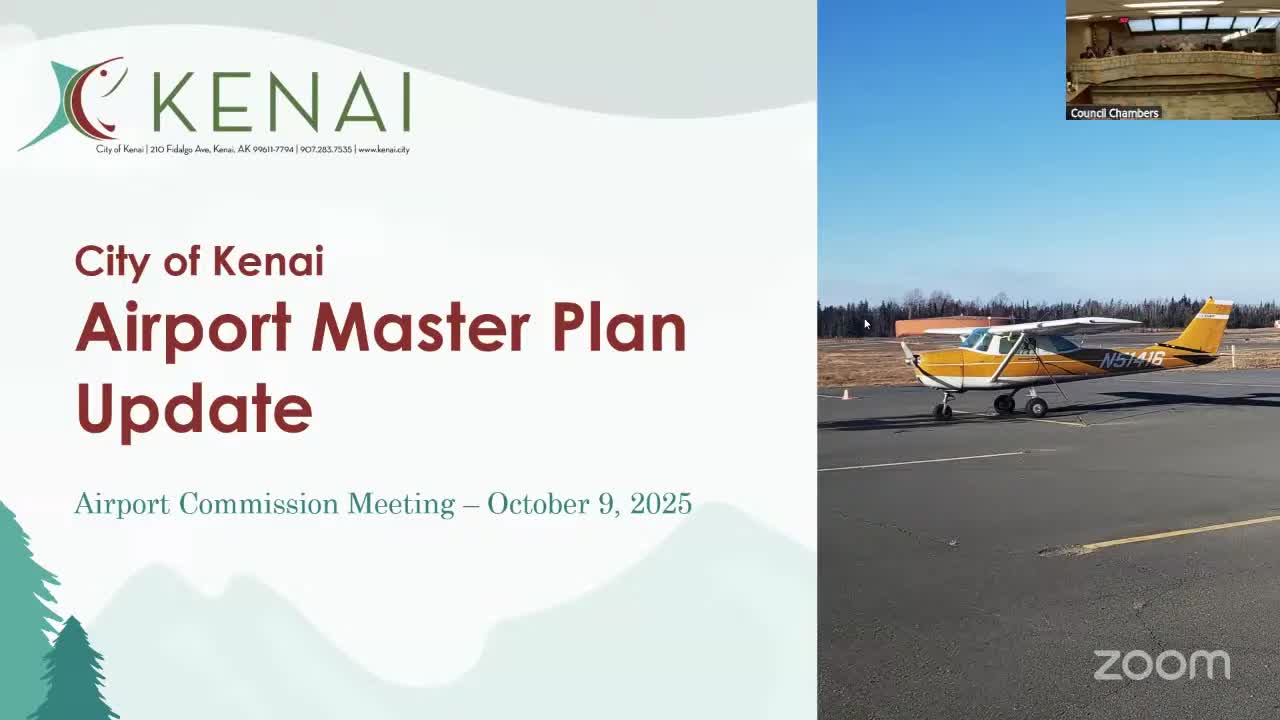
Summary
HDL Engineering told the Kenai Airport Commission that phase 1 of the Kenai Airport Master Plan is complete and that main runway 02L/20R will be closed for a planned 2026 rehabilitation, with the parallel taxiway proposed as a visual temporary runway; FAA instrument approaches would not be available during construction.
Eric George, a project engineer with HDL Engineering, told the Kenai Airport Commission on Oct. 9 that the consultant has completed the reconnaissance phase of the Kenai Airport Master Plan and will move into an evaluation phase this winter, and that a rehabilitation of the airport's primary runway, 02L/20R, is scheduled for summer 2026 and will close the runway for one construction season.
The update matters because the planned closure would require the airport to operate from a temporary runway on Taxiway Alpha and would suspend instrument approaches until the main runway reopens, limiting operations in poor weather. "The primary runway is going to be closed, and what that will leave us with, is use of the parallel taxiway, which will be used as a temporary runway," George said.
George said HDL completed the Phase 1 deliverables — inventory, socioeconomic evaluation, aviation forecasting and facility standards — over roughly 12 months and that the city is finishing its final review. He said the team expects to hold another public meeting to present Phase 1 findings before moving into Phase 2, which will develop alternatives, capital improvement programming, environmental review and a final draft master plan.
On the rehabilitation project, George said the design has been under development for several years and the contract was recently awarded to Quality Asphalt Paving (QAP) of Anchorage. He described the core scope: full pavement rehabilitation of Runway 02L/20R; extension of pavement limits to taxiway halfway points to stay outside the runway safety area; airfield drainage improvements to an existing storm drain at the northwest corner of the airfield; replacement of three supplemental wind cones; replacement of signage and edge lining; upgrades to navigational aids including conversion from VASI to PAPI; and replacement of runway and identifier lights in kind.
George said a temporary runway on Taxiway Alpha was previously used in 2006–2007 and could be used again next summer. "That time they completely closed down the runway full width, full length, for the entire construction season, and they operated traffic off of the gravel strip and off of this temporary runway off of Taxiway Alpha," he said.
Commissioners and airport users raised operational questions. One commissioner asked whether HDL had compared historical traffic frequency when the taxiway was used as a runway to current traffic levels; George said he would investigate and consult the FAA, adding, "if I was to ask the FAA for an alternative ... the FAA might lean on the safer option, which is to use the parallel taxiway." Another commenter who identified himself as a pilot recalled previous successful operations from Taxiway Alpha but warned about instrument-conditions limitations: "I'm just wondering what the minimums would be on, say, a GPS approach this summer." George responded that the temporary runway would be for visual operations only and that "instrument approaches will be no[t]" available until the main runway reopens.
George said HDL plans early and repeated public engagement with airport users and commercial operators — he named Kenai Aviation, Grand Aviation and Alaska/Aleutian operators as groups already contacted — and that the project team will identify staging areas and coordinate to mitigate impacts. He also said he will take notes of the commission's questions, discuss approach-minimum possibilities with his design team and the FAA, and report back to the commission.
The consultant said the master plan project maintains a public website (referred to in the meeting as "keeneyeamp.com") with slides, contact information and a user questionnaire. George asked attendees to submit feedback via the site or directly to HDL.
No formal action to approve the runway rehabilitation or the master plan occurred at the Oct. 9 commission meeting; Commissioners heard the presentation and asked questions. Mary Bondurant, the acting airport manager, and commission leadership were present for the discussion and will continue coordination with the consultant and FAA.
Looking ahead, George said the team expects Phase 2 work over the 2026 season and anticipates returning to the commission with a final draft in late 2026. He said the runway rehabilitation aims to complete construction in a single summer season, weather permitting.