Get Full Government Meeting Transcripts, Videos, & Alerts Forever!
Get email alerts on the Public Art Fund topic
No spam. Unsubscribe anytime.
Commission weighs allowing public-art fund to cover LPAC upgrades; flags future legal risk, agrees to 25% cap
Summary
The commission discussed a proposed ordinance amendment to allow the city's public-art fund to pay capital improvements at the Lauderhill Performing Arts Center (LPAC). City staff reported a fund balance of $264,002.64. The city attorney said a state law may bar local governments from assessing new public-art fees on developers going forward; the
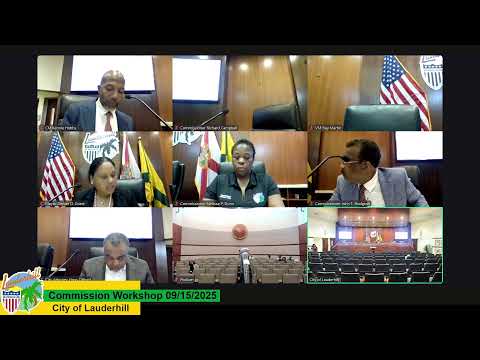
The Lauderhill City Commission discussed on Sept. 15 a proposed amendment to the city code to clarify that the public-art fund may be used for capital improvements at the Lauderhill Performing Arts Center (LPAC).
Why it matters: The public-art fund is supported by a portion of building permit fees and has been used for murals, utility-box wraps and other installations across city parks. Allowing limited use of those dollars for LPAC upgrades would give staff an additional funding source for audio/visual and other production-related improvements, but commissioners sought a cap and asked staff to confirm the long-term availability of the fund.
City Manager Kenny Hobbs reported the fund balance at the workshop as $264,002.64 and gave examples of past uses over the last decade, including murals at multiple parks, a mosaic floor and ceiling work at the LPAC, utility-box wraps and a cricket-related public art sculpture. "Over the last 10 years, we've used ranging from $54,000 in 2016... $294,000 in 2024, and $142,000 in 2025," Hobbs said while summarizing prior expenditures.
Hobbs said the fund is fed by a percent of building-permit fees; staff warned that redevelopment and large permit activity can increase the pot. The city attorney cautioned commissioners about an evolving legal landscape: "I would have to research that, so we may not have the authority to impose going forward these public art development fees on developers," the attorney said, noting a state-level change could prevent future collections.
Commission discussion focused on priorities and limits. Mayor Grant and others said existing park projects and new parks under development will also need public art, and cautioned that the current balance would not cover large-scale work across multiple parks. Several commissioners suggested a compromise that preserves most of the fund for traditional public-art projects while allowing a limited share for LPAC capital improvements.
The commission coalesced around a 25% cap on the current public-art balance for LPAC capital upgrades as a policy direction to staff (25% of the $264,002.64 balance equals approximately $66,000). Commissioners asked staff to confirm the legal authority to continue collecting the fee and to return with a specific ordinance drafting the amended language and fiscal projections.
No ordinance was adopted at the workshop. Staff agreed to research the statutory question, model ordinance language, and estimated future revenues from permit activity before returning to the commission.