Get Full Government Meeting Transcripts, Videos, & Alerts Forever!
Get email alerts on the Behavioral Health Provider Network topic
No spam. Unsubscribe anytime.
CareOregon and Columbia Pacific CCO tighten outpatient behavioral‑health billing to contracted providers; county commissioners raise licensure and rural access,
Summary
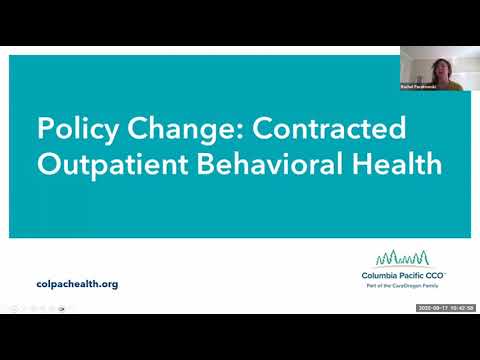
Rachel [last name not provided], a representative of CareOregon and Columbia Pacific CCO, told the Clatsop County Board of Commissioners that CareOregon has enacted policy changes that narrow Medicaid reimbursement to credentialed, contracted outpatient behavioral‑health providers, with an Aug. 1 change already in effect and an Oct. 1 change requiring routine outpatient care to be delivered by contracted providers.
Rachel [last name not provided], a representative of CareOregon and Columbia Pacific CCO, told the Clatsop County Board of Commissioners that CareOregon has enacted two behavioral‑health policy changes intended to narrow Medicaid reimbursement to credentialed, contracted providers and to improve oversight of care for members with the greatest needs.
The first policy, CareOregon said, went into effect Aug. 1 and removes reimbursement eligibility for certain provider types billing Medicaid as individual, uncontracted providers when providing routine outpatient mental‑health and substance‑use services. The CCO also announced a second policy requiring routine outpatient mental‑health and substance‑use disorder services be provided only by contracted outpatient providers; that change is scheduled to take effect Oct. 1. Rachel said the two policies are separate from Oregon Health Authority (OHA) rulemaking but that CareOregon will align with any future OHA rule changes if they occur.
Why this matters: CareOregon framed the changes as a way to focus limited resources on organizations that can provide a full spectrum of services, maintain credentialing and clinical oversight and coordinate crisis and primary‑care connections for Medicaid members with complex needs. "Our behavioral health strategy is rooted in ensuring our members, especially those living with the most complexity, receive not only consistent and accountable care, but also care that is connected to our broader health system," Rachel said.
CareOregon described its timeline and outreach. The CCO said it first notified impacted associate providers in December 2024, held a listening session in February 2025 and began proactive contracting outreach in July 2025 to offer contracts to providers who met region‑ and county‑specific volume thresholds. The organization said it sent multiple rounds of notifications to providers and members in August and September and will continue ongoing assessments after the Oct. 1 policy goes live.
CareOregon provided several network impact figures and equity findings. The CCO said about 19% of its outpatient behavioral‑health provider roster would be affected by the changes but that those providers represent only about 6% of outpatient utilization. Across the CCO’s three regions (Portland metro, Southern Oregon’s Jackson Care Connect and the North Coast), CareOregon estimated the change would affect roughly 500 members in Clatsop, Tillamook and Columbia counties. The CCO said some noncontracted providers are telehealth clinicians seeing only one or two members within the region and that those providers together represent about 8% of outpatient services to members in Clatsop County.
Rachel said internal reviews showed a cost differential between contracted and noncontracted providers and that, "non contracted providers can be 50% more expensive," a difference she attributed to limited ability to monitor utilization and medical necessity when providers are not under contract and credentialing oversight. She also said an equity analysis indicated English‑speaking white adults were disproportionately affected relative to the CCO’s overall membership and that American Indian and Alaska Native members were overrepresented among impacted members in one analysis (CareOregon reported an example figure of 8% of that subgroup impacted while that subgroup represented 2% of total membership, prompting targeted outreach to culturally specific providers).
County commissioners asked for clarifications and raised concerns about workforce and licensure. Commissioner Wakula asked why race and language data were cross‑referenced; Rachel said the CCO used those data to identify potential disparate impacts and to pursue contracts with culturally specific providers when gaps appeared. Commissioner Webb and Commissioner Thompson described personal and professional experience with the difficulty of obtaining Oregon licensure; Thompson pressed the CCO to assist with workforce issues and suggested the county and partners advocate for streamlined licensure processes.
Shaira [last name not provided], representing the Community Mental Health Program (CBH), confirmed the administrative burden of the Certificate of Approval (COA) and licensure processes. "It is laborious and time consuming," she said of the COA/licensure process, while also emphasizing CBH’s funding model: CBH told commissioners it is paid on a capitation basis by CareOregon and does not receive additional dollars for adding clients, clarifying that shifting clients between providers would not increase CBH’s capitation revenue.
Rachel and Shaira described single‑case agreements as a continuing pathway for medically necessary care that lacks an existing contract. Rachel said single‑case agreements — short‑term negotiated arrangements to cover care not available through standing contracts — "will still exist and do still exist after this policy change." The CCO also described supports for providers who seek contracts, including a Medicaid essentials program and a Quality Improvement Incentive Program.
Commissioners urged CareOregon and state leaders to address pay and workforce shortages. Multiple commissioners said low pay and rural workforce shortages drive difficulty recruiting licensed clinicians and recommended county engagement with governor’s workforce efforts. Shaira said she participates in a governor’s talent council committee that is discussing recruitment, retention and licensure barriers.
Commissioner Thompson asked for a way for HSAC (Health Services Advisory Committee) members and community stakeholders to review CareOregon data in more depth; the CCO agreed to follow up. Commissioners also raised concern from local private providers such as Shoreline Counseling about administrative burdens and timelines to obtain COAs and asked that CCO and OHA processes be clarified and streamlined where possible.
No formal county votes or motions were taken on the CCO’s policies during the discussion; the presentation and question period were an informational briefing and request for continued coordination between the county and the CCO.
What’s next: CareOregon said it will continue proactive contracting and network assessments after Oct. 1 and will track OHA’s rulemaking timetable; Rachel noted OHA was expected to finalize rule language by the end of the year with a possible effective date in summer 2026, and CareOregon would align with any OHA rule changes.
Ending note: Commissioners thanked the CCO and CBH representatives and asked to be kept informed of contract offerings and any gaps in access that emerge as the policy goes into effect. County staff postponed a separate Fort Point agenda item to a future meeting to allow more time for this discussion.