Get Full Government Meeting Transcripts, Videos, & Alerts Forever!
Get email alerts on the Energy Storage topic
No spam. Unsubscribe anytime.
Seattle fire marshal’s office urges 2024 IRC to reference NFPA 855 for residential energy storage systems
Summary
Seattle Fire Department Fire Marshal’s Office representative Ken Brulette told the IRC tag that a first-reading proposal would point residential energy storage systems to NFPA 855 and update related references in the state code.
Seattle Fire Department Fire Marshal’s Office representative Ken Brulette told the International Residential Code (IRC) tag that a first-reading proposal would point residential energy storage systems (ESS) to NFPA 855 and update related references in the state code.
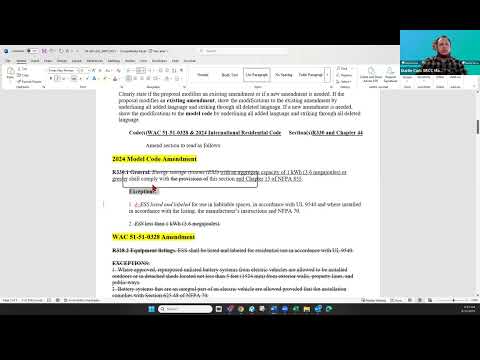
The measure would add language saying ESS with an aggregate capacity of 1 kilowatt-hour or greater must comply with chapter 15 of NFPA 855 and would remove a local exception so the NFPA standard is the primary compliance path. "NFPA 855 ... is where all the latest and greatest code provisions are located right now," Brulette said during the tag’s first reading.
Why it matters: NFPA 855 is a consensus standard recently updated and intended to consolidate ESS technical rules; proponents said referencing that standard would bring the IRC into alignment with new model-code proposals for the 2027 International Fire Code (IFC) and make state guidance clearer for manufacturers, listing agencies and local code officials.
During the discussion Brulette said Washington has a history of adopting newer cycles early and is proposing to adopt select 2027 IFC language into the 2024 IRC now to "stay ahead of the game." He asked the staff facilitator to incorporate small editorial changes, add UL 9540 to the reference standards section and to delete duplicate exceptions that will be replaced by a new r330.1.1.
Tag members asked practical and timing questions. TAG member Quinn Thai asked whether the proposal should specify the 2026 edition of NFPA 855; Brulette replied the 2026 edition is referenced in the code-change text and that NFPA has completed the edition now available for presale. Patrick Hanks asked whether the change was life-safety or editorial; Brulette responded the change also affects allowable ESS sizes in residences and thus can affect consumer options and building configurations.
No formal vote was taken; staff called the item a first reading and asked the proponent to supply a cleaned-up document and a public-comment version for subsequent meetings. The tag agreed to bring the item back with Brulette’s revisions and to consider it for final action at a later meeting.
Proponents said clarifying the compliance path would reduce confusion for permitting and inspection because ESS installations could be evaluated primarily against NFPA 855 rather than scattered code cross-references. Questions remaining for staff and the tag include final reference wording, the edition years to cite, and whether any state-specific exceptions are still needed.
Looking ahead: Brulette said he will provide a revised text and referenced materials (NFPA 855 and UL 9540) for the next tag meeting so the committee can consider final action.