
Apopka staff outline permanent irrigation plan for Clearwater Lake; HOA faces roughly $2,400 per household share
Get AI-powered insights, summaries, and transcripts
Subscribe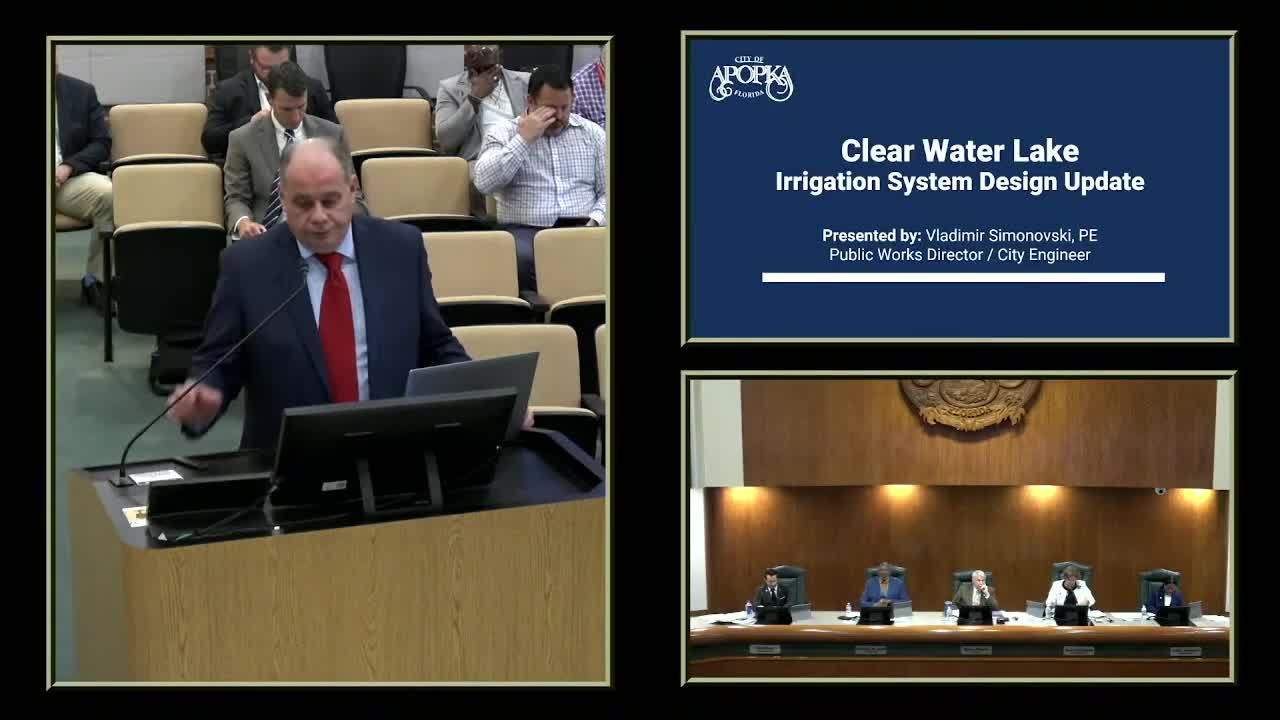
Summary
City staff presented a plan July 16 to create a private irrigation pump station for Clearwater Lake that would let Clear Lake Landing disconnect from the city’s reclaimed‑water system and use lake water for irrigation under a consumptive‑use permit; construction is estimated at about $456,000 and the HOA’s share was presented as roughly $2,400 per household.
City staff presented a plan July 16 to create a private irrigation pump station for Clearwater Lake that would let Clear Lake Landing disconnect from the city’s reclaimed‑water system and use lake water for irrigation under a consumptive‑use permit issued by the St. Johns River Water Management District. The council did not vote on the project that night but directed staff to pursue further meetings and a workshop with the affected homeowners associations.
The plan matters to nearby residents because the closed‑basin lake has been rising in recent years and flooded yards in Clear Lake Estates and Clear Lake Landing. Vladimir Simovsky, the city’s public works director and city engineer, told the council the long‑term design replaces emergency pumping used in February–April 2023, when temporary pumping reduced the lake by about 3.4 feet at a cost the city reported as $195,150.
Simovsky said his office contracted the Balmoral Group to design a permanent irrigation pump station and obtain permitting; he said the design cost was about $68,900 and the construction estimate is $456,000 (roughly $397,000 for construction plus a 15% contingency). “The normal water level of Clear Lake is at elevation 65 feet. The district permit allows surface‑water withdrawal of irrigation down to elevation of 63 feet,” Simovsky said, and he reported the lake elevation at about 69.75 feet the day of the meeting.
Under the staff plan, the Clear Lake Landing HOA would own and operate the private pump and irrigation system; the district permit was issued to Clear Lake Landing. Simovsky said Avian Point has already contributed $60,000 and the city could contribute about $60,000 in in‑kind services. With those amounts and the city’s prior emergency and design costs, staff presented an estimate leaving the HOA with about $336,000 of the construction cost. Dividing that by the approximately 142 homes in the subdivision produced a rough per‑household share of about $2,400 (Simovsky framed an earlier, higher estimate before applying the Avian Point and city contributions).
Council members and residents pressed staff on unanswered questions: who would finance the HOA’s share, whether residents understand they would also be responsible for long‑term maintenance and insurance, whether drought would force reconnection to the city reclaimed‑water system, and whether the HOA membership has formally approved the plan. Simovsky said the permit includes conditions for droughts and modifications and that re‑connection would be possible if the permittee requests changes from St. Johns, but he did not state a guaranteed process beyond permitting. Cliff Shepherd, the city attorney, said the city cannot simply loan funds to an HOA but that there are financing mechanisms—bonds or facilitation structures—staff can explore.
Brian Mader, who identified himself as president of the Clear Lake Landings HOA, said he had expected the city to do more outreach and said residents had not been told they might need to obtain a loan to pay their portion. “This is the first I’ve ever been told at all that the HOA was gonna have to go get a loan on this,” Mader said. Other residents said they had not received consistent notices and asked the council to avoid imposing unexpected costs on homeowners.
Simovsky estimated a six‑ to nine‑month timeline from mobilization to completion if construction started promptly, and he said the construction estimate did not include the costs to disconnect and reconnect the HOA’s service to city mains; staff said that physical disconnect could be done quickly but would be a separate expense. Commissioners emphasized the need for HOA approval of any funding plan and for staff to return with more detail on financing, operation, and contingencies.
The council agreed to schedule a public workshop with the affected HOAs and staff to review options and gather resident input before any formal council action; staff and commissioners discussed August dates and set a workshop for August 11 at 6:00 p.m. as a next step.