Get Full Government Meeting Transcripts, Videos, & Alerts Forever!
Get email alerts on the Small Business Impact And Cost Benefit topic
No spam. Unsubscribe anytime.
Building Code Council work group outlines plan for small‑business impact statements, cost‑benefit analysis
Summary
The Washington State Building Code Council work group on economic impact met virtually Aug. 18 to begin preparing small‑business economic impact statements and cost‑benefit analyses for code proposals moved to CR102 and to plan a questionnaire and outreach process to gather the data those reports require.
The Washington State Building Code Council work group on economic impact met virtually Aug. 18 to begin preparing small‑business economic impact statements and cost‑benefit analyses for code proposals moved to CR102 and to plan a questionnaire and outreach process to gather the data those reports require.
The meeting served as a preliminary screening session for the “Group 1” code proposals the council moved to CR102 and set a path for tag chairs and staff to flag proposals that need fuller economic review, said Dustin, staff member. "Today is this, designed as a preliminary look at what we have going here for the different codes, that were in group 1 and to try to get some input for our cost benefit analysis and then also for our small business economic impact statement," he said.
Why it matters: state rulemaking statutes and the council’s Administrative Procedures Act obligations require a completed small‑business economic impact statement and other analyses as the council moves rules through CR102 and CR103. The group said it must finish preliminary drafting and public outreach in time to meet an Oct. 1 filing expectation for the small‑business report, and it discussed using a mix of technical advisory groups, targeted surveys and public listening sessions to collect evidence.
Major points from the meeting
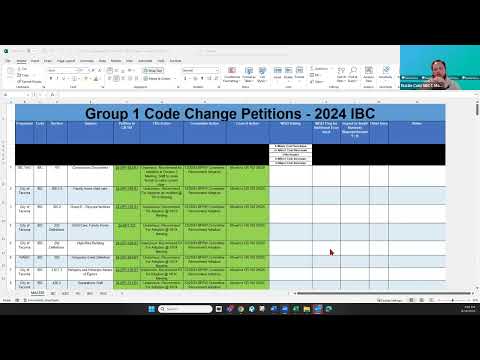
- Scope and screening: The staff spreadsheet reviewed at the meeting lists proposals that the council advanced to CR102, with two still lacking explicit council action (one consolidated proposal and a fixed‑guideway transit item). The work group agreed to run a rapid “sniff test” at the tag level to identify proposals with likely cost impacts and remove those with negligible impact from a heavier review path.
- Questionnaire and outreach: The work group tasked staff to prepare a questionnaire to send to small businesses and other stakeholders for proposals flagged for additional review. Dustin said the questionnaire will be drafted for use across multiple proposals and run by Patrick as a sounding board before distribution.
- Data defaults and thresholds: The group reviewed the small business template used by state staff and noted that, if survey data are insufficient, agencies sometimes use a $100 default to represent a ‘‘minor’’ cost. "If we don't get sufficient data, though, $100 can be the default minor cost used if data is unavailable," Dustin said.
- Treatment of model codes and the energy code: Members agreed that model codes adopted by reference generally are not subject to the same small‑business reporting requirements; the energy code is an exception because it is not adopted solely by reference and contains integrated draft elements and committee changes that may require a fuller cost‑benefit analysis. Patrick noted, "It still applies under APA rulemaking," reminding the group that APA requirements cover the energy code's stand‑alone rulemaking elements.
- Use of technical advisory groups (TAGs): Several members recommended leveraging TAGs to screen proposals before broader outreach; Ben O'Meara, work group member, said preliminary review of the mechanical code proposals showed mostly cost reductions and few clear cost increases: "I didn't see anything that would appear to add cost or have any kind of small business economic impacts that would be different except on the side of having really a cost reduction potentially." The group agreed TAGs, targeted surveys and selected listening sessions will be used depending on the proposal.
Funding and outside analysis: The group discussed a prior PNNL contract used for the 2021 energy code analysis and noted the council relies on legislative appropriations for similar outside studies. Staff warned that if contracted analysis runs short on funds, the council may need to prioritize which energy‑code proposals the contractor evaluates.
Formal actions and next steps: The group approved the meeting agenda and the minutes from Aug. 6. Members who are TAG chairs will screen code proposals before the next meeting; staff will draft the stakeholder questionnaire and circulate it for review. The group planned to reconvene the following week to move flagged proposals toward public survey distribution.
The work group emphasized that screening decisions, survey instrument content and any determination that a proposal imposes more‑than‑minor costs must be recorded in the small‑business economic impact statements and in the cost‑benefit materials filed with CR102/CR103. The group set an internal timeline to finish preliminary screening and begin surveys so staff can draft required reports ahead of the statutory timeline.