
Performer portrays Captain John Catlin and recounts his 19th‑century life in Missoula
Get AI-powered insights, summaries, and transcripts
Subscribe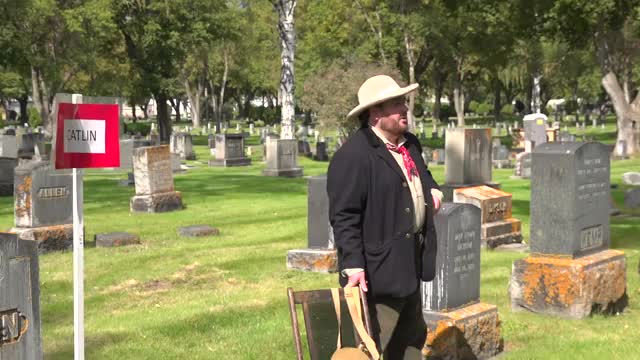
Summary
At a public meeting in Missoula, a performer portraying Captain John Catlin recounted the life and wartime service of a 19th‑century figure who the speaker said is buried in Missoula and for whom Catlin Street is named.
A performer at a public meeting in Missoula recounted the life of Captain John Catlin, saying Catlin is buried in Missoula and that Catlin Street is named for him.
The commenter, a performer who identified themself as a former park ranger at Big Hole Battlefield, spoke in character as “Captain John Catlin” and narrated episodes from Catlin’s life, including Civil War service, travel west, involvement in 1877 fighting in Montana and the Nez Perce conflict, later work as an Indian agent, and eventual residence and burial in Missoula. “He’s not exactly the greatest person in the world, but he’s not a horrible person either,” the commenter said.
The speaker said Catlin fought in the Civil War, praising the Union and recounting that he “signed on with the 80 seventh Indiana Infantry in the ’62” and that the regiment began “1,200 men strong” but that only about 300 marched before the president in 1865. The performer described serving with General William T. Sherman from Atlanta to the sea and being present when General Johnston surrendered in 1865.
Turning to postwar years, the commenter said Catlin moved west in 1866, worked on bullwhacker wagon trains to Fort Laramie, and later found the Bitterroot Valley, where he lived and ranched near the area now identified with Hamilton. The speaker recounted events of 1877, describing local militia activity during the Nez Perce movements through the region, a July warning that the Nez Perce were in the valley, and an August 5 engagement in which the performer said local men joined soldiers under General Gibbon.
The presentation included first‑person descriptions of a night attack that the speaker said went awry when a member of the valley party fired and alerted the village; the performer described retreating, digging rifle pits with kitchen knives and the death of his cousin Lynn. The performer said Catlin later ran a hotel in Stevensville, served as an Indian agent for the Blackfeet, and in 1891 was hired by a Missoula city office and lived the rest of his life in Missoula.
The remarks were a historical performance and part of public comment/agenda time; no formal action, vote, or directive resulted from the presentation.