Get Full Government Meeting Transcripts, Videos, & Alerts Forever!
Get email alerts on the Active Transportation topic
No spam. Unsubscribe anytime.
Murray councilmembers open months-long discussion on e-bikes, gates and signage for Jordan River Parkway
Summary
Council member Paul Pickett opened a 40-minute item to begin discussion about safety and enforcement for electric bikes and other motorized devices on the Jordan River Parkway; members and staff suggested signage, physical gates at narrow trail necks and follow-up with the Jordan River Commission and public outreach.
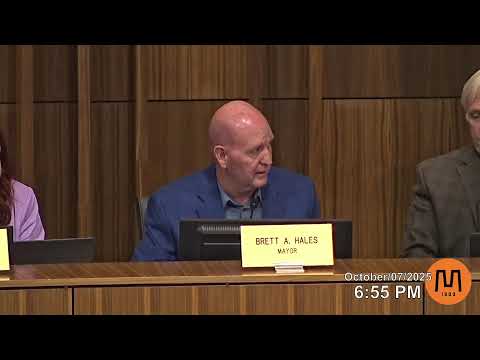
Council member Paul Pickett introduced a discussion Oct. 7 about electric bikes and other motorized devices on the Jordan River Parkway, saying the item was intended to begin a longer conversation rather than to produce a final policy.
"This topic is a serious one. It's one that deserves a discussion," Council member Paul Pickett said, describing repeated encounters with fast-moving e-bikes on the trail and saying he had observed riders — including adolescents — using throttle-only vehicles that he felt were unsafe.
The council's initial debate focused on three near-term options: signage reminding trail users that pedestrians have the right-of-way, physical fixtures to slow riders at constrained points, and enforcement. Pickett said Salt Lake City has written guidance for e-bikes that allows them only when ridden as a standard bicycle (actively pedaled, no throttle) and suggested Murray review that text as background.
Participants raised practical limits. Several council members and staff said enforceability by city police would be limited unless additional officers were tasked to trail patrols. Council members noted existing Canal Trail signage that bans motorized vehicles, the presence of multiple vehicle classes (three e-bike classes were mentioned), and accessibility concerns for people who rely on motorized wheelchairs or pedal-assist devices.
Staff and council members discussed physical gates and zig-zag slow points used in other cities. Pickett noted some gate designs allow wheelchair and service-cart passage while forcing a brief slowdown for bicyclists. Concerns included emergency and service access (city fire/EMS use pickup-style vehicles on the trail), snow removal, and whether trail utility carts could pass gates. A staff speaker said equestrian side-paths could provide alternate access where gates would block maintenance or emergency routes.
Council members suggested a stepwise approach: install signs first and monitor, then consider physical fixtures in constrained locations where riders commonly accelerate. "Baby steps — signage first," one council member said. Pickett proposed a public outreach period and returning to council with constituent feedback in winter (December–January) and asked staff to invite a Jordan River Commission representative to report on speed-limit discussions the commission has been having.
No motion or ordinance was proposed at the Oct. 7 meeting. Instead the council directed staff to gather more public input, consult the Jordan River Commission and relevant enforcement units, and return with additional information at a later meeting. Members repeatedly emphasized that the discussion was preliminary and intended to guide follow-up work rather than adopt rules on the spot.
What happens next: staff were asked to solicit feedback from constituents over the next month or two, invite a representative of the Jordan River Commission to brief the council, and return with options for signage, possible gate locations, and enforcement implications.