
Los Altos School District finance presentation: parcel tax, Prop. 13 and rising costs squeeze budget
Get AI-powered insights, summaries, and transcripts
Subscribe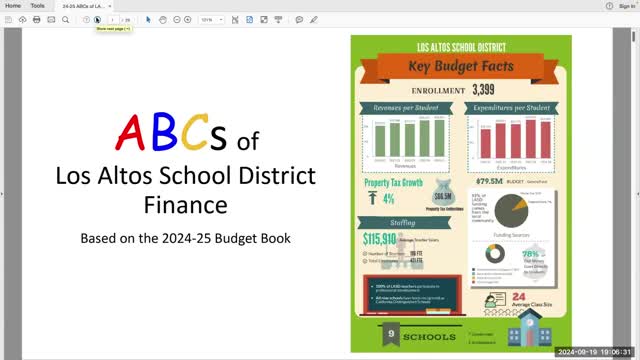
Summary
A Citizens Advisory Committee for Finance representative told attendees that Los Altos School District is community funded, relies on parcel and property taxes, and faces rising pension, special education, and charter-school facility costs that strain the operating budget.
A representative of the Citizens Advisory Committee for Finance (CACF), the parcel-tax oversight committee for the Los Altos School District (LASD), presented a slideshow to explain how the district is funded and the financial pressures it faces.
The presentation stressed that LASD is a community-funded (basic aid) district whose property-tax revenue exceeds the state's Local Control Funding Formula (LCFF) target; as a result the district retains excess property taxes and relies heavily on local measures, including a parcel tax that currently accounts for roughly 13% of district revenue. "Most of the charts and graphics that you'll see were pulled straight out of the LASD budget book," the CACF representative said.
The explanation centered on Prop. 13, which the presenter said reset assessed values in 1978 and capped annual assessed-value growth at 2% unless a property is sold or newly built. The presenter used two Los Altos homes as examples to show how assessed value diverges from market value: both homes were cited with market values near $4.8 million, but the presenter said one last sold in 1985 and had an assessed value of about $800,000 (generating roughly $10,000 total property tax with about $2,000 to LASD), while a home sold in 2021 had a much higher assessed value that produced a roughly $46,000 tax bill with just under $9,000 to LASD.
Why it matters: because assessed values do not track market prices for long-held properties, property-tax receipts per parcel can vary widely; the presenter said property tax makes up nearly three-quarters of LASD revenue overall and that commercial property constitutes only about 7% of LASD's tax base, compared with districts such as Mountain View-Whisman where commercial properties supply a much larger share of revenue.
The presenter distinguished parcel taxes (which go to operating costs such as staff and programs) from bonds (which pay for facilities), and noted a bond measure was on the ballot this year and would be discussed separately. "Parcel taxes can only pay for programs and people," the CACF representative said.
On expenditures, the slideshow showed that roughly 78% of spending goes directly to students and that about 81% is devoted to teachers and staff. The presenter said the district estimates total expenditures for the year at about $80 million and that the average cost for an individual teacher to the district is about $160,000 (roughly $115,000 in salary and $45,000 in benefits).
The presentation listed several cost pressures: rising utilities and insurance premiums; sharply higher required employer pension contributions (the presenter said what "used to cost the district only about $3,000,000" is estimated to approach "nearly $10,000,000" by next school year); a 22% increase in special education costs over four years (special education was said to be about 20'22% of expenditures while comprising roughly 7'9% of students); and state-mandated programs such as transitional kindergarten (TK) and universal meals that the presenter described as underfunded for a community-funded district.
The presenter said TK is "pretty much unfunded for a community funded district" because increasing enrollment does not bring proportional additional LCFF revenue to basic-aid districts. The slideshow also noted that universal meals are reimbursed for food costs by state and federal sources, but those reimbursements do not cover equipment, staffing and servery construction; the presenter said the district is expected to transfer nearly $1 million a year from the operating budget to meet universal-meal program costs.
Charter-school costs and facilities were highlighted as a significant ongoing expense. The presenter said LASD must transfer funds to a charter school under the LCFF calculation and provide facilities under Prop. 39; for the current school year the presenter estimated transfers to the charter at about $10,700,000, not counting approximately $625,000 the charter received from the parcel-tax measure renewal. The presenter said the district has leased portables for Bullis Charter School that cost close to $1 million a year in leasing alone, not including portables that were purchased and installed.
When asked how much it would cost LASD to educate an additional 950 students, the presenter said Eric Gluckovich, the district's chief business officer, told the CACF a "back of the envelope" calculation showed the district would spend about $5,000,000 less than the district currently spends to educate that number of students (as presented by Gluckovich to CACF).
No board action or formal vote was taken during the presentation; the session was informational and framed as community education about district finance and ballot measures. The presenter said attendees would hear more from a speaker named Brian about the bond measure on the ballot.
The presentation combined district-level figures with specific examples from Los Altos properties to illustrate how Prop. 13, parcel taxes and the lack of commercial property affect local revenue and the district's ability to meet rising personnel, special-education and mandated-program costs.