Get Full Government Meeting Transcripts, Videos, & Alerts Forever!
Get email alerts on the Land Acquisition And Stewardship topic
No spam. Unsubscribe anytime.
PFAS fund describes plan for 107‑acre Waldo County property: testing, lease for corn and environmental covenants
Summary
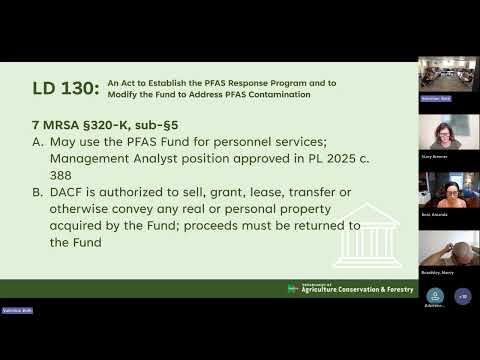
PFAS Fund closed on a 107‑acre Waldo County property with soil PFAS above dairy‑forage screening levels; department plans to lease for corn production with PFAS monitoring, enroll property in DEP VRAP environmental covenants, explore demonstration forest partnership and consider a payment in lieu of taxes to the municipality.
The PFAS Fund team told its advisory committee the fund’s first land acquisition — a 107‑acre property in Waldo County closed in February 2025 — has soil PFAS concentrations that make historical hay production unsuitable and that the department is pursuing a managed lease, environmental covenants and other protections.
“We closed on our first property in February 2025. It is a 107‑acre property in Waldo County. Of that, about a quarter is a field that historically had been used to grow hay for dairy animals. The soil is moderately contaminated, 12.6 parts per billion PFOS, 3.9 parts per billion PFOA,” Director Beth Valentine said.
Why it matters: The contamination levels meant the department concluded the field was “not suitable for growing hay for dairy animals.” The department is pursuing a lease to grow corn — for silage or grain — because corn has a lower PFAS transfer factor than grasses. As a condition of leasing, the lessee will be required to work with the department’s PFAS response program to test inputs and outputs from the lease to confirm product safety for sale and feed.
Property management and legal protections
Valentine said the department visited the site with an avian specialist and a dairy and forage specialist; the avian review found no threatened migratory birds in the area, and the forage specialist recommended a three‑to‑five‑year corn rotation to manage reed canary grass and reduce PFAS transfer risk. The department is exploring a demonstration forest partnership with the Maine Forest Service; the Forest Service will prepare a management plan as a training exercise for district foresters.
The Department of Environmental Protection’s Voluntary Response Action Program (VRAP) will be used to record environmental covenants on the property that restrict uses — examples cited included prohibiting groundwater extraction and disallowing residences, schools, child care or long‑term health care facilities. Valentine said enrolling the property in VRAP will both notify future owners of contamination and protect them from liability related to PFAS.
The department is also “investigating making a payment in lieu of taxes to the municipality,” Valentine said, noting state property purchases typically do not generate local property tax revenue. The proposed policy would approximate what a private owner would pay if the land were enrolled as open space, which she described as effectively reducing assessed valuation by about 20 percent for the payment calculation.
Outlook and next steps
Valentine said the department anticipates closing on a second property within roughly a month and has a third property in appraisal. The land advisory panel, established by PFAS fund rule chapter 405, advises on acquisitions and meets every other month.
Ending
The committee discussed leasing, monitoring and stewardship but took no formal vote. Melissa Hammond, who works on land acquisitions and stewardship for the fund team, and department staff will continue to refine lease conditions, VRAP enrollment steps and local tax‑payment mechanics with the municipality.