Get Full Government Meeting Transcripts, Videos, & Alerts Forever!
Get email alerts on the Administration And Governance topic
No spam. Unsubscribe anytime.
Maine law clarifies PFAS fund privacy, adds staff and changes committee chair rules
Summary
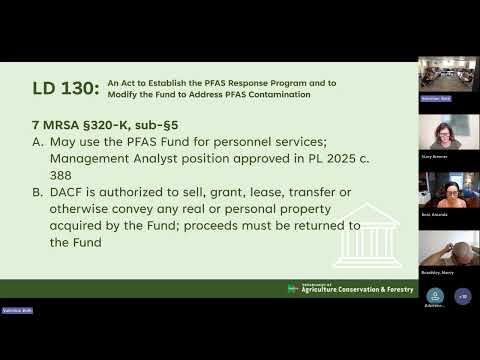
The Maine Legislature’s LD 130, signed into law and effective Sept. 24, 2025, added statutory language clarifying that PFAS fund-related health information is confidential and authorized the fund to pay for personnel services, among other administrative changes, Department of Agriculture, Conservation and Forestry officials told the PFAS Fund advisory committee.
The Maine Legislature’s LD 130, signed into law and effective Sept. 24, 2025, added statutory language clarifying that PFAS fund-related health information is confidential and authorized the fund to pay for personnel services, among other administrative changes, Department of Agriculture, Conservation and Forestry officials told the PFAS Fund advisory committee.
The changes “clarify that any information that the department collects related to our health initiatives ... is confidential medical information,” Director Beth Valentine said, noting the department does not receive clinical results but will develop lists of eligible people and billing information.
The statute also added personnel services as an allowable purpose of the fund, and the governor’s budget approved a management-analyst position that the department expects to advertise later this fall, Valentine said. The law makes explicit that proceeds from sales or leases of fund-owned real estate will return to the PFAS fund. It also changed how chairs are selected for the advisory committee: any member may serve as chair for a two-year term and chairs may serve consecutive terms.
Why it matters: The changes affect how the fund will be managed and supervised. Confidentiality language aims to address privacy concerns as the department collects names and billing information for blood-serum testing and other health services. Adding personnel services creates a funded staff position to centralize contract and finance management. The chair-selection change removes the prior requirement that legislative leaders appoint the committee’s chairs, a point committee members debated because legislators have session-time conflicts.
Committee discussion and next steps
Committee members debated how and when to select new chairs and whether to keep co-chairs for subcommittees. Senator Stacy Brenner, a committee member and past co-chair, cautioned legislative chairs can be constrained by legislative session schedules and said the committee has relied on department staff for most meeting preparation. “In terms of time commitment ... for the most part, I think we’ve been able to ... rely on the folks at the department who work within the fund to produce the agenda for the meetings and the materials,” Brenner said.
Director Valentine described the chair-selection item as a discussion, not a decision. She invited members interested in serving to contact her after the meeting so staff can collect interest and suggest timing for any election.
No formal votes were recorded on chair selection at the meeting. The department will proceed to advertise the management-analyst position and to implement the statutory changes enacted by LD 130.
Ending
Committee members asked staff to circulate options for chair-selection timing and to coordinate offline interest. Valentine said staff will gather feedback and return recommendations to the advisory committee at a future meeting.