
Sunbury finance committee reviews $21.8M in investments and studies $800,000 shortfall scenario
Get AI-powered insights, summaries, and transcripts
Subscribe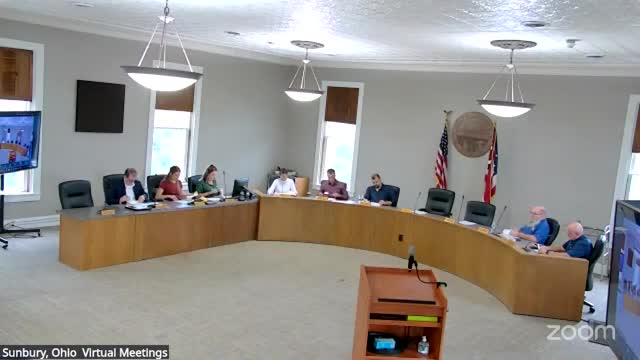
Summary
At an Aug. 20 Finance Committee meeting, staff reported Sunbury City’s investment and revenue picture, and presented options if a projected 10% general-fund revenue reduction — roughly $800,000 — materializes; Mayor Saint John proposed a three‑year phase‑out of inside millage as one path.
The Sunbury City Finance Committee on Aug. 20 reviewed the city’s quarterly investment holdings and year‑to‑date revenues and discussed scenarios for a possible 10% cut to general‑fund revenue, about $800,000.
Dana Stefan, a city staff member who presented the financial packet, told the committee that as of June 30 the city’s total cash and investments were “just under 22,000,000, about 21,800,000,” with roughly 46% in same‑day liquidity accounts such as Star Ohio and First Commonwealth and about $11.89 million in Fifth Third Securities. Stefan said Star Ohio held “about 7,200,000” earning about “a 4.45 annual percentage yield” and that the Fifth Third portfolio had a book yield near 4.3% and an average life of about 2.68 years; she cited ORC 135 as the authority limiting maximum maturity to five years.
The presentation highlighted revenue variances and expense lines. Stefan said Sunbury has collected “a little over 4,000,000 of our $6,000,000 budget” in income tax so far, and that the general fund was budgeted at $8.9 million with year‑to‑date collections of $5.5 million. Interest income has exceeded budget — $432,000 collected vs. $400,000 budgeted — and the staff projected that, if rates hold, the city could see roughly $850,000 in interest income for the year. She also noted development‑driven receipts: 87 new home permits, impact‑fee payments from Northport Place and other large projects, and pass‑through amounts from Eagle Creek and Price Ponds.
On expenses, Stefan called out high spending in contractual and travel services (about $1.1 million spent of a $1.6 million budget) and police cruiser repairs (about 89% of that budget line). She said the general fund budgeted $9.5 million and has spent about $7.1 million to date. Capital and project items identified as possible scale‑back candidates included the annual streets program ($1 million typical budget), Sedgwick Avenue park and reservoir improvements ($617,000 total, including roughly $40,000 NatureWorks grant), J.R. Smith Park improvements (more than $3 million), a $300,000 allocation for lower‑level admin building improvements, and a Columbus Street parking lot bid at roughly $767,000.
Stefan presented a set of scenarios showing where an $800,000 reduction could come from; she prefaced the list as estimates and not recommendations, saying, “None of this is a recommendation. This is all just, scenarios to show what type of expenses we could...change or do without.” She gave example totals for major cost buckets in 2024: police benefits $804,000; entire streets department operating costs $764,000; six patrol officers’ wages and benefits about $757,000; all administrative wages and pension just under $1 million; and total medical/dental/vision/Life/HSA funding about $1.5 million.
Mayor Saint John addressed the committee’s broader policy options and recommended a preemptive, phased approach should the state curtail inside millage. “I would recommend that we go on the offensive,” Mayor Saint John said, urging the committee to consider slicing the inside‑millage revenue reduction into three equal annual steps (about 33% per year) so Sunbury could “say Sunbury 100% is not reliant on any real estate taxes” after a multi‑year transition. He cited recent county and state activity, noting Delaware County had recently rolled back a portion of inside millage, and referenced House Bill 335 and pressures on real‑estate tax structures that affect “inside millage,” which he described as a constitutional mechanism used by local governments.
Committee members and staff discussed both expense and revenue levers. Participants pointed to impact fees and income‑tax collection processes (including work with REITA) as possible revenue adjustments and noted that some grant reimbursements (for example, a FEMA award for Walnut Street stabilization) depend on project spending and reimbursement timing. No formal vote or policy change occurred; instead, staff said they will produce a draft budget for the next finance committee meeting and research the timing and required ordinance steps to implement any change to inside millage with the county auditor.
The committee approved routine minutes and completed the bank‑to‑book reconciliation; it adjourned after the finance items. Stefan told the committee she will bring a draft budget to the next meeting and follow up on the timing of any ordinance or county coordination required to deliver benefits to residents.