
El Paso Commissioners Court adopts resolution demanding transparency, access for Fort Bliss migrant detention site
Get AI-powered insights, summaries, and transcripts
Subscribe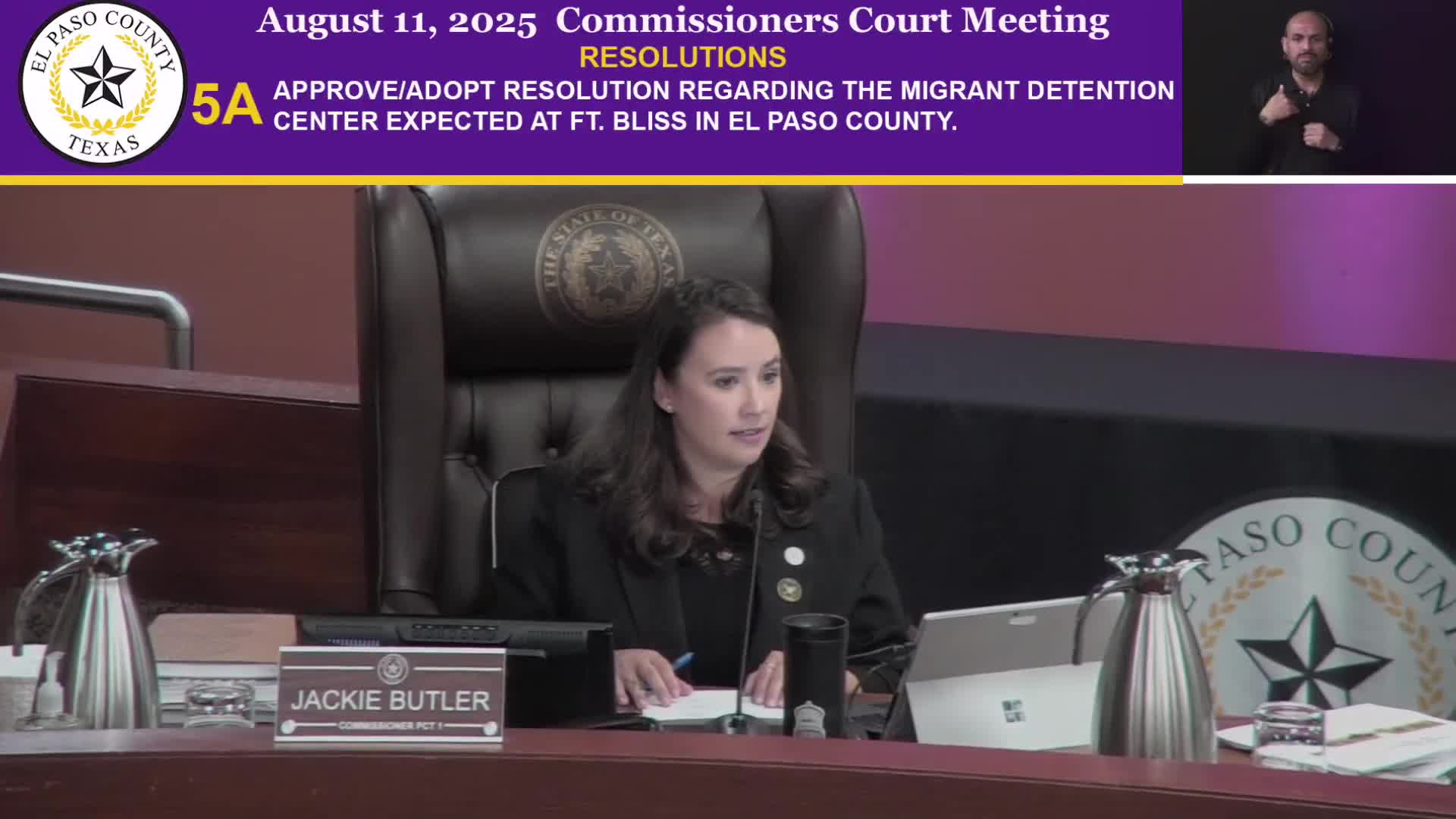
Summary
The El Paso County Commissioners Court voted to adopt a resolution calling for disclosure, local access and oversight of the new 5,000‑bed migrant detention facility on Fort Bliss—named Camp East Montana—after public comment from civil‑liberties and faith groups and extensive commissioner remarks.
El Paso County Commissioners Court voted Aug. 11, 2025, to approve a resolution asking federal agencies and Fort Bliss leaders for disclosure about operations at Camp East Montana, the new 5,000‑bed migrant detention facility on Fort Bliss.
The resolution, introduced by Commissioner Butler during the court’s Aug. 11 meeting, says the county denounces “the use of El Paso’s military installations for mass civil detention of migrants, particularly under opaque private contracts” and demands disclosure from the Department of Homeland Security, Immigration and Customs Enforcement and Fort Bliss about operational plans, contractor roles and detainee treatment protocols.
Why it matters: The facility is sited adjacent to populated neighborhoods in East El Paso County and — according to the resolution text read into the record — will be the largest ICE detention facility in U.S. history. The court’s action is a formal local request for transparency and access; it does not change federal control over the site but seeks briefings and local participation in oversight.
Commissioner Butler read the resolution at length and framed it as a call for “transparency, accountability, and open collaboration between federal agencies, local officials, and community stakeholders.” The resolution text asserts the facility is a DoD‑funded contract to Acquisitions Logistics LLC (cited in the resolution as a $1,260,000,000 contract, with roughly $232,000,000 allocated to date) and says staffing plans and vetting criteria have not been disclosed. The resolution requests a formal briefing within 30 days and access for local elected officials, legal advocates and human‑rights organizations.
During the public‑comment period the court heard multiple statements in support of the resolution. Sarah Cruz of the ACLU of Texas told the court the site would place up to 5,000 people “in a tent city where independent oversight will likely be restricted,” and urged the county to demand transparency and access. Diana Martinez, from the Coalition to End Child Detention, described conditions observed during previous Fort Bliss detentions and said employees were reportedly required to sign nondisclosure agreements; Anna Reza of the Episcopal Diocese of the Rio Grande and Laurie Marshall (Unity Through Creativity; adjunct faculty, UTEP) also urged the court to press for oversight and due process for detainees.
Court discussion emphasized two strains: concern for detainee welfare and the county’s relationship with the military installation. Commissioners repeatedly said they wanted to preserve a positive relationship with Fort Bliss while asserting the county’s interest in what happens within its borders. Commissioner Butler told the court he frequently sees the site near his commute and said the court must represent local values; Commissioner Stout and others said the resolution leverages the county’s “bully pulpit” to press federal partners for access and accountability.
Action and next steps: Commissioner Butler moved the resolution with a second from County Judge Samaniego. The motion carried. The court also authorized staff to prepare letters to the county’s congressional delegation, the U.S. Department of Defense and the Department of Homeland Security in the spirit of the resolution so those offices are formally notified of the court’s requests for briefings and access. Commissioner Butler’s office will circulate drafts for court review.
Context and limits: The resolution is a county‑level statement calling for transparency and access; it does not change federal custody or operational authority over Camp East Montana. The resolution cites federal contract amounts and asserts concerns about contractor experience and past tent‑camp conditions; those claims are drawn from the resolution text and public comments recorded during the meeting. The court’s request for briefings and access is directed to federal agencies and Fort Bliss leadership.