
Committee discusses broad UDO changes to speed housing approvals, expand district options
Get AI-powered insights, summaries, and transcripts
Subscribe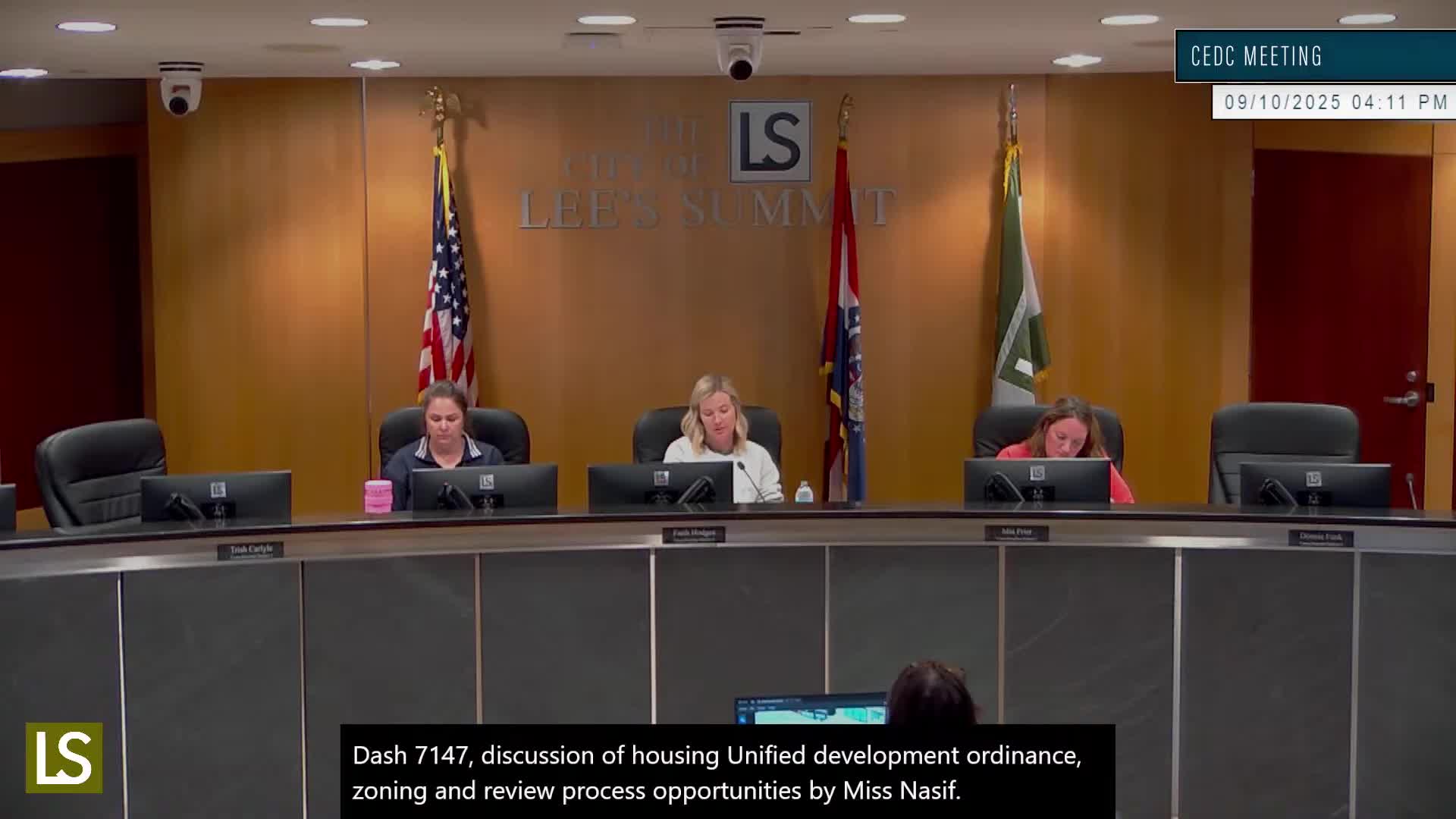
Summary
City staff presented a package of proposed UDO and zoning-process changes Sept. 10 intended to reduce review times for smaller residential projects, expand allowable housing types in certain districts and generally streamline procedures for developers and homeowners.
City staff presented a package of proposed Unified Development Ordinance (UDO) and zoning-process changes Sept. 10 intended to reduce review times for smaller residential projects, expand allowable housing types in certain districts and generally streamline procedures for developers and homeowners.
Miss Nassif of Development Services summarized the list of potential changes developed after the committee’s June meeting. "There's no magic bullet where we do 1 thing and then everything changes," she said, adding staff sees a set of coordinated process and zoning options intended to reduce delays for homeowners and homebuilders and to keep the city competitive in the metro market. Staff asked the committee for direction on which items to research further and whether to return proposed ordinance or code language for council consideration.
Key staff recommendations and discussion points
- Administrative review of minor modifications: Staff proposed expanding the set of minor modifications that can be approved administratively rather than going through the longer governing-body review. Miss Nassif said the current timeline for modifications can be three to four months; shifting eligible items to staff review could shorten that to roughly 7–10 days. She cited setbacks, materials, parking and landscaping items as examples for potential administrative handling.
- Increased residential setback flexibility for repairs/replacements: Staff recommended increasing the allowed administrative setback adjustment from the current 10% (up to 1 foot) to 15% or up to 5 feet for replacement or repair projects on single-family homes, which would not apply to multifamily projects. Miss Nassif noted Board of Zoning Appeals applications can cost more than $500 and add roughly two months, so this change targets homeowner reinvestment without affecting multifamily properties.
- Preliminary Development Plans (PDPs): Staff proposed exemptions from full PDP submittal for small infill projects (for example, up to three residential lots) where zoning entitlements already exist. The intent is to remove redundant four-month PDP reviews in cases where zoning and district requirements were already established during rezoning.
- Revisions, extensions and administrative extensions: Staff asked to align PDP extension procedures with other plats and plan types by allowing staff to grant a single one-year extension administratively after the initial two-year PDP approval period, with additional extensions or concerns returned to council. Staff emphasized that projects with incentive agreements or development contracts would continue to be governed by those controlling documents.
- Concept plan submittal requirements: Staff recommended relaxing detailed requirements for voluntary concept-plan submittals (for example, eliminating required building elevations, materials and final square footage) so the concept step remains genuinely conceptual and usable by applicants who do not yet know tenants or final building designs.
- Zoning district reforms and a new conventional district option: Staff proposed adding more permitted housing types across existing districts to increase housing-type flexibility. They also proposed creating a new conventional district option (analogous to the existing R1 conventional district) for R2-like areas so developers who meet fixed district standards could use a streamlined plat-based review (preliminary plat) instead of the full PDP process. Examples cited included R1/RP1 and the option to use either the conventional or planned approach depending on whether the developer meets established district standards.
- Public-hearing consolidation: Staff asked whether the committee would support satisfying the public-hearing requirement at Planning Commission only (one public hearing) rather than requiring a second public hearing at City Council for PDPs and revised PDPs. Staff noted the second public hearing is not required by Missouri statute, that most public commenters already attend Planning Commission hearings, and that eliminating the council public hearing could reduce time, notice and advertising costs. Several committee members said they were open to limiting the change to revised PDPs rather than all PDPs and asked staff to provide examples from peer cities.
Questions, clarifications and committee direction
Committee members questioned specifics about ownership changes during construction, incentives and projects with contractual schedules. Miss Nassif clarified the proposed administrative extensions and other changes would not supersede controlling contracts or incentive agreements: "If this is attached to any kind of an incentive, that incentive is gonna have a contract with a schedule, and so that schedule would supersede any of this," per the committee exchange. Staff agreed to limit some proposed administrative allowances to residential contexts if the committee preferred and to explicitly note in future materials that incentive agreements govern when present.
Council members asked for more research and examples from other cities showing which housing types are allowed in which zoning districts and how public-hearing processes operate elsewhere. Staff said they would return with draft code language for the committee’s direction, comparisons to peer cities, and estimated time and cost savings for the administrative changes.
No formal vote was taken on the UDO items at the meeting; staff requested direction and permission to prepare more-detailed drafts. The committee signaled support for further study and requested clarifications on distinguishing townhomes from duplexes in code definitions and on limiting some administrative changes to residential uses where appropriate.