Get Full Government Meeting Transcripts, Videos, & Alerts Forever!
Get email alerts on the Employee Benefits topic
No spam. Unsubscribe anytime.
Health care, retirement and buyouts drive town budget increases, finance director says
Summary
Town finance director told the board that rising retirement contributions, self-insured health insurance costs, and unpredictable retirement buyouts are central drivers of the proposed 2026 budget and explained options for managing fund balance and reserves.
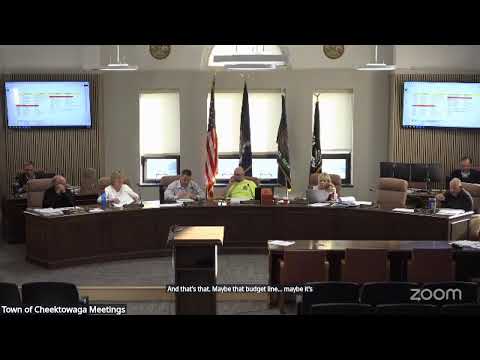
Rising employee-related fixed costs'pensions, health insurance and retirement buyouts'were the central focus of a town presentation at the Feb. 19 budget hearing. Brian Krause, the town's finance director, told the board that New York State retirement rate changes, contractual pay increases and an aging workforce are pushing retirement and payroll-related costs higher in 2026.
Krause told the board he estimated New York State retirement expense at about $11.25 million for 2026, up more than $1 million from current-year appropriations, driven largely by higher employer rates and the structure of police and fire retirement tiers. "As our payroll costs increase, so does our retirement costs," he said.
Health insurance: Krause said the town's self-insured medical plan saw premium equivalents jump about 13% in the most recent renewal cycle, citing nationwide trends such as high-cost specialty drugs. The town uses stop-loss insurance with a $275,000 per-claim attachment point. He said medical costs for the town and retirees were substantial (nearly $14 million+ in recent years) and that increases in specialty drug costs contribute to the pressure.
Retirement buyouts and volatility: Krause warned that retirement buyouts are especially hard to forecast. Recent years produced buyout payments that exceeded budgeted amounts, sometimes by several hundred thousand dollars. "You can have a retirement buyout jump from one year to the next," he told the board, and the town has to either build a buffer in the operating budget or rely on reserve funds as needed.
Fund balance and reserves: Supervisor and board members engaged the finance director and comptroller about whether to reduce planned appropriated fund balance or keep it conservative. The finance director recommended keeping a cushion, arguing repeated use of reserves without replenishment is risky. The comptroller told the board he would also err on the side of caution for fixed costs and suggested reviewing some funds individually before making reserve reductions.
Options discussed: Board members and staff discussed several options: reassigning appropriated fund balance among funds, making targeted cuts in non-fixed areas, or using one-time funds to pay down capital purchases such as vehicle replacements. Krause also discussed a plan that would increase the general fund balance target from 15% to roughly 17.7% by the end of 2026 under the supervisor's tentative plan, to build a larger cushion for emergencies and avoid tapping reserves when unanticipated costs occur.
Why it matters: The combination of increasing pension rates, higher health-care costs, and volatile retirement buyouts are central to the tentative 2026 budget and were repeatedly cited by board members as the main reason the town's preliminary levy would rise. The board signaled it is open to reassessing specific non-fixed appropriations but said there is limited room to cut payroll-driven costs.
Ending: Officials agreed to keep working through budget detail in follow-up sessions, with the finance director and comptroller offering to present potential discretionary reductions and to provide additional breakdowns of non-fixed vs. fixed costs.