Get Full Government Meeting Transcripts, Videos, & Alerts Forever!
Get email alerts on the Water Safety topic
No spam. Unsubscribe anytime.
Seal Beach updates municipal code for cross‑connection control, adopts draft management plan for state review
Summary
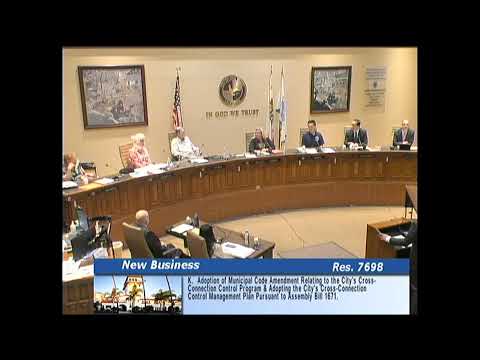
The Seal Beach City Council on Sept. 22 approved on first reading municipal code changes and a citywide cross‑connection control management plan to comply with a State Water Resources Control Board policy adopted in 2024.
The Seal Beach City Council on Sept. 22 approved on first reading amendments to the municipal code to update the city’s cross‑connection control program and adopted a cross‑connection control management plan consistent with state policy.
Sean Lowe, Deputy Director of Public Works and Utilities, told the council that the State Water Resources Control Board adopted a cross‑connection control policy handbook effective July 1, 2024, and that public water systems were required to submit a management plan by July 1, 2025. City staff submitted a draft management plan to the state before that deadline and said the plan is currently under state review.
Under the proposed code changes, the municipal code will be expanded to add definitions required by state policy (including “approved water supply,” “backflow prevention assembly,” “cross‑connection” and “cross‑connection control specialist”), adopt the citywide management plan, and give the city explicit authority to install, inspect and test backflow prevention assemblies and, if necessary and in accordance with state law, suspend water service for noncompliance.
Lowe emphasized that the state handbook places a strong emphasis on education and that enforcement is secondary. He also told council that the city had already reclassified an in‑house water operator as the city’s cross‑connection control specialist and that no new staff were being added specifically for the program. Lowe noted that the state policy does not provide additional funding; the change is therefore an “unfunded mandate.”
Council members asked about costs and implementation. Lowe said capital equipment for backflow devices already in the field would remain in place; if a specific site required a new assembly, the city would evaluate whether the work could be done by internal staff. Lowe also reported that only two addresses in the city currently have water service terminated for long‑term vacancy; termination for cross‑connection noncompliance would be an administrative enforcement tool of last resort.
The council approved the ordinance on first reading and adopted Resolution 7698 (findings and adoption of the management plan); a second reading and public hearing were scheduled for Oct. 13 as part of the normal adoption process. The council vote was 5-0.
City staff will continue to work with the State Water Resources Control Board during its review of the draft plan, and staff said it will return with any required changes or implementation updates during the Oct. 13 meeting.