Get Full Government Meeting Transcripts, Videos, & Alerts Forever!
Get email alerts on the Alpr topic
No spam. Unsubscribe anytime.
Eugene council votes 8-0 to pause use of Flock license-plate readers pending policy review
Summary
On Oct. 8, 2025, the Eugene City Council voted unanimously to recommend pausing use of automatic license-plate reader (ALPR) cameras installed under a state grant, citing privacy concerns and the need for a broader council-level policy discussion. The pause directs the city manager to return with next steps and policy options.
The Eugene City Council voted 8-0 on Oct. 8 to recommend that the city manager pause use of the city’s automatic license-plate reader (ALPR) cameras while the council develops further policy guidance and reviews the system’s contract and data-sharing terms.
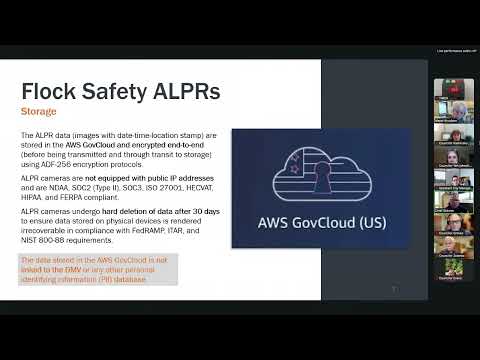
Chief Chris Skinner, who led a work-session presentation for the council, described ALPR as “a crime fighting tool. There's no question about that,” and said the cameras were brought to Eugene using a state grant and are configured to capture still photographs of vehicle license plates and the rear of vehicles, stored in an Amazon Web Services government cloud with a 30-day hard-deletion policy.
The recommendation to pause responds to concerns raised repeatedly by council members about third-party control of data, the vendor’s track record, and risks that data could be used outside the city for immigration or reproductive-health enforcement. Council debate included calls for an immediate halt to camera use and alternative proposals to pause operations while city staff and councilors work through policy options and contract implications.
Why it matters
The ALPR system has already been used by Eugene Police Department (EPD) investigators in felony and property-crime investigations, including recovering stolen vehicles. Chief Skinner told the council the technology has contributed to arrests, and the department reported 63 felony arrests linked to ALPR hits in examples cited during the presentation. Council members said the technology’s law-enforcement benefits must be balanced against civil-liberties concerns, the fact that Flock Safety — the vendor — owns the cameras and the initially proposed contract language, and broader fears about governmental misuse of location data.
What the council heard and decided
Skinner summarized the procurement and grant timeline: Eugene applied for an organized-retail-theft grant through the Oregon Criminal Justice Commission (CJC) in July 2024, implemented the ALPR agreement in early 2025 and deployed fixed, still-photo plate readers on public rights-of-way. He told council the cameras are not video, do not pan/tilt/zoom, do not perform facial recognition and are triggered by vehicular traffic.
On data-security and sharing, Skinner said the department arranged to store images in an AWS government cloud with FedRAMP, SOC 2 and other standard security evaluations and that Flock agreed to a 30-day “hard deletion” schedule. He also said Eugene has opted out of Flock’s nationwide data-sharing network so that “no entity outside Oregon can access EPD’s image database” under the current configuration.
Skinner said the city negotiated changes to the original vendor contract, adding more detailed language in a revised Section 5.3 to limit who may request data, to exclude Department of Homeland Security as an authorized requester, and to remove a broadly worded “emergency” exception. New contract language also addresses deidentification of stored plate numbers, a requirement for faster breach-notification efforts (24 hours, not to exceed 72), and limits on where data may be hosted.
Councilors pressed for operational details. Questions centered on cost after the grant period ends (Skinner said he would follow up), how searches are audited (officers must select a search reason from a drop-down menu and enter a case or CAD number that links the query to a law-enforcement purpose), how “hot lists” are validated and cleared, and whether the city or vendor would face liability if an inappropriate search occurred. Skinner described supervisory review of hot lists and internal audit and disciplinary mechanisms for misuse.
Several council members said they trust Eugene Police Department staff but do not trust the vendor, Flock Safety, or federal actors to respect local protections. Councilor Zelenka said, “I simply don't trust Flock,” and other councilors highlighted concerns that data could be used by outside agencies in ways that could harm immigrant or LGBTQ residents.
Motion and next steps
Councilor Kaczynski initially moved to direct the city manager to turn off the cameras; that motion was seconded. Councilor Evans offered and the council accepted a substitute motion — to pause use of the ALPR cameras pending additional council discussion and to return with policy recommendations — which passed by recorded vote 8–0. The council’s substitute motion is a recommendation to the city manager; under the city charter the city manager retains operational authority and will implement the pause and return to the council with options for policy and contract actions.
What officials and staff say about outcomes and limits
Skinner emphasized that the ALPR database is a standalone image repository that, in EPD’s configuration, does not automatically cross-reference DMV or other databases with personally identifying information. He told the council that ALPR-derived images accounted for about 1% of the department’s data-queries over a 30-day average and framed the tool as one of several data sources EPD uses on an investigation.
City attorney staff told the council the contract contains provisions that could make mutual termination negotiable with the vendor; the city attorney also noted potential grant-clawback risk if the city abandoned grant-funded equipment without resolving the grant terms. City Manager Madari (not present for the start of the session) said the pause should be treated as a recommendation to her office, which will return with the manager’s recommended next steps while preserving the city’s chartered separation between policy (council) and operations (city manager and staff).
Context and community concerns
Council discussion repeatedly mentioned national developments cited by members — immigration enforcement, reproductive-health investigations, and federal deployments in other cities — as reasons to take a cautious approach. Several councilors said they want a broader, council-level policy that governs use of surveillance technologies citywide rather than a single-vendor decision.
What to watch next
The council asked the city manager to return with options and a timeline for follow-up discussion and possible policy recommendations. The ALPR contract’s initial term runs two years from first operational camera deployment (city staff stated the initial operational date in May 2025), so the council and staff will consider timing and grant implications, whether to negotiate mutual termination, and whether to pursue alternative vendors or internal controls. The council did not set a specific return date at the Oct. 8 session.
Sources and attributions
This article is based on the Oct. 8, 2025 Eugene City Council work session on automatic license-plate recognition. Speaker quotes and factual claims in this story are attributed only to people who spoke at that session or were identified by name during the meeting.