
Planning and Zoning Commission backs Ashford Place PD plan despite neighborhood traffic, density objections
Get AI-powered insights, summaries, and transcripts
Subscribe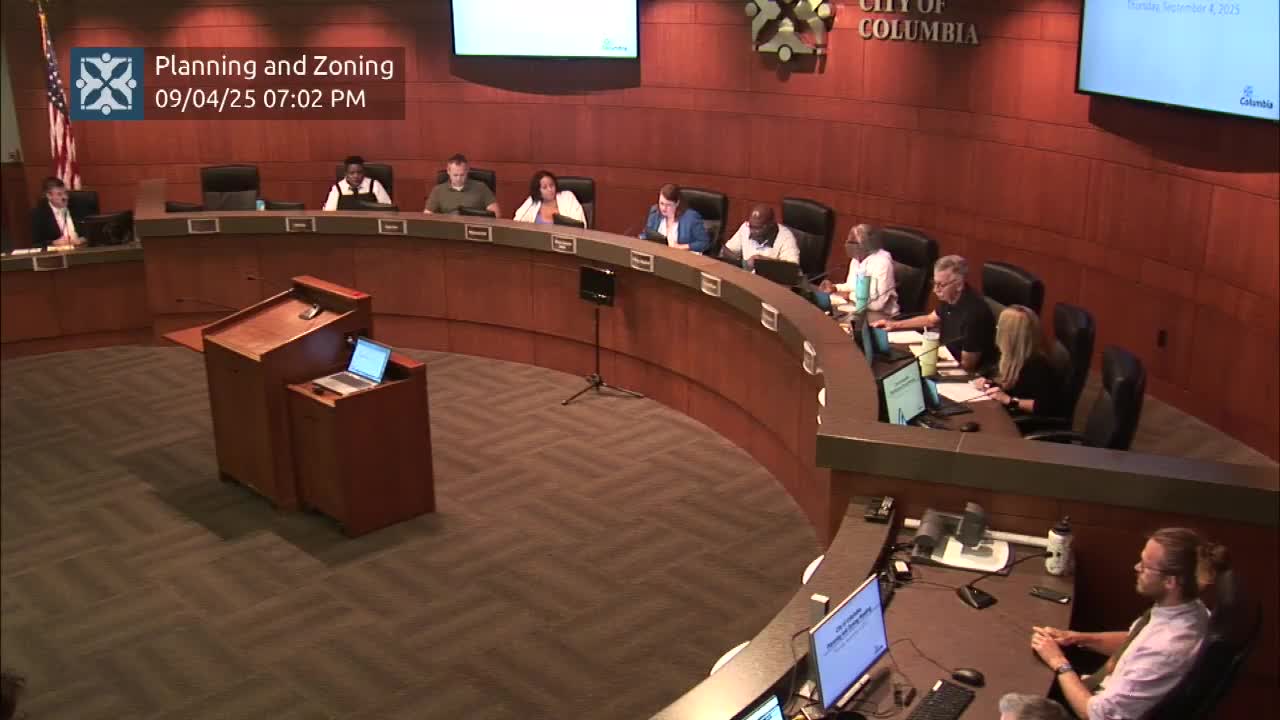
Summary
The Columbia Planning and Zoning Commission on Sept. 4 recommended approval of a planned development plan, revised statement of intent and preliminary plat for “Ashford Place,” a 24.13‑acre project proposing 77 single‑family attached units, by a 7–1 vote.
The Columbia Planning and Zoning Commission on Sept. 4 recommended approval of a planned development plan, revised statement of intent and preliminary plat for “Ashford Place,” a 24.13‑acre project proposing 77 single‑family attached dwelling units, by a 7–1 vote.
The recommendation, moved by Commissioner Walters and seconded by Commissioner Ortiz, directs staff to place the project on the City Council agenda subject to technical corrections and an agreed development agreement before council introduction.
City planning staff, represented at the meeting by David Koontz, planning staff, told the commission the proposal conforms to the tract’s 2010 annexation statement of intent and cited existing infrastructure and prior traffic work as the basis for its recommendation. Koontz said staff received 91 written comments on the case, “87 were in opposition,” and listed traffic, parking, stormwater, green space and neighborhood character as the primary concerns.
The applicant’s team — Andy Green of Crockett Engineering Consultants and engineer Tim Crockett — told the commission the plan complies with the 2010 statement of intent and reduces the theoretical maximum unit count for the tract. “3.2, that’s, that’s in the range of single family densities all over Columbia,” Crockett told the commission, noting the proposed density is below the PUD‑4 maximum assigned at annexation.
Neighbors and attorneys who appeared for residents urged commissioners to require stronger mitigation before recommending approval. Tracy Delavecchia, a Brooks subdivision resident, said neighborhood streets have already become a cut‑through and “Hoylake, in its current state, poses a significant danger to joggers, walkers, children’s dogs, and families with strollers.” Several speakers urged the city to require the developer to build a new external connection rather than using Sagemore Drive as the primary ingress and egress.
Key factual details presented at the hearing: the site totals 24.13 acres and the plan shows 77 attached single‑family units in groups of up to three (most lots are three‑unit groups); proposed density is about 3.2 units per acre when the whole tract (including preserved climax forest and floodplain) is counted; front yard setbacks are increased to 25 feet from the previous 20 feet; the applicant proposes two off‑street parking spaces per unit and staff noted roughly 60–68 on‑street spaces on nearby streets; open space on the PD plan was raised from 25% in the earlier statement of intent to about 55% on the current plan; about 1 acre of the site is reserved for stormwater detention, roughly 3 acres are proposed for climax forest preservation and roughly 3 acres are in floodplain or floodway.
Staff and the applicant relied on prior transportation work, notably a 2017 transportation impact study that modeled several build‑out scenarios for the larger tract and that recommended certain collector and major‑collector improvements. Staff and the applicant argued that the street network as constructed — including Sagemore and Holy Lake — was built to accommodate the volumes contemplated in those prior studies and that the project falls within those assumptions. The staff report said the applicant must meet any technical corrections and enter a development agreement before council action.
Opponents pressed several technical and policy points in discussion: that the 2017 TIS is nearly a decade old and may undercount current cut‑through traffic; that the plan relies on floodplain and preserved forest acreage to lower the apparent density; that the proposed lots and “postage‑stamp” layouts yield a higher felt density than the raw per‑acre number suggests; and that on‑street parking management and enforcement are uncertain. Attorneys representing adjacent property owners called the proposal incompatible with the prevailing single‑family character and said the application lacked enforceable commitments for off‑site traffic mitigation.
Commissioners asked staff about triggers for a new traffic study and were told the development agreement and the underlying annexation agreement allow the city to require a TIS if future adjacent development would materially change assumptions — and that staff may request an updated study if warranted by new proposals for the neighboring tracts. Staff also confirmed Sagemore and Holy Lake are accepted public streets; Sagemore was constructed to neighborhood‑collector standards and Holy Lake to a higher major‑collector standard, and both are within the city’s roadway plan.
In their formal motion the commission approved the PD plan "subject to technical corrections and an agreed upon development agreement prior to introduction to city council." The roll call recorded seven yes votes (Darr, Galway Jones, Gray, Ortiz, Stockton, Walters and Grama) and one no vote (Wilson). The motion was therefore recorded as approved and will be forwarded to the City Council for final action.
The commission also placed a separate statement on the public record urging the city to accelerate traffic‑calming and safety work on Holy Lake and to consider a stop sign at the Sagemore/Royal Country intersection; commissioners said they want public works and council to “expedite” solutions for the safety issues cited repeatedly in public comment.
What’s next: the P&Z recommendation will be transmitted to Columbia City Council; staff will work with the applicant on technical corrections and a development agreement before council introduction. The council will have the final approval authority for the PD plan, revised statement of intent and preliminary plat.
Speakers at the public hearing included David Koontz (planning staff), Andy Green (Crockett Engineering), Tim Crockett (Crockett Engineering), Caleb Colbert (attorney for the applicant), Commissioner Walters, Commissioner Ortiz, Commissioner Wilson, Commissioner Gray, Commissioner Darr, Commissioner Stockton and numerous Brooks neighborhood residents who testified during the public comment period.