
Seal Beach planning commission approves 1.5 MW Hellman Ranch solar project over objections, adopts MND
Get AI-powered insights, summaries, and transcripts
Subscribe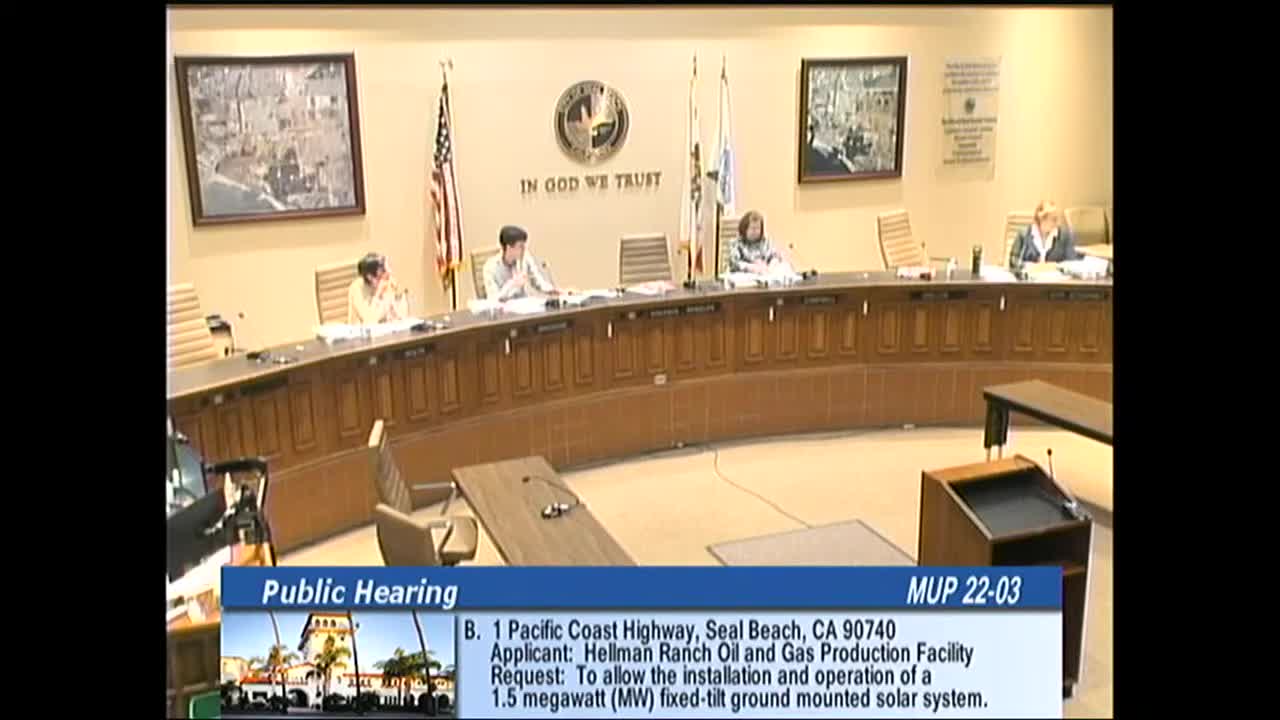
Summary
The Seal Beach Planning Commission voted 2-1 on Sept. 29 to adopt a mitigated negative declaration and approve a minor use permit for a 1.5-megawatt ground-mounted solar array at the Hellman Ranch oil facility, despite public requests for a full environmental impact report and objections about wetlands, cultural resources and wildlife impacts.
The Seal Beach Planning Commission on Sept. 29 adopted a mitigated negative declaration and approved a minor use permit for a 1.5-megawatt fixed-tilt ground-mounted solar photovoltaic system at the Hellman Ranch oil and gas production facility, voting 2-1 on both actions. The commission approved the project with conditions including preconstruction soil testing for hydrocarbons and a one-year bird-impact monitoring and reporting requirement.
The project would place three arrays made up of 56 solar table structures on roughly 2.66 acres at the Hellman Ranch site adjacent to the Los Cerritos Wetlands, the San Gabriel River and the Haines Cooling Channel. Sean Temple, interim community development director for the city, told commissioners the system “would reduce overall air emissions and lower operating costs” and would interconnect with existing on-site electrical infrastructure to support facility operations.
Why it matters: public commenters, environmental groups and tribal representatives urged the commission to require a full environmental impact report (EIR) instead of the staff-proposed mitigated negative declaration (MND). Speakers and the environmental contractor debated potential effects on biological resources, flooding, tribal cultural resources and an alleged “lake effect” that some research has tied to bird fatalities at large solar installations. Commissioners cited the CEQA record and mitigation measures when weighing whether to require an EIR.
Staff and consultant findings and mitigation: interim Community Development Director Sean Temple and John Pearson, an environmental consultant with MRS Environmental who prepared the CEQA initial study, said the MND includes mitigation measures addressing glare, biological surveys, tribal monitoring and erosion control. Temple said project design features and proposed mitigations include dark, anti-reflective panel coatings; construction timed to avoid bird nesting season; preconstruction surveys for southern tarplant and Coulter’s goldfields; allowing a Native American monitor during ground disturbance; an interim soil-stabilization plan; and maintaining a 30-foot minimum setback from city water lines.
On the lake-effect concern, John Pearson summarized recent research: “The study demonstrated that the solar panels mimic water surfaces in terms of polarization,” and while the California Energy Commission study (published June 2024) found some evidence of attraction-related fatalities at much larger, utility-scale desert installations, it did not conclusively generalize that effect to all landscapes or species. Pearson said the MND used that study as the best available guidance and recommended post-construction monitoring.
Public and tribal concerns: Environmental and conservation groups urged an EIR. Elizabeth Lam of the Los Cerritos Wetlands Land Trust said “this seems like the wrong place to put such a project so close to adjacent to sensitive wetlands that host, threatened species” and asked for more in-depth analysis of habitat, flooding and public-recreation impacts. Anna Christensen, representing the Sierra Club Los Cerritos Wetlands Task Force and Provoonga Wetlands Protectors, urged a full EIR and added that the Sierra Club opposes urban oil drilling. Tribal consultation under AB 52 prompted requests from the Keach Nation and a Tongva representative for tribal monitoring; Sean Temple noted those requests and said monitors would be allowed during ground disturbance.
Applicant statements: Devin Shade, general manager for Hellman Properties, said the family and company have discussed wetland restoration and “we have ongoing communication at least with LCWA” (Los Cerritos Wetlands Authority). Shade also said “I can be honest that the economics have changed, so I do wanna address 1 point. This does not lower operating cost.” He said the original program goal three years ago was to offset grid outages and reduce draw from the local community.
Soil testing and other conditions: Commissioners added or clarified conditions before approval. The planning commission amended condition 6 to require soil testing at proposed pile/boring depths prior to on-site redistribution; if hydrocarbon contamination is detected, contaminated soil must be removed and hauled off-site rather than spread on-site. The Environmental Quality Control Board’s recommendations to test soils and require one-year bird-impact monitoring were referenced; staff carried forward recommendations 2 and 3 (soil testing/reporting and one-year bird-impact monitoring) as enforceable conditions. Commissioners and staff said any bird fatalities or accidents identified during the monitoring year would be reported to city staff; staff could then bring the matter back to the planning commission for further action, including additional conditions or modification.
Votes and appeal: The commission voted 2-1 to adopt the MND (Resolution 25-06) and then 2-1 to approve the minor use permit (Resolution 25-07) with the amended condition on soil testing. Vice Chair Mangiani and Commissioner Nolte voted in favor; Commissioner Campbell voted no. The decisions may be appealed to the City Council within 10 days.
Next steps and limits: If the project proceeds, the applicant must apply separately for a coastal development permit with the California Coastal Commission. Several speakers and commissioners noted the site’s long industrial history — Temple said the Hellman site has been used for oil production since the 1920s — and that CEQA’s environmental baseline treats existing, ongoing industrial disturbance as part of the baseline condition. Public commenters and local organizations asked the city to require a fuller, earlier public engagement process and to consider whether the project’s proximity to the wetlands and cultural landscapes justifies an EIR.
Commissioners' stated rationale and dissent: During deliberations some commissioners expressed that the MND and mitigation monitoring program were thorough and sufficient to find impacts could be mitigated to less-than-significant levels; at least one commissioner voiced continuing concern about wildlife and site suitability prior to casting a no vote. The commission also included language clarifying enforcement of mitigation measures and the mitigation monitoring program as part of the approval.