Get Full Government Meeting Transcripts, Videos, & Alerts Forever!
Get email alerts on the Economic Development topic
No spam. Unsubscribe anytime.
Winnsboro EDC hears plan to prioritize existing businesses with business-retention program
Summary
At a special Winnsboro EDC workshop, a consultant urged establishment of a business retention and expansion (BRE) program to speed responses to local business needs, strengthen downtown firms and connect employers to training and state resources; no formal action was taken.
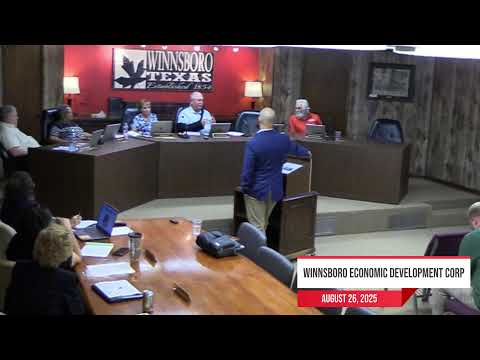
At a special workshop meeting in Winnsboro, members of the town’s Economic Development Corporation heard a consultant’s presentation urging creation of a formal business retention and expansion (BRE) program to identify and respond quickly to problems faced by existing local businesses.
The consultant said BRE “is about building an early warning system, a growth pipeline, and a relationship of trust between Winnsboro’s business and leadership,” and argued that a rapid-response team and routine outreach would protect the town’s tax base and anchor employers while supporting downtown merchants and entrepreneurs.
The presentation, given to EDC board members and city leaders, laid out core BRE elements the consultant recommended: structured, scheduled business outreach and surveys, business-health assessments that identify workforce and infrastructure needs, a rapid-response problem-solving process, workforce-training partnerships, and basic tracking and reporting (a modest CRM instead of a single spreadsheet). The consultant said roughly 80% of local growth typically comes from existing businesses and noted that smaller communities can compete by being nimble.
The consultant described local interviews with several Winnsboro businesses and with Carolyn, identified in the meeting as the Main Street director, and said some firms reported longstanding frustration with slow or unclear public-sector responses. “We want to be here. We just don’t know that we can be,” the consultant said, paraphrasing feedback from one local employer who told him the company had been seeking answers for about six months without resolution.
The presentation offered concrete examples and resources: a Texas community case where BRE outreach supported an expansion that created 125 jobs and a $30 million investment; connections with a local community college and an industrial training center (identified as available in Mount Pleasant); and use of the Small Business Development Center and Small Business Administration resources for business planning. The consultant also recommended succession-planning tools such as employee stock ownership plans (ESOPs) to keep long-running local firms in town when owners retire.
Board members and other attendees asked operational questions about eligibility, fairness and costs. The consultant said small investments—examples included a CRM costing “less than $20 a month” and targeted grant or loan funds—can be more cost-effective than recruiting new firms. He suggested the EDC and city establish clear, published policies so board members and staff can explain programs plainly in public-facing conversations.
The consultant said he will deliver a more detailed set of deliverables in the coming weeks and may return to present them to the board. No motions or votes were recorded at the workshop.
The meeting record shows the discussion centered on improving responsiveness and trust between the city and its businesses, aligning training resources with employer needs, and creating a sustainable outreach and tracking system that can persist beyond individual staff or board turnover. The consultant cautioned that inconsistent personnel and slow public-sector decision flows can prompt businesses to consider relocating.
The EDC did not take formal action at the workshop; the consultant said he would provide follow-up materials and recommended the board consider adopting a structured BRE program, a rapid-response protocol for urgent business issues, and basic CRM tracking to record contacts, barriers and outcomes.