
Council clears first reading of ordinance loosening demolition review for wildfire hardening and repairs
Get AI-powered insights, summaries, and transcripts
Subscribe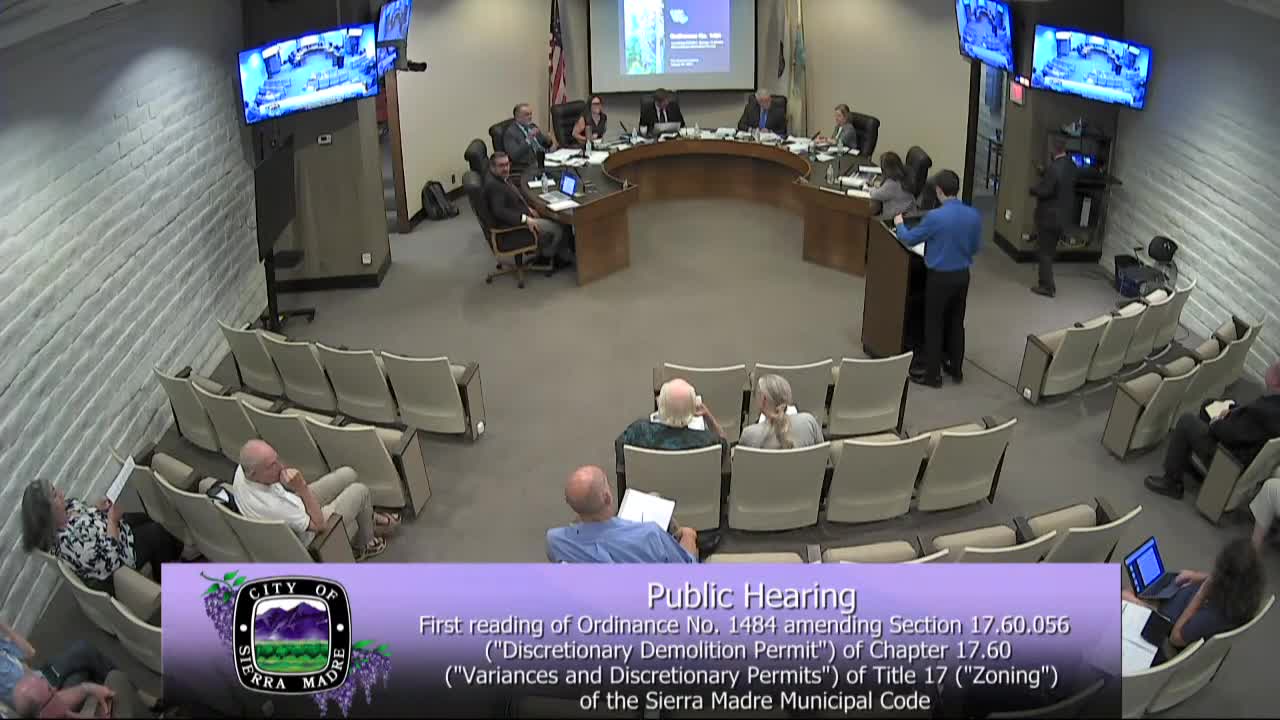
Summary
After months of planning‑commission work, councilors on Tuesday approved the first reading of an amendment to the municipal code that creates exemptions and streamlined review for certain demolition and replacement work tied to home hardening, wildfire recovery and public‑safety upgrades.
Sierra Madre’s City Council held a public hearing and voted to approve the first reading of an ordinance that amends the city’s discretionary demolition permit rules to better accommodate home hardening, wildfire recovery and routine repairs.
Why it matters: The measure revises Chapter 17.60.056 of the municipal code to clarify exemptions, speed review for certain fire‑hardening work and reduce procedural burdens for homeowners replacing hazardous materials after the Eaton Fire and during required home‑hardening work in the Wildland‑Urban Interface (WUI).
Senior planner Wolf summarized the ordinance’s intent and key changes. The ordinance creates a new definition, “fire hardening update,” and allows use of state fire‑marshal‑approved WUI materials where those alternatives maintain the historic appearance of the structure. It adds a pre‑application screening step, codifies public‑notice timelines, creates categorical exemptions (for example, for non‑visible demolition and for structures that are demonstrably altered since original construction), and establishes a streamlined “certificate of economic hardship” process handled by the director rather than by lengthy public hearings. The ordinance also shifts some evidentiary burdens away from applicants and clarifies required findings for approval.
The planning commission reviewed the draft ordinance in July and August and recommended it to council (PC Resolution 25‑12). Councilors praised staff and the commission for laboring through a complex balance between historic preservation and wildfire safety. Council member remarks noted the ordinance’s aim to avoid delays in restoring homes and enabling “reasonable” fire‑resistant substitutes that match historic styles.
What happens next: The council adopted the ordinance on first reading Tuesday; a second reading is scheduled for Sept. 9, 2025. If adopted at second reading the ordinance would become effective Oct. 9, 2025. No immediate change to existing landmark procedures for designated historic properties was proposed—the ordinance retains the current, higher level of review for designated landmarks.
Council members and staff emphasized that the change is intended to harmonize conservation of historic character with a need for resilient construction and faster recovery after wildfire damage.