
Sierra Madre council approves traffic-report changes, asks staff to prepare stop‑sign findings for three intersections
Get AI-powered insights, summaries, and transcripts
Subscribe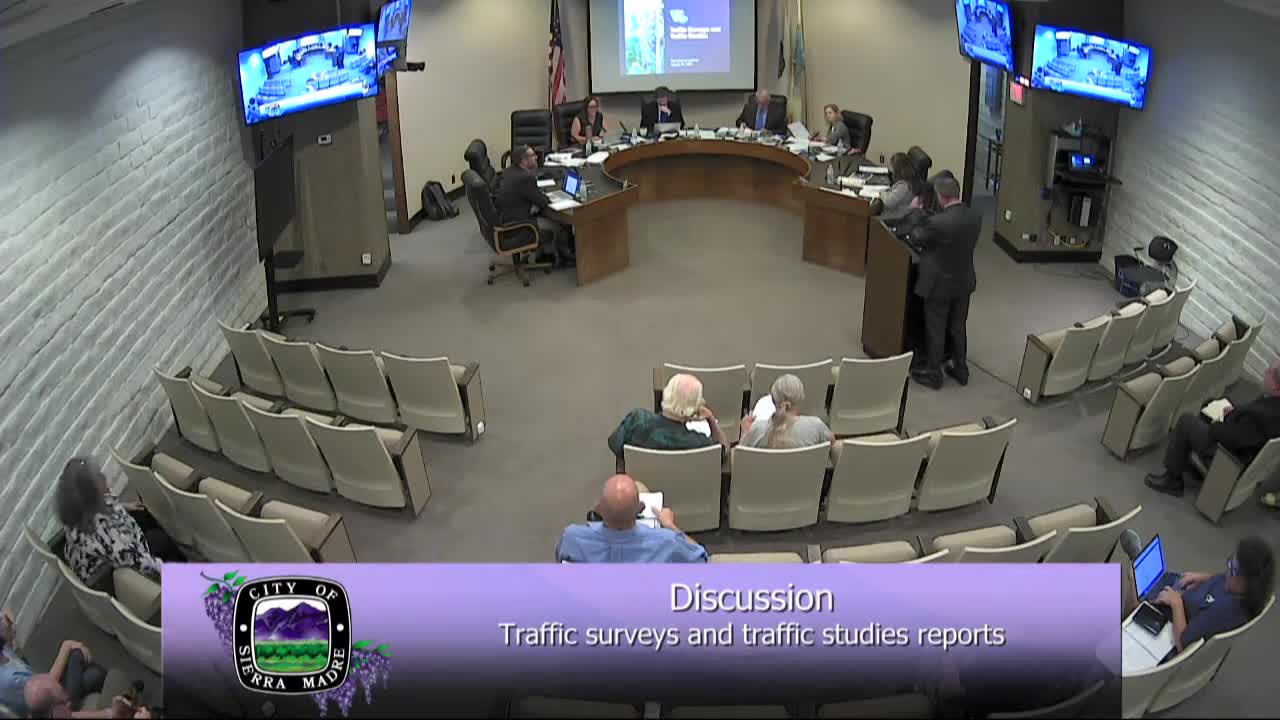
Summary
Sierra Madre City Council members on Tuesday accepted the bulk of a city traffic survey and directed staff to prepare formal findings to consider additional traffic controls at several neighborhood intersections, including Grandview and Cannon, where residents and school officials have raised safety concerns.
Sierra Madre City Council members on Tuesday accepted the bulk of a city traffic survey and directed staff to prepare formal findings to consider additional traffic controls at several neighborhood intersections, including Grandview and Cannon, where residents and school officials have raised safety concerns.
The council approved the engineering report’s recommended speed‑limit and signing changes for several streets but rejected a recommendation to raise the posted limit on East Sierra Madre Boulevard from 25 to 30 mph. Council members also declined to enact the consultant’s proposed weekday parking restrictions on West Grandview Avenue, and instead asked staff to return with alternatives.
Why it matters: Council members said the moves aim to balance enforceable traffic controls with neighborhood needs and pedestrian safety near schools. Several residents told the council they had witnessed near‑misses at the Grandview‑Cannon crossing and urged steps to reduce vehicle speeds and improve visibility.
Senior analyst Carlson summarized the city’s work, saying the traffic survey covered 22 roadway segments and a targeted study of six intersections. The consultant, Willdan, recommended only a small number of speed‑limit changes and no new stop signs in most locations—except where sight lines or traffic patterns warrant further review. The council accepted most of those recommendations but instructed staff to prepare the legal and engineering findings needed to pursue additional measures at three intersections: Fairview & Sunnyside; Sunnyside & Mariposa; and Mitchelllinda & West Grandview.
Residents from the Grandview corridor described daily safety problems at the Grandview‑Cannon crossing—particularly at school drop‑off and pick‑up times. “We hear the screeches. We hear the running,” said Mary Doyle, who lives near Sunnyside and Grandview. Kurt Young, who lives on Grandview, told the council the crosswalk at Cannon is hard for drivers to see until a car is almost on top of it and urged “calming measures” rather than only paint or signs.
Staff said the city’s recent counts were completed in late May and attempted to capture school‑period flows; however, council members and speakers noted peak afternoon conditions and student crossings may not have been fully reflected in the counts. Council directed staff to return with the additional engineering analysis and the formal findings required by the California Manual on Uniform Traffic Control Devices (MUTCD) if the city pursues new stop control or other traffic‑calming hardware at the identified intersections.
On West Grandview, the consultant had proposed intermittent weekday parking restrictions on the south curb to relieve congestion. Council voted not to implement those restrictions after members and residents said the short‑term truck traffic that prompted concern had eased and that curbside parking sometimes acts as a speed‑reducing “choke” for drivers. Council asked staff to explore other safety options.
What happens next: Staff will bring back the MUTCD‑based findings and any recommended design changes or traffic‑calming alternatives for council consideration. The council’s motion to implement the report in part, to reject the proposed East Sierra Madre speed increase and West Grandview parking limits, and to direct staff to prepare stop‑control findings carried on a voice vote.
Community context and forward look: Council members and residents said they want a thorough, systematic approach rather than ad hoc fixes—an approach that can incorporate an active‑transportation plan when funding and consultant capacity are available. Several council members asked staff to examine regional grant opportunities and to coordinate future surveys with school schedules to better capture peak pedestrian activity.