
Dallas County budget workshop outlines FY2026 baseline, three tax-rate scenarios
Get AI-powered insights, summaries, and transcripts
Subscribe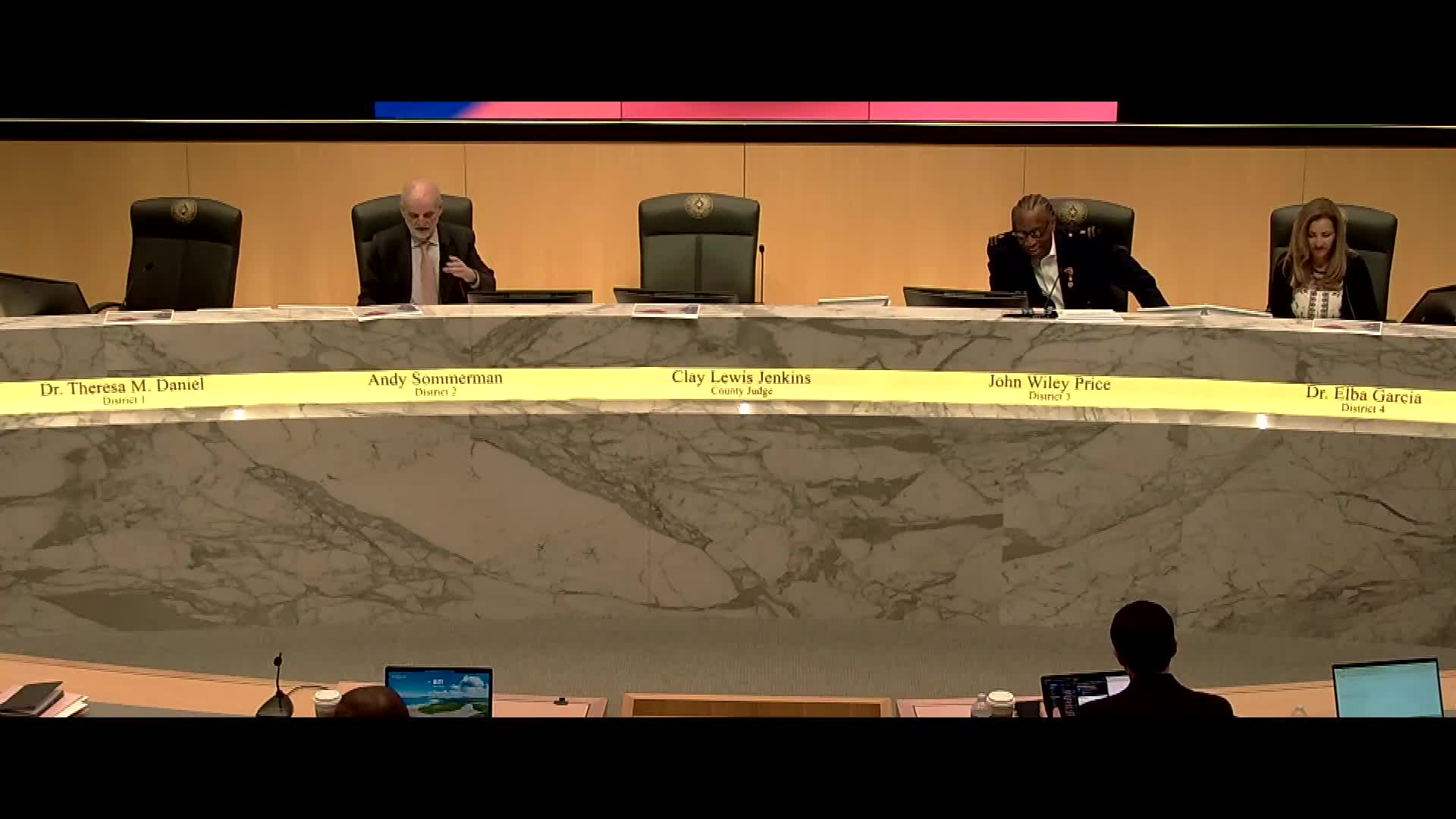
Summary
This is a work session regarding the FY '26 budget workshop, Doctor Watkins, budget director, told the court as she opened the presentation.
This is a work session regarding the FY '26 budget workshop, Doctor Watkins, budget director, told the court as she opened the presentation.
The county’s FY2026 baseline budget starts at $821,284,504, a $29,500,000 (3.7%) increase over the adopted FY2025 budget of $791,784,504, Doctor Watkins said. She attributed the increase primarily to inflationary pressures and to positions and costs first funded by the American Rescue Plan (ARPA) that are now being folded into recurring county budgets. "Those are basically the two biggest buckets that caused this $29,000,000 increase," she said.
Why it matters: Commissioners must choose how to pay for the baseline increases and a set of programmatic options. Staff presented three tax-rate scenarios computed from auditor and appraisal data: the no-new-revenue rate, the current rate and the voter-approval rate. Each produces different room in the budget for programmatic items such as a judicial supplement, fleet replacement and infrastructure, housing programs, and mental-health diversion funding.
Key figures and fund structure: Doctor Watkins said May year-to-date projected expenditures were $819,396,459 and that after adjustments the projected fund ending balance (closeout) would be approximately $339,852. She also said the county established a dedicated emergency reserve account (fund 12112183500000) holding about $83,500,000, which moved previously pooled reserves into a separate line for transparency. She spelled out categories driving changes from May to August, including corrected court-cost projections and a much larger mileage reimbursement line (from an earlier $6,000 budget to a projected $300,000 countywide) that reflected post-COVID travel resumption.
Staff also presented the capital and technology requests. IT’s recommended allocation for FY2026 operations and capital was $84,000,000 with $2,000,000 for capital projects; major capital requests include an estimated $35,000,000 for public works and $30,000,000 for facilities (staff noted prior-year encumbrances and that the numbers would be refined). Fleet operations requests included $2,700,000 for vehicle replacement and a $1,500,000 proposal for electric-vehicle infrastructure. The presentation flagged that adopting all requests at the voter-approval rate would still require direction on which optional items to program into the budget.
Tax-rate scenarios and next steps: Staff presented three rate options and the programmatic packages each would permit. Commissioner discussion focused on methodology for the no-new-revenue and voter-approval calculations and a large-looking average tax increase figure on one slide that several commissioners asked staff and the Dallas Central Appraisal District (DCAD) to verify. "We used the Dallas Central Appraisal District. That's what they published," Doctor Watkins said; commissioners asked the auditor and DCAD staff (Mr. Ames) to be present at the next briefing to explain methodology.
What commissioners asked staff to do: commissioners directed staff to (1) provide updated slides and vendor/item lists (IT and fleet), (2) verify the appraisal/ tax-rate methodology with DCAD and the auditor, (3) confirm whether mental-health diversion and DIAC (eviction/tenant advocacy) requests are already included in the baseline or would be additional asks, and (4) provide more granular priority lists for facilities (including jail intake needs) and capital requests.
Ending: Staff said they will return with updated numbers and supporting documentation at the next court session and will work with departments to refine encumbrance and vendor details. The court left open the choice among the three tax scenarios pending those follow-up materials.