Get Full Government Meeting Transcripts, Videos, & Alerts Forever!
Get email alerts on the Temporary Structure Signage topic
No spam. Unsubscribe anytime.
Architectural board OKs comments on Reserve at Wildwood construction trailer wrap, asks for skirting and landscaping conditions
Summary
The board reviewed a temporary vinyl banner wrap on a construction trailer at the Reserve at Wildwood subdivision and advised the Board of Adjustment that the trailer and wrap are acceptable if conditions (skirting, bond, relocation plan, and eventual landscaping) are met; the developer said it will remove or modify the wrap if required.
The Wildwood Architectural Review Board on Sept. 11 reviewed a temporary vinyl banner wrapped around a construction trailer at the Reserve at Wildwood subdivision and agreed to forward advisory comments to the Board of Adjustment supporting limited temporary signage with conditions.
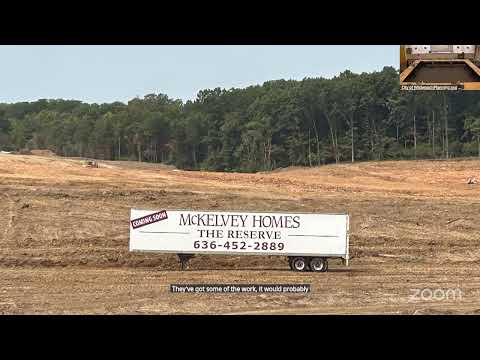
The issue is substantive because the trailer wrap is oversized compared with typical temporary signage rules and the trailer is already on-site; the developer seeks an exception to regulations governing temporary structures and signs for a 115-lot subdivision being built by McKelvey Homes.
Staff member told the board the Reserve at Wildwood site is about 50.7 acres and zoned R-3 (10,000-square-foot residence district) with a planned residential development overlay. The trailer wrap faces Route 109, measures about 8.5 feet high and 47 feet wide, and displays the developer's name, the development name, and a contact phone number. "This temporary sign is depicted here. It displays the name of the company, the name of the development, and a phone number. It is 8.5 feet high and 47 feet wide and affixed to the side of the construction trailer," the staff member said.
McKelvey Homes representative Mr. Foley told the board the wrap was installed because of a misunderstanding about whether a wrapped trailer required a separate sign variance. He said the company submitted the application as soon as it was made aware of the issue and that the trailer could be unwrapped or painted if the Board of Adjustment rejects the variance.
Board members noted that construction trailers are allowed on-site in association with development, but signage on trailers requires either a temporary-sign permit or a variance. Staff outlined additional requirements for construction trailers, including a $1,000 bond and skirting to conceal wheels. "There's a number of things that have to go into that. There's a bond requirement of a thousand dollars. The bottom has to be skirted so you can't see the wheels," the staff member said.
Members recommended that the memorandum to the Board of Adjustment note: the trailer is acceptable for construction use, the developer should skirt the trailer and use materials that allow relocation as the project progresses, and the developer should proceed with the landscaping schedule tied to grading along Manchester Road and Route 109. Planning commission liaison Mayor Bollard, referenced during discussion, had advised that final landscaping along the two major roadways should begin as soon as grading is complete.
No formal action was taken by the Architectural Review Board; its comments are advisory and will be summarized in a memorandum to the Board of Adjustment. Mr. Foley said the builder has not started sales but has an interest list of about 200 people and expects to submit a request for a display trailer soon.
Key clarifications made at the meeting: the Reserve at Wildwood comprises approximately 115 lots on 50.7 acres; the construction-trailer sign is a polyester wrap 8.5 by 47 feet; a $1,000 bond and trailer skirting are typical conditions for permitted construction trailers; and the Board of Adjustment has previously granted a similar temporary-trailer signage variance once, in 1999 for Dierbergs. Staff said the developer is willing to skirt the trailer and move it as required by construction staging.