Get email alerts on the Building Codes topic
No spam. Unsubscribe anytime.
IRC technical advisory group approves reports, advances crushed‑stone footings and sleeping‑loft proposals
Summary
The IRC Technical Advisory Group approved its existing‑amendments and significant‑changes reports and moved several tag proposals toward final action, including a staff proposal to add crushed‑stone footings language and a public proposal clarifying sleeping‑loft language and footing tables.
The IRC Technical Advisory Group on Thursday approved its existing amendments and significant changes reports and advanced a set of tag proposals that staff and members said will be posted for final action next week.
The approvals came during an online meeting convened Aug. 21, where members also discussed a staff proposal to incorporate crushed‑stone footings into R403.1.1 of the state code, debate over terminology in footing/span tables created for eastern Washington, and proposed changes to sleeping‑loft and appendix language in the 2024 International Residential Code (IRC).
The group’s action clears the way for final votes on public proposals at meetings scheduled for next week. “We’re hoping to get all tag proposals in by this Friday,” Dustin, a staff member coordinating the group’s work, told the committee, adding that the group has meetings next week to review and take final action.
Why it matters: The tag proposals under review would change how Washington amends the 2024 IRC and could affect prescriptive footing options, construction cost and permit processing for one‑ and two‑family dwellings, as well as how states adopt or decline new appendices such as electric‑vehicle and solar provisions.
Most important decisions and next steps
- The advisory group voted to approve the existing‑amendments report on a voice vote after a motion to “approve as amended.” Patrick Hanks moved the motion; a member identified as Josh seconded. No opposition was recorded.
- The group later voted to approve the significant‑changes report. Patrick Hanks moved the motion; Jonathan (committee member) seconded. The motion passed by voice vote with no recorded opposition.
- Staff and members confirmed a schedule for final action: tag proposals should be submitted by the coming Friday so staff can post them for the committee meetings planned for Tuesday and Thursday next week.
Substantive proposals and technical discussions
Crushed‑stone footings (R403.1.1). Dustin said he would write a staff proposal to “incorporate the model code language” that would add crushed‑stone footings as an alternate for cast‑in‑place concrete footings. He said the International Code Council (ICC) materials indicate the option would reduce construction costs in some scenarios: “According to what was viewed on the ICC codevelopment, access information, the addition of bringing in crushed stone footings ... will reduce construction cost,” Dustin said. He said he will attach material from ICC’s economic notes to the proposal when posted.
Tributary span vs. tributary width in footing tables. Members discussed a public technical table created for eastern Washington to limit engineering requirements for footings. One member flagged confusing terminology in the table that used the phrase “tributary span,” saying engineers and permit reviewers commonly use “tributary width” or “tributary length.” The group traced the table to work by Harvey at Harms Engineering and the Tri Cities Home Builders Association; members said the table helps avoid unnecessary engineering for typical floor plans on the East Side of the state.
Committee members agreed the language needs clarification so jurisdictions and permit reviewers can apply the table correctly. Josh (committee member) said he planned to contact the table’s author to confirm intent and to prepare a clarifying proposal. Several members suggested either replacing “tributary span” with “tributary width” or adding explicit measurement guidance. One member explained why the distinction matters: using outer span (out‑to‑out truss span) instead of tributary width could double the design value and lead to overconservative footing sizes.
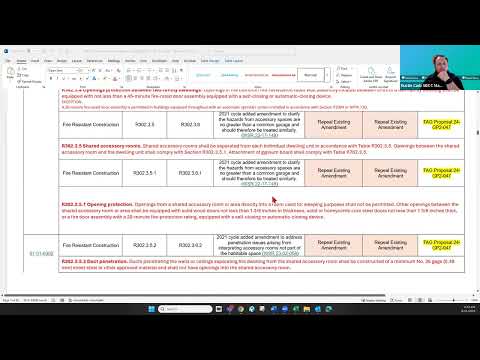
Sleeping lofts and related definitions (proposal 046). The group discussed a public proposal to revise sleeping‑loft language and related definitions (proposal 046) and to repeal certain existing state amendments where the model code now incorporates similar language. Members said the model code’s new phrasing has prompted proposals to adjust Washington’s state amendments so definitions and references align with the 2024 IRC.
Appendices, solar, EV charging and new 2024 appendices. The significant‑changes report includes a review of the new and revised appendices in the 2024 codes. The staff recommendation in the report generally flagged most new appendices (for example, electric‑vehicle charging infrastructure and several energy‑related appendices) as not adopted and not recommended for adoption in Washington at this time. Dustin asked members to review individual proposals for appendices that proponents have submitted.
Seismic map and ASCE guidance. The group reviewed an illustrative seismic‑design map comparing 2021 and 2024 values and noted the map’s limited precision. One member reminded the committee that ASCE guidance encourages using point‑specific hazard data rather than the illustrative maps: “At this point, the official position from ASCE, from my understanding, is these are just illustrative,” Josh said, and jurisdictions should rely on the ASCE hazards service for numeric values.
Care facilities and sprinkler language (WAC 51‑51‑0101.2). A member raised a concern that a staff draft might omit Washington’s current amendment about when sprinklers apply to adult family homes. Staff confirmed the intent is not to remove the sprinkler amendment and said the change under consideration is clarifying the scope so jurisdictions know when the sprinkler requirement applies (for example, care homes with seven or more beds). The group asked staff to ensure the proposal language makes that distinction explicit.
Member assignments and communications
- Dustin (staff) said he will draft and post the crushed‑stone footings proposal in time for the Friday posting deadline.
- Josh said he will contact Harvey at Harms Engineering to confirm the table’s intent and will prepare clarifying proposal language on the footing tables and on the 403.1.1 figures.
- Staff will send communications to proponents and interested parties notifying them that the committee plans to consider final action at the Tuesday and Thursday meetings next week.
What members said
“I’ll try to get something together before then. And if not, it’s pretty minor to wait ’til next cycle,” a committee member said when asked about preparing a proposal on short notice.
“I think it makes perfect sense to incorporate the model language,” Josh said about adopting the model‑code footing language.
“The official position from ASCE ... is these are just illustrative,” Josh said when discussing seismic maps and the need to use point‑specific hazard data.
Background and context
The IRC Technical Advisory Group reviews proposed state amendments and “tag” proposals to the model IRC before the Building Code Council and staff finalize draft rule language. Tag proposals are a way for proponents and staff to identify and number changes that may be discussed for adoption into state code. In Washington, the state amends the model codes through the WAC rulemaking process; the advisory group’s recommendations feed into that process.
The group’s approvals on Thursday were procedural votes to advance the two reports for committee consideration and to allow proposals to be posted for the committee’s review next week. Members repeatedly emphasized the difference between discussion and formal action: while many proposals were discussed and staff said it would draft or refine language, final adoption will occur only after posting and a formal vote at a subsequent meeting.
Next steps
Staff and proponents are expected to post finalized tag proposals by Friday so members can review them before the scheduled meetings next week. The advisory group will consider first readings and is expecting to take final action on many items at the Tuesday and Thursday meetings next week.
The committee adjourned after confirming next meetings and thanking members for their work.
AI generated
The text on this page is AI generated. Summaries, highlights, analysis, and video transcripts are all produced from the original source material.
AI can make mistakes, so if you spot one, and we will fix it for everyone.
Note: the source content is unaltered by us. Any content source we link to, be it a video, an audio recording, or a document, is presented exactly as its publisher released it. That publisher is usually a government body, sometimes an individual official or another organisation.