
North Clackamas reports October enrollment of 16,962; elementary target class size held at 25
Get AI-powered insights, summaries, and transcripts
Subscribe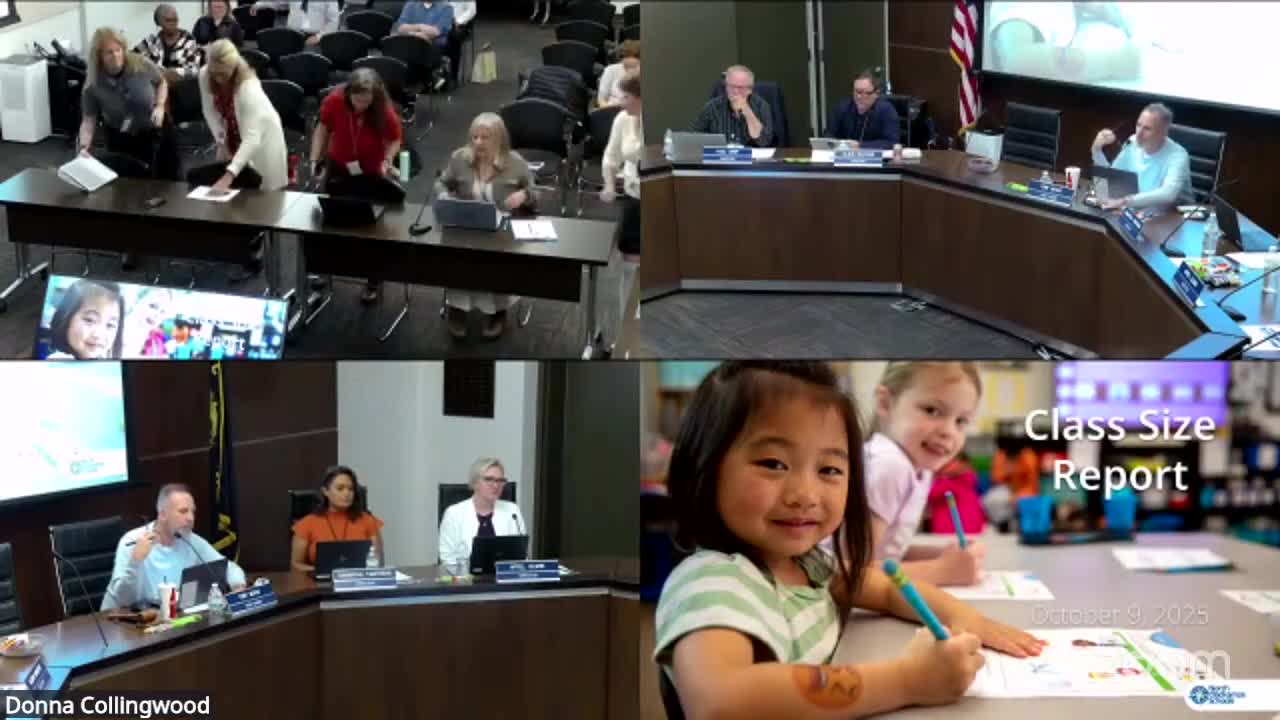
Summary
Superintendent Yvonne Dibley told the North Clackamas School District board on Oct. 9 that the district’s Oct. 1 enrollment was 16,962, slightly below the projection of 17,134, and confirmed target staffing allocations of 25 students in elementary, 29 in middle and 32 in high school.
Superintendent Yvonne Dibley told the North Clackamas School District board on Oct. 9 that the district’s Oct. 1 enrollment was 16,962, slightly below the flow-analytics projection of 17,134 for the 2025–26 school year.
Dibley said the district kept its staffing allocation targets at 25 students for elementary classes, 29 for middle schools and 32 for high schools. "Allocations are done in a way that we work with Flow Analytics," Dibley said. "Their total projected enrollment was 17,134 students. So we're just a little bit under their projection for the year."
The class-size report, presented as the district’s annual October update, showed average elementary class size at 24.9 (kindergarten 22.4; grades 1–3 average 24; grades 4–5 average 26.5). Middle-school core classes averaged 28.2 and high-school core classes averaged about 28. The district reported 172 elementary classes at or below 25 students and said no classroom exceeded 35 students.
Dr. Patricia Ahrens, director of elementary programs, and Dr. Petra Callan, director of secondary programs, joined Dibley in explaining how enrollment shifts and program needs shaped staffing. The district said elementary enrollment declined by about 70 students, middle school enrollment rose by about 100 and high school enrollment rose by about 85 from projections used for spring allocations. "We right-sized certain situations," Dibley said, citing adjustments tied to dual-language immersion (DLI) and other programmatic needs.
The board heard that Sabin Schellenberg Center added an FTE after principal Huja used course and seat data to expand offerings such as cosmetology and fire science; presenters said Sabin saw 407 more course enrollments (an 11% increase) and a 4% increase in seats filled after those adjustments.
The report also described 14–15 blended classrooms at the elementary level (combined-grade classes created when enrollment bubbles occur) and explained how schools choose whether to have a single teacher cover both grades or to specialize by subject. "Some schools are opting to specialize," Callan said, describing arrangements where one teacher focuses on math while another teaches language arts to the blended cohort.
Board members asked for follow-up data on net enrollment change year-over-year and on how special-program staffing has changed over time. Dibley said staff will refine and return the data; Dr. Callan and Tammy O'Neil, executive director of teaching, learning and professional development, offered to supply additional breakdowns on special education and classified staffing.
The presentation placed class size in the context of broader supports: instructional coaches, campus monitors, restorative-justice coordinators and paraprofessionals were cited as investments that affect students’ school experience beyond per-class ratios.
Directors thanked staff for year-over-year trend data and requested a future agenda item to review longitudinal special-program staffing and the district's October 1-to-October 1 enrollment comparison.
The board did not take formal action on the report; it was received for information.