Get Full Government Meeting Transcripts, Videos, & Alerts Forever!
Get email alerts on the Wildfire Wui Adoption topic
No spam. Unsubscribe anytime.
Alta planning commission to adopt state WUI rules, direct staff to draft vegetation code changes
Summary
The Alta Planning Commission agreed Sept. 24 to move forward with adopting Utah's Wildland-Urban Interface (WUI) code required by House Bill 48, set a public hearing for October and asked staff to draft amendments to resolve conflicts with the town's vegetation protections.
The Alta Planning Commission on Sept. 24 agreed to begin adopting Utah's Wildland-Urban Interface code required by House Bill 48 and to hold a public hearing in October, directing staff to draft code language to reconcile the WUI rules with the town's existing vegetation protections.
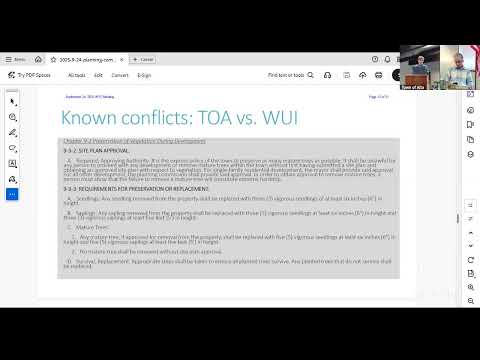
Commission Chair John, chair, opened the discussion and turned the presentation over to Chris, a staff member, who told commissioners the town "has to adopt the WUI code in a WUI boundary by the end of the year." Chris said the state's WUI requirement includes defensible-space vegetation management and that the town's current vegetation ordinance (Town of Alta code chapter 9.3) contains strict limits and replacement requirements that could conflict with the new state rules.
Why it matters: House Bill 48 requires municipalities to adopt a WUI boundary and the WUI code, and the state will separately designate "high-risk" properties and assess fees tied to structure exposure. Commissioners were told the state's program could affect insurance availability and costs, and that the fee assessment process will be administered through tax notices at the county level.
Most important details: Chris emphasized that defensible-space work under the WUI code is not a clear-cutting mandate. "Defensible space is not clear cutting," he said, adding that the code allows retained trees so long as crowns and ladder fuels are managed. Jay, a Unified Fire Authority liaison, told the commission that many WUI provisions would be applied through building permit and inspection processes: "when people apply for permits for building, it would be part of that process and part of the inspection process," Jay said, explaining that the WUI construction standards and defensible-space measures typically apply when a permit is sought and are not enforced retroactively against existing, permitted structures.
Legal and policy context: Town attorney Cameron Platt advised that state statute requires local adoption of the WUI code but allows municipalities some room to remain stricter than the state standard. "As long as we are more restrictive and not less restrictive than the WUI code, then I think we can articulate that we're still in compliance," Cameron said. Staff and commissioners discussed a practical approach: adopt the WUI code and boundary now to meet the statutory timeline, then pursue a comprehensive rewrite of the town's vegetation and tree-protection rules during the winter public-engagement period.
Scope and enforcement: Commissioners pressed for clarity on enforcement and impacts. Jay and staff said WUI construction and materials standards, defensible-space requirements, and vegetation-site approvals will generally be enforced through building-permit review and inspections; existing projects with vested permits will remain under the code in effect when their permits were issued. Staff said property owners will be able to seek reductions in any state-assessed fee by undertaking mitigation work and submitting that work for review.
Boundary and recommendation: Unified Fire Authority staff recommended adopting the entire municipal boundary as the town's WUI boundary; staff noted the state's separate high-risk mapping tool may also classify many town parcels as high risk. Commissioners generally agreed to schedule a public hearing in October and to recommend the adoption to the Town Council, while asking staff to prepare narrowly targeted, temporary code language to resolve direct conflicts (especially the vegetation-replacement rules) before a later, more comprehensive ordinance rewrite.
Next steps: Staff will draft formal code language and an adoption package for the October public hearing, aiming to deliver a recommendation to the council before the end of the calendar year. The commission also asked staff to track the state's high-risk mapping and the statute's implementation timeline, and to present specific proposed amendments to chapter 9.3 that would permit defensible-space work consistent with the WUI code without wholesale removal of all trees.
Ending: Commissioners set a public hearing for October and agreed to return in November with draft language and a recommendation to the Town Council. The commission did not take a final vote on adoption at the Sept. 24 meeting.