
BAR rules on teardown estimates take effect; towing disclosure sparks widespread industry concern
Get AI-powered insights, summaries, and transcripts
Subscribe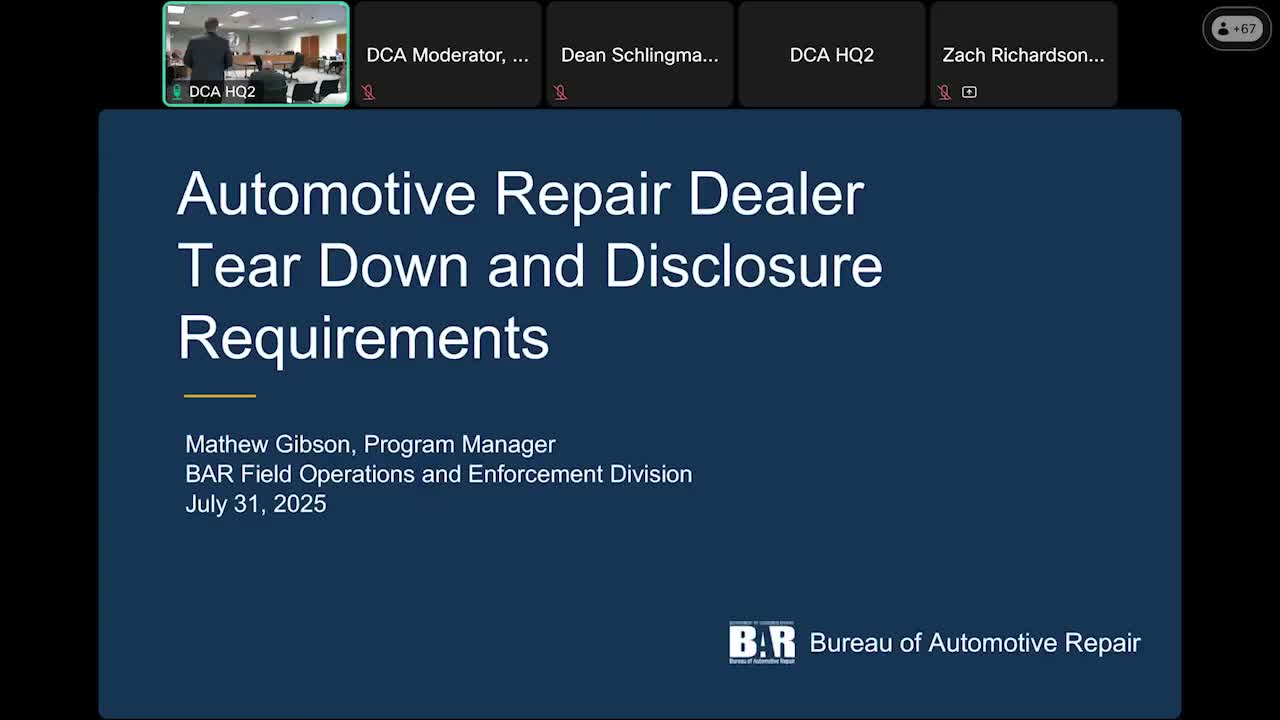
Summary
The Bureau of Automotive Repair (BAR) adopted new rules that expanded and clarified "teardown" estimate and teardown-disclosure requirements for automotive repair dealers, and those rules took effect July 1.
The Bureau of Automotive Repair (BAR) adopted new rules that expanded and clarified "teardown" estimate and teardown-disclosure requirements for automotive repair dealers, and those rules took effect July 1. The changes require repair shops to provide a clear description of the portion of a vehicle to be disassembled, include maximum reassembly time and costs on the estimate, and add new disclosure language when a repair is being billed in whole or in part to a third-party payer such as an insurer.
The bureau’s move to require separate documentation for towing fees touched off the largest debate of the meeting, with collision repair associations, individual shop owners and insurance representatives saying the change will cause operational burdens, billing confusion and consumer confusion unless BAR clarifies how the rule should be applied.
BAR officials told the advisory group the towing clause was adopted only after staff discovered text in Vehicle Code section 22651.07 and related customer-towing notices indicating towing authorizations and invoices should be handled separately from repair estimates. BAR presenters said separating the towing paperwork was intended to align industry paperwork with that statute and to reduce downstream regulatory and investigative complications.
"Tear down regulations are not new. They've been in the Automotive Repair Act since 1978," said Matthew Gibson, program manager, Field Operations and Enforcement Division, while explaining the bureau's intent. Gibson said the new rules require an ARD (automotive repair dealer) to provide a description of the area of the vehicle to be disassembled, an itemized estimate for reassembly, and notice that the teardown may prevent restoration to the vehicle's delivered condition. He also described how an ARD that adopts a third-party payer's estimate must attach that estimate and record the payer's payment amount when known.
But advisory-group members and several public commenters said the new towing language was inserted late and has not been adequately tested with shops or integrated with auto-industry billing systems. "Auto body shops are not storage units. I'm not a tow company," said Alyssa Lair of Johnny's Custom Auto Body, who described difficulties she faces getting timely insurer decisions and said she feared the new language would expose shops to unpaid time and paperwork. Christina Coopran of 52 Innovation asked what happens when a vehicle owner cannot obtain insurance that qualifies as a "collector" as envisioned in one of the legislative items discussed earlier; Gibson and others reiterated that the rules track statute and that some implementation details will be handled by BAR rules or future regulation if and when bills pass.
Several collision-industry representatives pressed BAR staff on practical scenarios: when a consumer calls for a tow and a vehicle is moved to the shop before any repair authorization; when a shop later sublets repair work to a specialist and must move the vehicle again; and when manufacturers, fleet managers or leasing companies expect a single repair-order accounting record for system or warranty reporting. Jeffrey Cox of the Automotive Maintenance and Repair Association and other commenters warned that mandating a separate towing invoice in every situation would create multiple documents for a single repair event and could break existing workflows used by shops and insurers.
BAR deputies said the bureau did not intend to make shop compliance harder and that, in its view, the separate-document requirement reflects existing Vehicle Code language. But BAR officials also acknowledged the new language has produced confusion. "We hear you," Deputy Chief Bill Thomas told the group. "We need to go back and clarify this a little more than we apparently did, and we'll revisit the towing section and get started doing that." Chief Patrick DeRay said BAR staff will follow up and offered to convene additional workshops to refine the implementation and to work with industry partners.
Industry associations and multiple shop owners urged BAR to publish clear examples and templates and said BAR should coordinate with the Department of Insurance and with towing industry stakeholders. Insurance counsel at the meeting also asked whether BAR would make a template or clear guidance available so insurer and tow-provider invoicing would be consistent and easily auditable.
BAR reiterated other aspects of the teardown and disclosure rules that took effect July 1: an ARD must record when it adopts a third-party estimate, must attach the third-party estimate to its customer estimate, and must notify customers when an insurer's payment amount is known. The regulations also clarify that teardown estimates are repair transactions under the Automotive Repair Act and therefore must include the elements the law requires (a description of dismantled area, an itemized reassembly time and cost, and notice about restoration limits).
BAR staff said the bureau will: - Publish guidance and sample forms and update the bureau's "Right to Repair" guide to reflect the new teardown rules and the towing-document interpretation; and - Convene a workshop to address the towing-document question, clarify when a separate towing invoice is required, and identify how shops should document sublets and internal transfers for warranty and manufacturer reporting.
Bar officials encouraged shops and insurers to provide concrete examples in writing and said BAR would follow up with stakeholders to refine practical compliance guidance. "We recognize ... we need to be a little more thorough and clarify this towing section a lot more than we did," DeRay said.
Ending: BAR’s July 1 teardown rules change existing disclosure practice for collision and mechanical repairs; the bureau has signaled it will return to industry stakeholders to clarify how the Vehicle Code’s towing language should be applied in practice and will publish updated guidance and samples to reduce confusion and compliance risk.