Get Full Government Meeting Transcripts, Videos, & Alerts Forever!
Get email alerts on the School Mental Health topic
No spam. Unsubscribe anytime.
Wyoming education leaders propose classroom-discipline changes and outline school mental‑health pilots
Summary
State Superintendent Megan Degenfelder told the Mental Health & Vulnerable Adult Task Force the Department of Education will pursue statutory changes on student discipline and described three pilot efforts—BAR, AWARE and a care‑coordination line—while warning long‑term funding is uncertain.
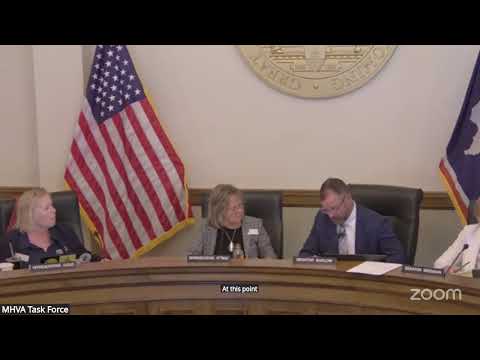
Megan Degenfelder, Wyoming state superintendent of public instruction, told the Mental Health & Vulnerable Adult Task Force that the Department of Education will pursue statutory changes on student discipline and described pilot programs aimed at prevention, identification and referral of student mental‑health needs.
Degenfelder said the issue has been rising in schools and in teacher surveys. "This is an issue that we keep seeing, grow more and more in our schools and something that we're hearing from teachers," she said, adding the department has shared the topic with the Legislature's Joint Education Committee and is watching statutory approaches adopted in other states.
The department framed its work around a three‑part GRIT framework: prevention, identification and referral. The department described three pilot efforts in detail: BAR (a school‑level, professional‑learning approach intended to change classroom culture and strengthen teachers' ability to support students), AWARE (a grant program that embeds clinical‑level coordinators in schools to connect students and families to outside treatment) and a statewide care‑coordination telephone line that helps districts and families find local or virtual providers.
Degenfelder said the department used remaining COVID relief and ESSER funds to launch pilots and that those sources are time‑limited. She said the AWARE program, if scaled statewide, would cost about $13,200,000 per year. "That was in a bill to fund the AWARE program this last session," she said, and the earlier bill did not pass. Department staff warned school pilots and the care‑coordination line have discrete funding timelines.
Dustin Brown, the department liaison to the task force, described how the pilot programs fit together. "BAR is really good at a baseline reducing the overall prevalence of need within the school setting," Brown said. He added: "AWARE is really focused on those tier 3 clinical intervention services, where BAR is really focused on the foundational aspect of the MTSS pyramid." Brown said the AWARE grants are structured to reinforce programs already used in districts and that AWARE grant funding for participating districts is roughly $100,000 per district per year under the current grant model.
Brown gave the task force a roster of participating districts for the three AWARE grants: Campbell County School District No. 1, Fremont County School District No. 1, Park County School District No. 1 (first grant); Carbon County School District No. 1, Sweetwater County School District No. 1, Uinta County School District No. 1 (second grant); and Sweetwater County School District No. 1 and Sweetwater County School District No. 2 (third grant). He said there is currently no geographic overlap between the active BAR pilots and AWARE district pilots.
Public commenters and local providers emphasized implementation choices and school‑level capacity. Cheryl Foland, an LCSW in private practice, supported code‑of‑conduct authority for teachers but cautioned against adding administrative positions when community providers already deliver direct services. "When asked why do you behave this way in your classroom? And the response overwhelmingly is because I can," Foland said, urging the task force to prioritize direct service funding and clearer referral pathways rather than expanding in‑school clinical services by default.
A retired principal from Cheyenne, Carla Gregorio, urged continued emphasis on school counselors and on feeding programs for low‑income students. "Our kids deserve the right to be fed 3 65 days a week," she said.
The task force received timeline details from department staff: care coordination funding has been extended through 2028 through a public‑health connection; AWARE grants have staggered end dates (the department said one AWARE grant ends in October [year provided in grant documents], a second ends in October 2026 and a third in December 2026); BAR is a three‑year training commitment for participating schools and is designed to shift classroom culture rather than provide clinical care.
No formal action was taken by the task force on discipline or the school pilots. Degenfelder told members the department "do[es] believe there will be some draft legislation on student discipline at the next joint education committee meeting," and the department asked the task force to consider the pilots' funding timelines and whether state support should be made sustainable through the budgeting and education committees.