
Planning commission recommends Cache County water-use and preservation element to county council
Get AI-powered insights, summaries, and transcripts
Subscribe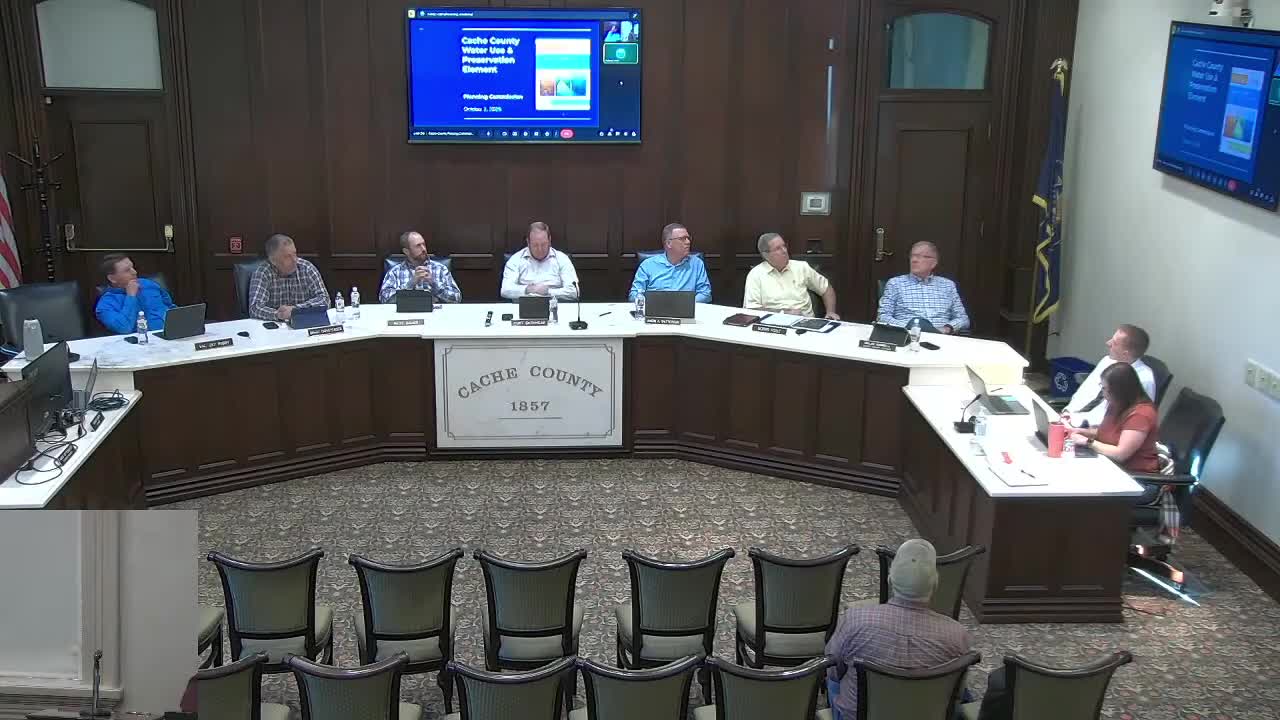
Summary
After a public hearing, planning commissioners voted to recommend adoption of the county’s updated Water Use and Preservation Element, a state-mandated update to the general plan, while flagging need for follow-up on basin-wide groundwater study and implementation steps such as tracking and triggers for future development.
Cache County planning staff and a consultant presented the county's draft Water Use and Preservation Element to the Planning Commission on Thursday, and after public comment the commission voted to recommend that the County Council adopt the document as the county’s updated water element.
Aubrey Larson, the consultant who led the project for Landmark Design and partner firm Hansen, Allen & Luce, reviewed the project background and the role of the water element as an advisory chapter of the general plan. “It describes generally where you are, where you wanna be, how you'll get there, and it does not create regulations,” Larson told commissioners during the presentation.
Larson and staff emphasized the element is intended to help the county manage growth while preserving agricultural uses and to incorporate a basin-wide groundwater study that the state is completing. Commissioners and members of the public raised questions about the element’s conservation targets and whether the county moratorium on new subdivisions larger than five lots would be followed by state agencies; staff clarified that the moratorium is a county action and that state bodies continue to process water-right transfers but that transfers do not guarantee local well reliability.
Members of the public asked whether the basin-wide study and a new state modeling tool would change the county’s targets; staff said basin-level numbers were not final. After opening and closing the public hearing, a commissioner moved that the Planning Commission recommend the Water Use and Preservation Element to the County Council for adoption. The motion was seconded and passed with all commissioners voting aye.
Commissioners asked staff to ensure the county has a development-tracking mechanism and to identify clear triggers (for example, thresholds of unit approvals) that would require supplemental traffic, soils or hydrology studies before larger phases of development proceed. Staff and the consultant both suggested the interagency groundwater study and state modeling tool will be key inputs for future policy decisions; the commission asked that any subsequent code or policy recommendations be brought back for review.