Get Full Government Meeting Transcripts, Videos, & Alerts Forever!
Get email alerts on the Public Safety Warrants topic
No spam. Unsubscribe anytime.
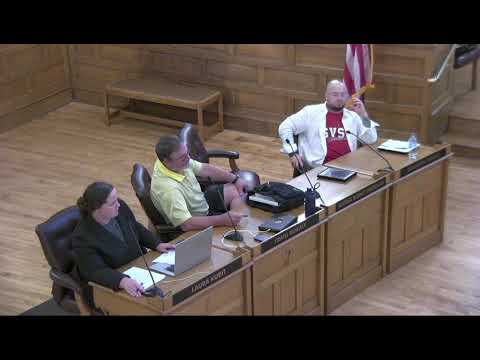
Bay City commission directs manager to craft policy on no-knock warrants after hours of public comment
Summary
The Bay City City Commission approved a resolution directing the city manager to develop a Department of Public Safety policy governing execution of no-knock or similar high-risk warrants, following debate about oversight, officer safety and outside-agency assistance.
The Bay City City Commission voted 7-1 on Aug. 18 to direct the city manager to develop a policy for the Department of Public Safety on how high-risk search warrants — including no-knock entries — are executed.
The resolution, introduced by Commissioner Tenney and seconded by Commissioner Runberg, asks the manager to return a draft policy for commission review that would codify existing practices, address notification and oversight and consider collective-bargaining and operational constraints.
Supporters said the item formalizes a practice that already exists. "This would basically be codifying current practice into policy so that nobody thinks that police are intruders," Commissioner Tenney said. She added that codification is intended to reduce the chance of a forceful entry turning deadly, as has occurred in other jurisdictions.
Members of the public and several commissioners pressed the department for facts about how often the tactic is used. The director of public safety told the commission the city had participated in four no‑knock operations in the last five years — all when assisting state police — and that those operations were carried out without injuries. "We assisted with four of them. We don't execute any no‑knock search warrants. We assisted the state police in execution of them. Nobody was injured," the director said.
Opponents, including Commissioner Coakley, said officers had told them they preferred to retain the option in their operational toolbox. Coakley said officers she consulted wanted to "keep it as is" and cited officer safety concerns.
Commission debate also focused on whether limiting the practice would reduce the willingness of other agencies to assist. The director responded that the city requests assistance when it lacks the specialized personnel or equipment for high-risk entries and that on some occasions outside assistance is requested for safety and capability reasons.
The commission's action directs staff to prepare a policy for later consideration; it does not itself change current operating procedures or discipline rules. The vote on the resolution was recorded as 7 in favor and 1 opposed.
The commission did not specify an implementation date; the resolution asks the manager to bring the draft back to the commission for review. Further public comment and formal adoption would be required before any operational change took effect.