
California Naturopathic Board adopts fee increase after rejecting public objections
Get AI-powered insights, summaries, and transcripts
Sign Up Free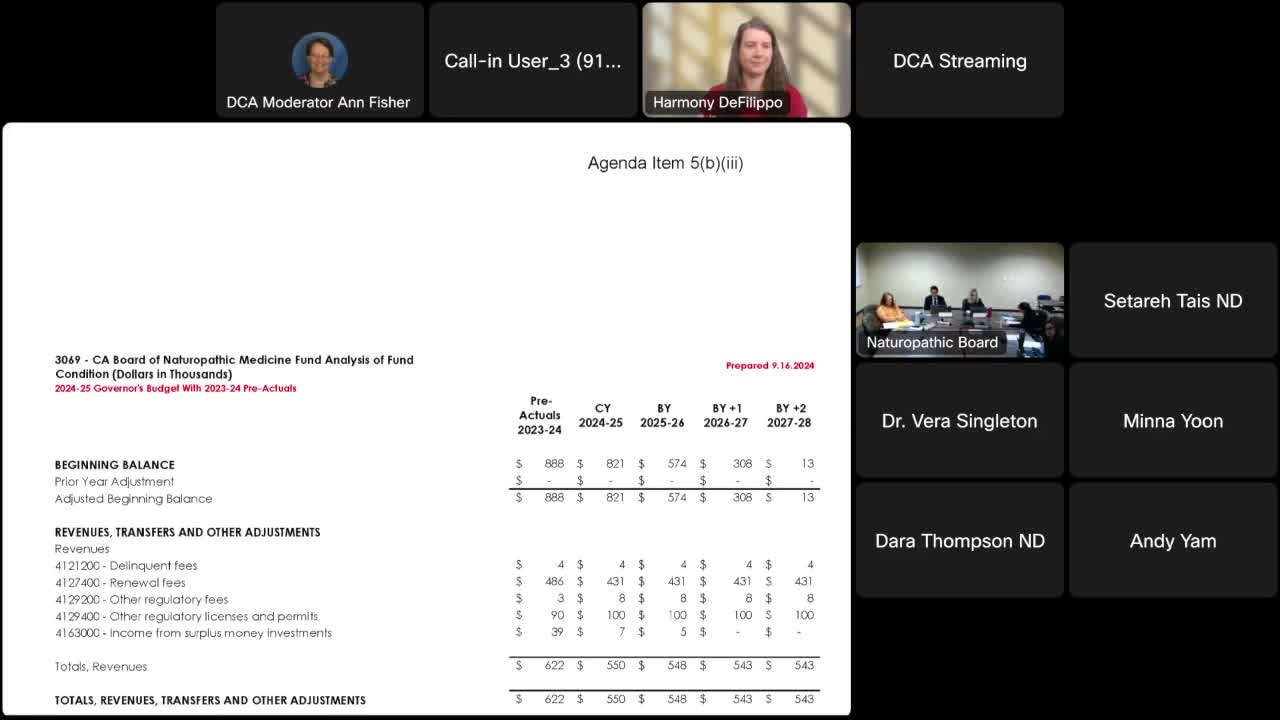
Summary
The California Board of Naturopathic Medicine voted unanimously to adopt staff responses to adverse public comments and to finalize rulemaking that raises several licensing fees, following staff explanations that fee increases are needed to prevent insolvency.
The California Board of Naturopathic Medicine voted 5-0 on Oct. 4 to adopt staff responses to adverse public comments and to file a final rulemaking package that raises several licensing fees.
Board members said the increases are meant to shore up the board’s fund and avert a projected shortfall. The board’s regulations counsel and budget staff told members that the board’s small licensee population means per-license costs are higher and that the proposed changes — including a $200 increase to the biannual renewal fee from the current $1,000 — are needed to preserve operations.
The board’s regulatory counsel, Christy Shields, explained the process after the board received two public comment submissions. “After the board receives adverse comments, we’re required to bring the comments back to you so you can see them, understand what the issues are,” Shields said. She and staff summarized the commenters’ objections and recommended that the board reject the adverse comments and adopt the staff responses (referred to in materials as page 5, option A). The board then approved that motion by roll call.
Why it matters: board staff and legal counsel told members that without the fee increases the board’s fund condition will deteriorate and could ultimately jeopardize licensing operations. Staff emphasized the board cannot rely on unpredictable revenue sources such as fines and citations and must base its budget on licensing revenue.
Board members acknowledged the burden on licensees. “We really are in a situation where we don’t desire to charge our licensees more,” Board President Dara Thompson said during the discussion, “but in order to be able to run and be able to license them so that they can be licensed professionals in the state of California, we just have to.”
Among commenters, a clinic operator and several licensees opposed the size of the increase and requested alternatives, including the ability to pay in installments. Staff responded that installment payments cannot be accommodated under current administrative procedures and that the increase is smaller than the commenter’s characterization (staff told the board the increase is $200 from the existing $1,000 biannual renewal fee, not a 150% rise). The board accepted staff’s proposed language responding to each comment and directed staff to finalize the rulemaking records for filing with the Office of Administrative Law.
The board then took a separate roll-call vote to adopt the final regulatory text (16 CCR §4240 as noticed) and authorized the executive officer to make non-substantive edits for filing. Members were told the Office of Administrative Law will take roughly 30 working days to review the package; if approved, the fee changes would be implemented on a staggered basis because licensees renew biannually by birth date.
The board also discussed the broader structural issue that underlies the increase: a relatively small licensee population. Regulations counsel noted that boards with more licensees spread costs across a larger base, lowering per-license fees. Staff and counsel suggested the board may need to consider longer-term fixes — including statutory adjustments to fee caps or legislative steps tied to the upcoming sunset review — but those were not enacted by the board during the Oct. 4 meeting.
The board’s roll-call votes on Oct. 4 were recorded as unanimous (5–0) for (1) adopting staff responses to the adverse comments and (2) adopting the proposed fee regulation text and authorizing staff to file the final rulemaking package.