
Westborough reports lower preschool enrollment, uneven elementary enrollment ahead of redistricting
Get AI-powered insights, summaries, and transcripts
Subscribe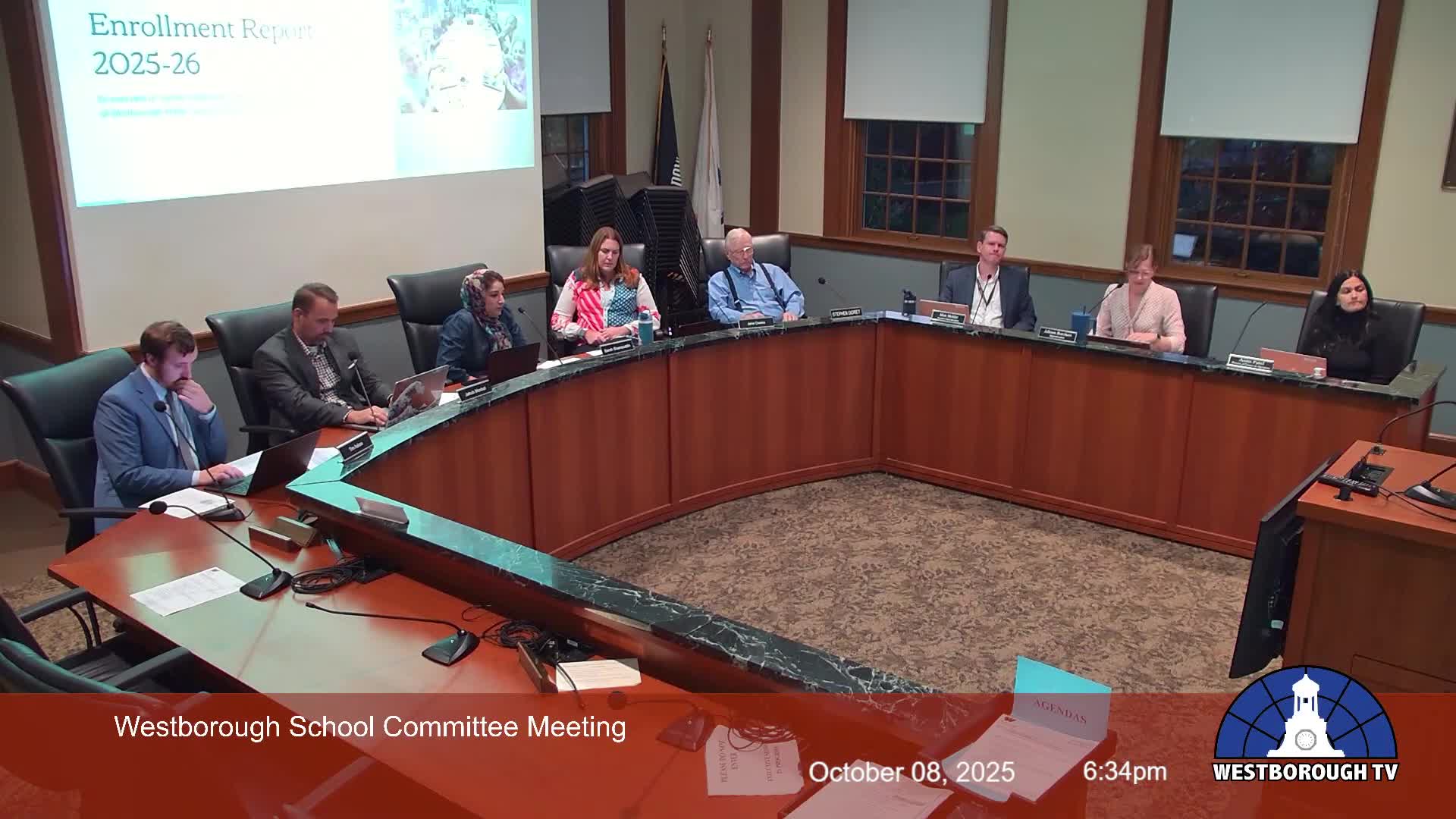
Summary
Superintendent Allison presented enrollment figures showing a decline in preschool enrollment and uneven K–3 distribution across elementary schools; district officials flagged staffing, transportation and facility utilization as factors for upcoming planning and budget decisions.
Superintendent Allison presented the district’s fall enrollment snapshot and told the School Committee that total student counts are lower than the district projected for the year.
She reported 84 students enrolled in preschool, a decline from last year, and said district K–3 enrollment was "just under 1,000" students across the three elementary schools. Allison gave specific counts for two schools: Fales at 284 students and Hastings at 322 students; Armstrong remained the largest elementary but Allison did not provide an exact count at the meeting. At the secondary levels, Allison reported 569 students in grades 7–8 and 1,141 at the high school, for a district total she later noted as 3,641.
Allison said preschool enrollment is down in part because the program’s short day leads families who need before‑ or after‑care to place children elsewhere. "Reports that we're getting indicate that essentially without, before or after school care ... the current population of families is looking for their care elsewhere," she said, and the district will explore extended‑day options.
The superintendent showed 10‑year enrollment trends that display a modest decline consistent with statewide patterns and cited NESDEC projections as a broad trend tool. She said Westborough’s enrollment has been relatively stable compared with districts that have seen sharp swings, but the current year is below the district’s earlier projection of roughly 3,700 students.
Allison also presented classroom‑level data for K–3 and middle‑school sections. She said most K–3 classes fall within the district’s class‑size guidelines (16–21 for younger grades, 18–22 for grades 2–3) and that several sections are under guideline size; some principals have chosen to keep intentionally small classes for educational reasons. At Mill Pond (grades 4–6) and Gibbons (middle school), averages are generally within targets though middle‑school staffing uses team structures that affect when reductions are possible.
Committee members asked about enrollment drivers, including regional birth rates and resettlement programs. Allison said some changes relate to the closure of hotel‑based shelter programs that previously placed short‑term students in town and that she will seek more granular data on January upticks and local development yield from planning. She said the district will share the underlying data files with the redistricting consultant.