Get Full Government Meeting Transcripts, Videos, & Alerts Forever!
Get email alerts on the Public Events Free Speech topic
No spam. Unsubscribe anytime.
Marshfield residents debate drag events; city attorney says statute unlikely to apply to Wenzel Plaza shows
Summary
Public commenters argued for and against drag performances at Wenzel Plaza during the Aug. 12 Marshfield Common Council meeting. Opponents cited Wisconsin Statute 948.055; City Attorney Harold Wolfram told the council he found no basis to conclude the statute was violated and summarized the law’s elements.
At the Marshfield Common Council meeting on Tuesday, Aug. 12, dozens of residents spoke during the public comment period about drag performances and pride events staged at Wenzel Plaza, with both supporters and opponents urging the council to act.
Supporters urged the council not to restrict drag as an art form and as an economic driver. "Drag is an art form," said Megan Craig, a resident, adding that "there is a spectrum of drag that exists from family friendly to adult oriented and absolutely everywhere in between." Kevin Craig, who attended Marshfield Bridal, said he "saw nothing obscene for children" and described the event as "a family friendly environment through and through." Several other speakers — including Caleb Engvold, who identified themself as a local drag performer and producer — asked the council to allow events to continue and to defend First Amendment rights.
Opponents said events in public parks risk exposing children to illegal material. Ray LeBlanc, a Marshfield resident, cited what he described as Wisconsin statutory law and said the issue was "about the children that we're concerned about." Dottie Schnitzler likewise cited the state statute and said it was "meant to protect the young."
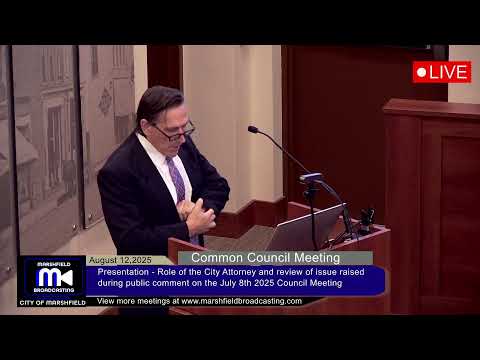
City Attorney Harold Wolfram addressed the council in a presentation about his role and the applicable criminal law cited during public comment. Wolfram said he had reviewed the matter with police and other staff and "has no basis whatsoever to believe that there's been a violation of 948.055 by any of the activities that went on at Wenzel Plaza." He explained the elements of the offense as stated in the jury instruction he provided, including that the statute requires (1) proof beyond a reasonable doubt that a defendant caused a child to view or listen to sexually explicit conduct; (2) that the conduct qualify as sexually explicit (for example, an exposed "intimate part"); and (3) that the defendant acted with the purpose of causing a child to view or listen to the conduct.
Wolfram summarized that the statute, as instructed to juries, requires actual or simulated sexual acts or lewd exhibition of an intimate part and also a showing of the actor’s purpose to cause a child to view or listen for sexual gratification or humiliation. Based on information available to him and discussions with the police chief, Wolfram said he had seen "no evidence that [intimate parts] were exposed at this event," and that the intent element would be difficult to prove.
The discussion did not produce formal policy changes. Council members later voted to adjourn into closed session, an action that included as one of its agenda items the "tourism entity agreement with Visit Marshall," among other negotiation items.
The council did not take a public, binding vote on any new restrictions for public events during the meeting; councilors and staff said future steps would depend on legal review, enforcement considerations, and potential policy proposals.