Get Full Government Meeting Transcripts, Videos, & Alerts Forever!
Get email alerts on the Central Office Reorganization topic
No spam. Unsubscribe anytime.
MCPS retools central office around cross‑functional teams to put staff into schools
Summary
Montgomery County Public Schools reorganized central services into 13 cross‑functional teams assigned to school clusters, aiming to reduce layers, improve responsiveness and tie central support to school improvement plans; leaders acknowledged implementation disruption and outlined accountability and equity supports.
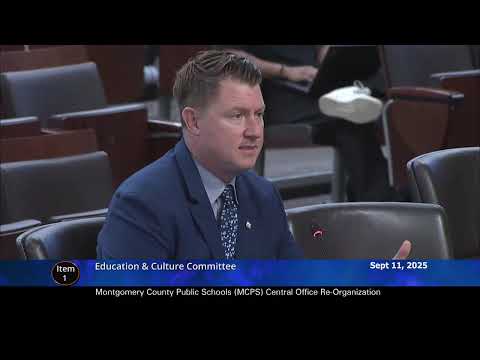
Montgomery County Public Schools has reorganized its central office into 13 cross‑functional teams that are assigned directly to clusters of schools, officials told the Montgomery County Council’s Education and Culture Committee on Sept. 11. The change is intended to reduce administrative layers, put central‑office expertise “in the schools,” and align central services with each school’s improvement plan.
The reorganization consolidates specialized units — including curriculum, special education, equity, restorative practices and student support — so those staff are part of a cluster team and are present on school sites an expected 80% of the week, Dr. Moran, a member of the MCPS leadership team, said at the committee meeting. “One of the keys to cross‑functional teams has been taking out essentially the middle person and having this direct 1 to 1,” Moran said.
District leaders said the teams are meant to deliver more equitable, differentiated support rather than equal distribution of services. “If I have a school that demonstrates significant needs based off of either their student achievement data, their chronic absenteeism, more intensive support is being provided to that particular school,” Moran said. The district created three focus clusters — John F. Kennedy, Watkins Mill and Gaithersburg — where more intensive, dedicated teams serve between eight and 11 schools.
Nut graf: The restructuring aims to improve student outcomes by making central‑office staff more directly accountable for school goals. Officials said they will measure success primarily by gains in student achievement and secondarily by perceptual data from teachers and school staff on the usefulness of central supports.
Officials described several core elements of the model: directors who each carry caseloads of roughly 8–18 schools; regular Friday team meetings to review data and differentiate support; placement of specialists (math, literacy, special education, English learner supports, equity and restorative practice) on cluster teams; and a clearer line of who schools should contact for specific supports. “Progress towards that goal is not based off of the school’s performance alone,” said a member of MCPS leadership. “We all own that data and are being evaluated on the performance of how that data moves and improves.”
Leaders acknowledged the change produced disruption for some staff. Doug Prouty, senior legislative analyst, and Ms. McGuire of the MCPS leadership team said every displaced employee was offered a position in the reorganized structure, though some individuals later chose to retire or leave the district. “We were able to offer and place, if someone accepted it, everyone that was displaced,” McGuire said; she also noted the district recognized the “storming, norming, performing phases of change” and the personal impact of reassignment.
Equity and restorative practices were explicitly folded into the cross‑functional teams. Naya Hamlet, identified at the meeting as the district’s chief of equity and organizational development, has assigned equity instructional specialists to clusters and maintained a set of restorative practice specialists so schools can access both prevention and incident response supports. Leaders said hate‑bias protocol training was delivered to principals during the summer leadership academy and then to staff and students through subsequent sessions.
The district also disclosed short‑term operational steps triggered by the reorganization. For central‑office staff affected by building issues at the Carver Educational Services Center (CESC), MCPS opened the Grosvenor Holding School as an alternate work location while remediation proceeds. Officials said not all of Carver is affected but that offices with reported mold or rodent concerns are being assessed and — when remediation is required — staff may be temporarily relocated.
Council members pressed for ways to measure success and maintain staff buy‑in. Measures cited by MCPS leaders included: student achievement gains in literacy and math; perceptual surveys and qualitative feedback from principals, teachers and cross‑functional team members; and the degree to which school improvement plans include measurable actions tied to central supports.
Ending: District leaders said reorganization work will continue through the year and will be refined; they invited council members to observe cross‑functional teams in schools as a way to assess implementation. “Everybody got started at a baseline, and we built from there,” one MCPS official said. “There will be challenges and things we’ll have to change as we go.”