
Board approves Cartwright's FY25 annual financial report showing $106.2M M&O spending and capital rollovers
Get AI-powered insights, summaries, and transcripts
Subscribe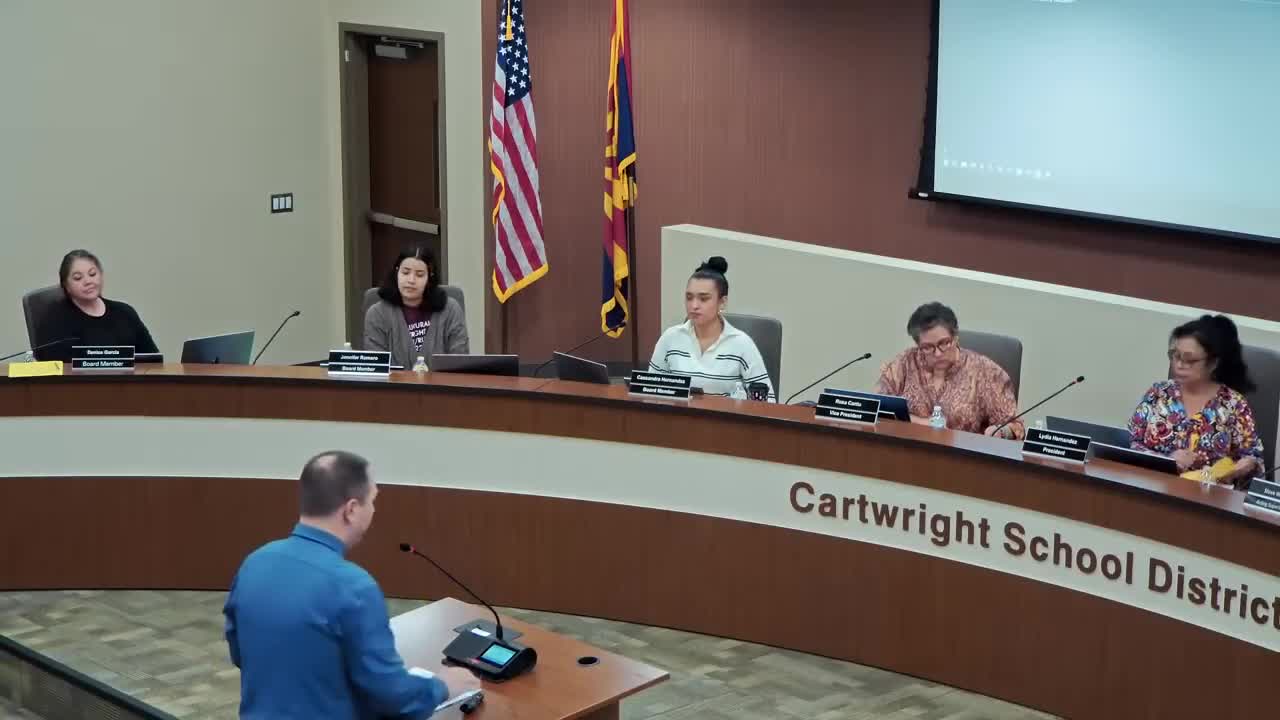
Summary
The governing board approved the district's FY25 annual financial report Oct. 1. The report shows $106.17 million in maintenance-and-operations expenditures, $8.6 million in capital outlay spending and several fund shifts and carryovers that affect how services are funded and reported.
The Cartwright Elementary District governing board approved the fiscal year 2024'5 annual financial report at its Oct. 1 meeting after a presentation by the district's business office.
Executive Director of Business Services Dr. Derek Etheridge summarized key figures: maintenance-and-operations (M&O) expenditures for FY25 totaled about $106,167,746 (with roughly $67.8 million in salaries and $23.3 million in benefits), classroom site fund expenditures totaled about $7.4 million, and capital outlay spending was roughly $8.6 million. The presentation broke spending down by object codes (salaries/benefits/purchase services/supplies) and by functions (instruction, student support, facilities acquisition and construction). The capital category included cafeteria remodels, facility construction and multi-year projects that created carryovers from prior fiscal years.
Etheridge explained several fund movements and accounting mechanics the public often finds confusing: some funds are "budget-controlled" by the state (meaning the district can spend only what the state budget permits even if cash is available), while other funds are "cash-controlled" (available cash sets spending). He noted the district had about $12.6 million in M&O cash but the statutory budgeted carryover the district may spend was about $12.1 million, leaving a gap often called "dead cash." He also explained that some student-support expenditures moved between M&O and federal funding (for example, Medicaid and IDEA) for compliance and to meet federal "supplement, not supplant" rules.
Board members asked detailed questions about capital spending and fund balances and emphasized caution for future capital draws as enrollment declines and state funding uncertainty reduce predictable revenue. The board later moved to approve the annual financial report; the vote carried and the AFR will be filed as required by state deadlines.
The AFR presentation included several other funds and technical items (indirect cost transfers from federal grants, food-service matching, tax-credit account balances, and employee insurance withholding account rules). District staff said they would continue working to make the report accessible to stakeholders and to align future spending with strategic instructional priorities.
(Reporting note: figures come from the AFR presentation to the Oct. 1, 2025 board meeting.)