Get Full Government Meeting Transcripts, Videos, & Alerts Forever!
Get email alerts on the Water Septic Fire Subdivisions topic
No spam. Unsubscribe anytime.
Cache County officials seek new subdivision rules after water, septic and fire concerns
Summary
Cache County planning commissioners, public health and water experts discussed new subdivision standards — including when developers must provide shared water systems, septic density limits and requirements for second access and fire protection — and scheduled a focused meeting Oct. 22 to begin drafting code changes.
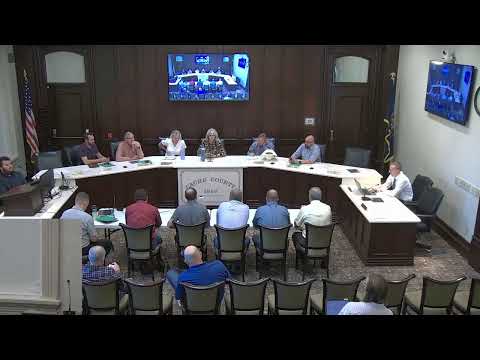
Cache County planning commissioners, county staff, public-works and fire representatives and regional water experts met to discuss growing concerns about multi-lot subdivisions in unincorporated areas, focusing on groundwater availability, septic contamination risks and emergency access.
The conversation followed recent applications for 20-lot subdivisions in parts of the county and recurring complaints from long-time residents about wells drying up and nitrate concerns. ‘‘We have 3 in front of us that are 20-lot subdivisions,’’ a county official noted during the meeting, saying commissioners have ‘‘no tools to say no’’ when applicants meet existing technical requirements.
Why it matters: County leaders said current rules — many set by state regulations and by the health department — permit approvals when technical standards are met, but they leave little local discretion to require shared water systems, additional environmental testing or stronger fire protections for larger developments. Commissioners, public-works staff and fire officials said that could shift long-term costs and risks onto neighbors and first responders.
Participants and evidence: U.S. Geological Survey scientist Eric (U.S. Geological Survey) described an ongoing regional groundwater study for Cache Valley aimed at measuring recharge rates, groundwater age and flow paths. ‘‘We are looking at this large regional aquifer in Cache Valley,’’ Eric said, adding that final quantitative results and modeled scenarios are about a year away. Richard Worley of Bear River Health summarized existing septic-permitting authority and cited the applicable regulation: ‘‘Our authority comes from Utah Administrative Code R317-4,’’ he said, noting that the code sets lot-size ranges tied to soil transmissivity.
Technical background: Bear River Health confirmed the department permits septic systems sized for individual homes (less than 5,000 gallons per day) and applies a soils-based table that, for private wells, generally requires parcels between about 1 acre and 1.75 acres depending on soil transmissivity. When public water is available, smaller lots — down to roughly 20,000 square feet or a half-acre in county practice — are allowed. Officials said those standards reflect Utah Administrative Code R317-4.
Water questions and preliminary findings: USGS staff said phase-one sampling is complete and analysis is under way; some isotope and age-dating samples require longer laboratory processing. Eric said the study aims to provide recharge-rate estimates and scenario modeling (for example, effects of additional pumping or changes in snowmelt timing). Participants cited a previously published recharge estimate of roughly 220,000 acre-feet per year for the wider area and noted reported pumping of about 30,000 acre-feet annually; USGS said part of the project is to reconcile and better measure those numbers and the role of canal seepage in recharge.
Septic and water-supply tradeoffs: Commissioners and public-health staff discussed nitrate detections in denser communities such as Millville and said public sewer eliminated some local problems there. Bear River Health emphasized that evidence of contamination requires a density study and monitoring to justify more stringent, higher-cost septic technology; advanced treatment systems require operating permits and higher ongoing costs.
Fire protection and emergency access: County fire staff described a recent wildland-structure fire that required mutual-aid tankers and underlined the operational risk where subdivisions lack hydrants or reliable local water supply. ‘‘If we can’t have water, we’ve gotta have a way out,’’ a county fire official said, arguing for second egress requirements and minimum fire-suppression supplies for clustered developments. Fire standards discussed included a target fire-protection water volume and access for apparatus — e.g., hydrants or tanks sized to meet local fire-flow code — and that many of the county’s volunteer departments currently rely on tankers and neighbor systems.
Policy options and constraints: County Attorney Andrew Crane and staff clarified that state land-use law requires approval of preliminary subdivision applications that comply with ‘‘applicable county ordinances.’’ That means the county can adopt new ordinance requirements (for example, triggers for shared water systems, minimum second-access thresholds or developer responsibilities for future annexation) but cannot apply new requirements retroactively to already-submitted applications. Several participants proposed a threshold tied to the state definition that requires a public water system for five or more connections; multiple speakers suggested using ‘‘five or more lots’’ as a starting trigger for requiring a shared water system or other mitigation measures, while leaving room for site-specific exceptions based on soils and transmissivity.
Next steps and commitments: Staff and elected officials agreed to pursue code updates and additional study. Development Services interim director Angie Sutterquist said staff have placed related items on next month’s planning commission calendar and have proposed budget money for a full code update and consultant assistance (subject to budget approval). Andrew Crane said he would work with staff on draft ordinance language. The group scheduled a stakeholder work session for Wednesday, Oct. 22, at 6 p.m. to begin drafting and coordinating a recommended approach.
What was not decided: No formal ordinance changes were adopted at the meeting, and no new county-wide standards were finalized. Several participants asked for more site-specific data — for example, additional well tests and USGS transmissivity analysis — before the county adopts a single fixed lot-count trigger that applies uniformly across geologically diverse parts of the county.
Context and implications: Officials said a practical approach could require developers of larger subdivisions to provide a shared water system built to municipal design standards (so a city could accept it later if annexation occurs), or to demonstrate via field tests and USGS-informed modeling that private wells and septic systems will not adversely affect neighbors’ water quality or existing wells. Public-works and fire staff emphasized the administrative and long-term maintenance burdens of many small private water systems and private roads, and discussed options including developer-funded impact fees, water-district takeover of systems, or conditions tied to future annexation.
Closing: County leaders asked staff to coordinate input from Bear River Health, USGS, public works, fire chiefs and planning staff and to return with draft ordinance language and options at upcoming meetings. The group invited interested community members and the planning commission to participate in the Oct. 22 work session.