Get Full Government Meeting Transcripts, Videos, & Alerts Forever!
Get email alerts on the Airport Operations topic
No spam. Unsubscribe anytime.
Airpark advisory panel urges stronger oversight, bilingual noise tracking; revenue authority backs studies including possible control tower
Summary
A county advisory committee’s first annual Airpark report calls for stronger oversight, multilingual noise tracking and enforcement of lease and safety obligations; the Montgomery County Revenue Authority pledged greater transparency and asked the advisory body to study an FAA‑staffed control tower.
A county advisory committee released its first annual report on Sept. 15 calling for stronger county oversight of the Montgomery County Airpark, better bilingual noise complaint tools and more enforcement of lease and safety requirements — and the Montgomery County Revenue Authority said it would work with the committee and federal partners to pursue fixes.
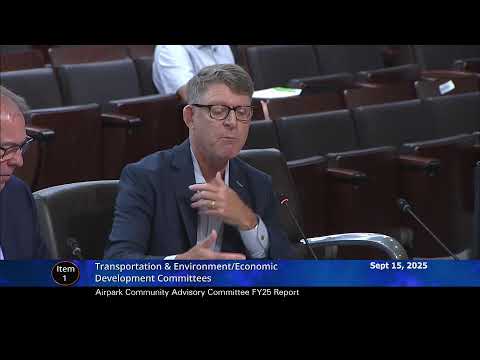
The Airpark Community Advisory Committee’s report lists repeated facility and management problems under the airport’s master lease, urges the county to publish noise complaint summaries in English and Spanish and recommends improvements to hangar leasing, maintenance processes and tenant oversight. “This is just the tip of the iceberg,” said Skip Rheindaler, chair of the advisory committee, describing the committee’s unanimous findings and recommending council leadership to press the Revenue Authority, county departments and the lessee for action.
Why it matters: The Airpark sits inside a densely developed Montgomery County area and is governed by a mix of county, state and federal rules. The Federal Aviation Administration (FAA) holds primary authority over flight operations and enforces grant assurances tied to federal funds. Committee members and several councilmembers said the mix of limited local authority, long-standing lease terms and an active flight school environment have left residents exposed to sustained noise, uncertain facility conditions and what the committee describes as inconsistent enforcement of lease terms.
The committee’s findings and recommendations
The committee highlighted four core problem areas: weak enforcement of the master lease by the lessee and by county oversight; long-standing facility maintenance problems (including reported flooding and building-code concerns at individual hangars); a lack of transparent, multilingual noise complaint reporting; and operational pressures from concentrated flight-school activity that the committee says overloads the airport pattern.
Rheindaler said the committee documented cases where the lessee, identified in county materials as Montgomery County AirPark 1 Limited Partnership and operating as DC Metro Aviation Services, failed to obtain required permits for hangar work, produced poor repairs and — in at least one instance cited by the committee — disassembled an aircraft that a committee member described as an abandoned aircraft without clear accounting for its parts or proceeds. The committee also reported a resident-filed FAA complaint about hangar wait-list handling.
“Many provisions in the master lease were not enforced,” Rheindaler said, adding that enforcement gaps could jeopardize federal grant eligibility if grant assurances are violated.
MCRA response and next steps
Keith Miller, chief executive officer of the Montgomery County Revenue Authority (MCRA), acknowledged the committee’s work and said MCRA would pursue greater transparency and coordinate with agencies such as the FAA and the Department of Permitting Services (DPS). Miller described the property split in the 2004 amendment to the lease that left runways and taxiways under MCRA control while the lessee controls many buildings, and said that arrangement constrains what the authority can do unilaterally.
Miller outlined several current or planned actions: publicizing additional information on the Airpark website, continuing FAA grant applications (MCRA said it has received more than $20 million in FAA grants over the past decade and typically programs projects through a multi-year FAA plan), pursuing design funding for a new hangar on a north-end parcel and working with DPS and county attorneys when building-code or permit issues arise. “We remain committed to continuous improvement, transparency, and partnership with all stakeholders,” Miller said.
Noise, data and enforcement limits
Both the committee and MCRA emphasized limits on local authority over aircraft operations. The FAA’s noise measurement framework (including the 65 DNL metric) and the Airport Noise and Capacity Act of 1990 govern what local airports can require; any local access or operational restrictions must be approved by the FAA. Miller and committee members said the Airpark already uses an online complaint system based on FAA best practices and that complaint volumes spiked after the system’s rollout; MCRA reported about 106 unique households filed complaints since 2021 and told the committee 2025 is trending to a large decline in total complaint volume compared with 2023.
The report recommends clarifying the data goals and improving how complaints are summarized — including publishing bilingual summaries — so the community and decisionmakers can interpret unique complainants versus repeated automated campaigns. MCRA said it will review the complaint goals and consider system adjustments and improved outreach; the authority also said it will publish more detailed noise information on its website.
Safety, FAA role and flight schools
Committee members, pilots and councilmembers described recurring safety concerns tied to pattern congestion at the non-towered airport and to operations by large flight schools. MCRA emphasized that only the FAA’s Flight Standards District Office (FSDO) can investigate pilot-specific safety violations and take enforcement action. Several councilmembers and ACAC members said they have raised repeated safety concerns with the FAA and urged stronger federal follow-up; MCRA said it has forwarded information to the FAA and will continue to coordinate with congressional offices to elevate concerns where necessary.
Control tower proposal and funding notes
The MCRA and the committee both recommended the ACAC evaluate whether a staffed FAA control tower is feasible. MCRA staff said building a tower would likely cost in the tens of millions of dollars and would require community support, inclusion in FAA grant programs and local construction to qualify for FAA staffing. One MCRA estimate presented in the hearing put a ballpark figure of roughly $25–$30 million for construction; the FAA would staff a tower if approved. Committee members urged the ACAC to study community support and pursue federal and congressional engagement if the community backs a tower.
Other recommendations and administrative items
The committee recommended the council press for stronger enforcement of lease maintenance language, review hangar-assignment transparency, improve homebuyer disclosure language for properties near the Airpark and expand outreach and multilingual materials. MCRA agreed to implement several transparency improvements and asked the ACAC to study specific follow-up items, including control-tower feasibility, revisions to the fly‑friendly guidelines and goals for the noise-complaint system.
What the meeting did not decide
The council committees did not take any binding votes at the Sept. 15 work session. Councilmembers encouraged continued coordination among the ACAC, MCRA, county permitting and legal staff, and federal authorities. Several councilmembers requested written follow-up, including copies of communications and of the challenge materials MCRA sent to the FAA about specific operators.
Ending
Committee members and MCRA leaders said they will continue work in the coming year; the ACAC plans further research and recommended follow-up to translate several report recommendations into measurable deliverables. Council chairs said they will remain engaged and asked staff to return with updates and any items that require council action or additional staff resources.