Get Full Government Meeting Transcripts, Videos, & Alerts Forever!
Get email alerts on the Municipal Finance Salaries topic
No spam. Unsubscribe anytime.
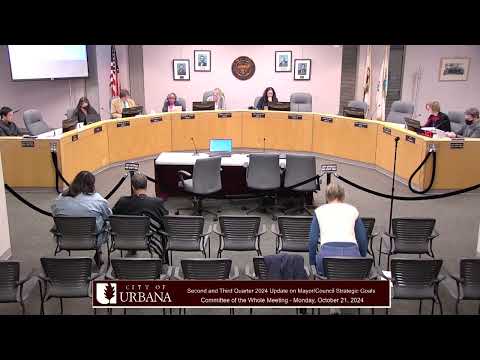
Urbana committee advances competing salary ordinances for mayor, clerk and council to full council
Summary
The Committee of the Whole voted to forward two differing ordinances — one drafted by the city clerk and one from city staff — that would set 2025–2029 salaries for the mayor, city clerk and alderpersons to the full City Council for final action; members debated pay compression, comparables and budget impact.
The Committee of the Whole on the evening advanced two competing ordinances to the City Council that would fix salaries for Urbana elected officials for the 2025–2029 term.
One ordinance, sponsored by Councilmember Shandra, would set the city clerk’s salary at a level intended to correct pay compression between the elected city clerk and the deputy city clerk; City Clerk Darcy said her proposal targets a midpoint salary consistent with professional clerk salary surveys. “The clerk’s office oversees all veil operations for the entire city,” Darcy said, describing duties that include keeping contracts, ordinances and minutes, acting as the Open Meetings Act (OMA) designee and serving as the public-facing office for FOIA intake. Darcy told the committee that the deputy city clerk’s recent market adjustment left the deputy at 98 percent of the clerk salary and that the proposed adjustment would bring that ratio closer to the city’s internal policy ceiling.
A second ordinance, sponsored and explained in detail by Diane (as presented to the committee), proposed smaller, uniform percentage increases across elected positions and emphasized different philosophical priorities, including limiting reliance on the city’s class-and-compensation (class-and-comp) study when setting elected-official pay.
Why it matters: Salaries for the mayor, city clerk and alderpersons must be fixed by ordinance at least 180 days before the start of the new term. Committee members framed the debate as a choice between correcting long-running compression for the clerk’s office and applying a consistent, modest increase across all elected positions to limit budget impact.
Key facts and debate - Darcy said the city clerk’s office averages 50–55 hours per week, performs OMA and FOIA functions, maintains city records and issues certain licenses. “I maintain full office hours. I would say an average week for me is 50 to 55 hours with the council meetings,” Darcy told the committee. - Darcy cited two professional salary surveys — an International Institute of Municipal Clerks survey and a Central Illinois municipal clerk survey — and said the clerk position in Urbana is full-time and should be compared to full-time clerks. - Diane described a philosophical difference over applying pay-compression guidance from the city’s class-and-comp study (which covered non-elected staff) to elected offices, noting elected officials’ different accountability mechanisms and statutory roles. - Councilmembers voiced competing priorities: some favored raising the clerk’s pay to remain competitive and retain qualified candidates; others pressed for a consistent percentage for mayor, clerk and alderpersons to limit immediate budgetary impact.
Committee action and next steps - Committee moved the clerk-focused ordinance forward to the City Council with a recommendation for approval (motion by Councilmember Chandra; second by Councilmember Jaya). The committee discussion record reflects the motion carried and was forwarded to full council for final action. - The second ordinance fixing salaries for all elected officials (mayor, clerk, alderpersons) was also moved forward to the City Council for approval with an amendment to the city clerk dollar amounts; committee members divided the question on alderperson compensation before forwarding the mayor and clerk items.
Budget and process notes - Committee members asked for and staff agreed to provide budget-impact information showing how the proposed salary schedules would affect recurring expenses and reserves in FY 2026 so councilors could judge affordability before final council action. - Several members emphasized that elected-official salaries are fixed dollar amounts in the ordinance (not automatic annual cost-of-living adjustments) and remain in force for the four-year term. Staff confirmed those dollar amounts will be included in the FY 2026 budget formulation.
Context and background - The city’s last technical compensation study for staff (Evergreen Consulting Co., 2021) influenced pay grades for non-elected positions; the clerk’s office deputy received a significant adjustment under that study. Committee discussion repeatedly contrasted elected-official compensation practice with staff compensation policy.
Looking ahead - The ordinances will appear on the next City Council agenda for final votes. Council members asked for a short budget projection and a concise summary of current salaries and the proposed changes before council consideration.
Ending - The committee did not finalize salaries at tonight’s meeting; it forwarded both ordinances to the City Council for final action and asked staff for budget projections and clarifying materials to accompany the ordinances at council.