
Council approves OPRA exemption for 35 S. Johnson; owner plans $3.3M medical clinic redevelopment
Get AI-powered insights, summaries, and transcripts
Subscribe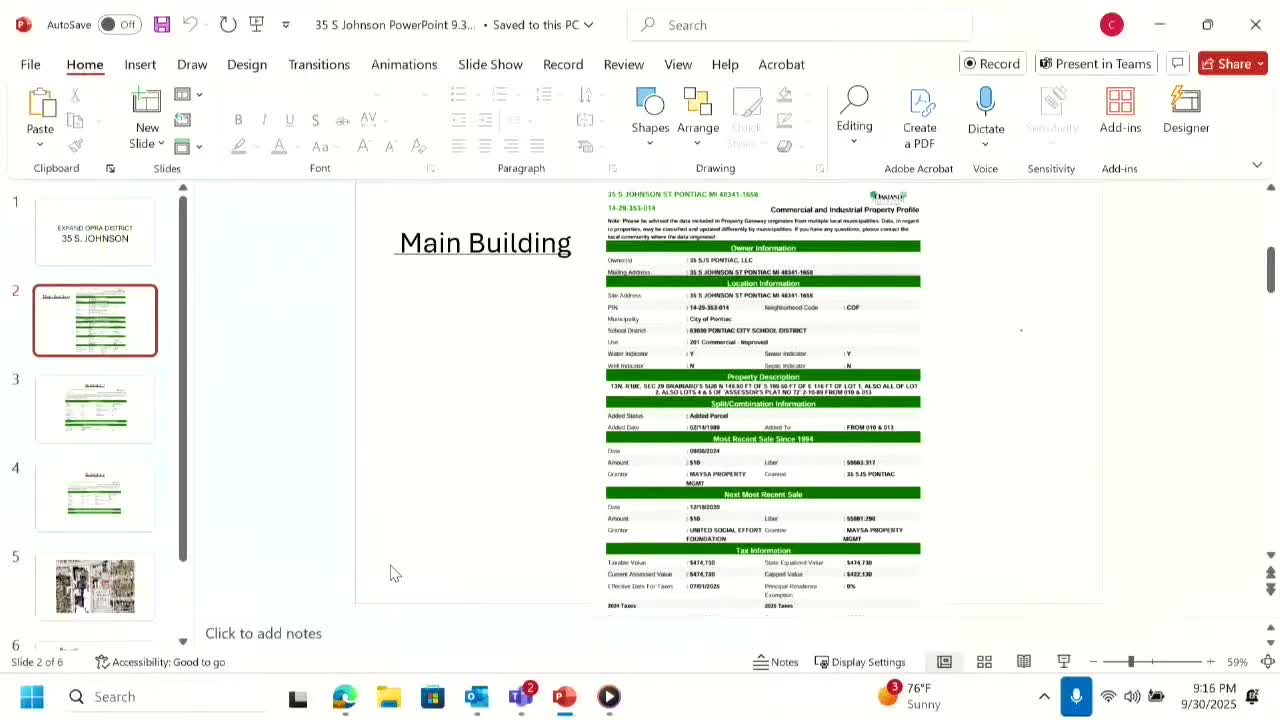
Summary
Pontiac City Council approved an exemption certificate under the Obsolete Property Rehabilitation Act for 35 South Johnson, clearing the way for a proposed $3.3 million rehabilitation into medical clinics and a pharmacy and a minimum of 50 permanent jobs.
Pontiac City Council approved an Obsolete Property Rehabilitation Act (OPRA) exemption certificate for 35 South Johnson Street, clearing the path for a planned conversion of the long-vacant three-story office building to a cluster of medical clinics and a pharmacy.
The project applicant, identified as Kirkland Capital Group in council materials and represented during the meeting by Jamie Leclaire of Lipstick Properties, proposed a $3.3 million renovation and said the redevelopment will create at least 50 permanent jobs and additional construction jobs during rehab.
At the public hearing, Leclaire outlined the scope: new roof, replacement of HVAC, parking-lot repairs and interior build-outs for medical tenants. "They're gonna be taking a space in there, and there's other leases we're working on... Honor Community Health is coming in there," Leclaire said, referring to a federally qualified health center that will operate a clinic in the building.
The property sits in the newly expanded Huron Corridor OPRA district that the council adopted earlier in the meeting. The council approved the certificate after updating the resolution language to reflect the public hearing and the newly-expanded district boundaries.
Why it matters: OPRA certificates allow developers to seek a temporary partial property-tax exemption for rehabilitating underused or obsolete structures. The city said the project restores a vacant building to productive use, increases local medical services, and should generate payroll and economic activity downtown.
Terms and timing: The applicant requested a 10-year tax-exemption certificate (the OPRA statute allows up to 12 years). The project team expects to finish major rehabilitation work in 2026 with a 2027 occupancy target for tenants.
Council action: After a public hearing with no speakers, the council voted to approve the certificate. Council members emphasized priorities for local hiring and asked staff to track procurement and job creation during construction and after occupancy.
What comes next: The developer must complete the specified rehabilitation work and comply with any conditions in the certificate; the city will record the exemption and the county/state tax roles will reflect the OPRA schedule. The final abatement will apply only to the increased taxable value attributable to qualified rehabilitation work and the certificate covers the specific parcel listed in council materials (parcel ID 641429353014).