Get Full Government Meeting Transcripts, Videos, & Alerts Forever!
Get email alerts on the Ab 1175 topic
No spam. Unsubscribe anytime.
CBA advances licensure policy changes tied to AB 1175 and ramps up student outreach
Summary
The California Board of Accountancy approved policy recommendations to define ethics coursework and list advanced degrees that can substitute for one year of required accounting experience under Assembly Bill 1175, and staff described a major outreach campaign to explain the changes to students and educators.
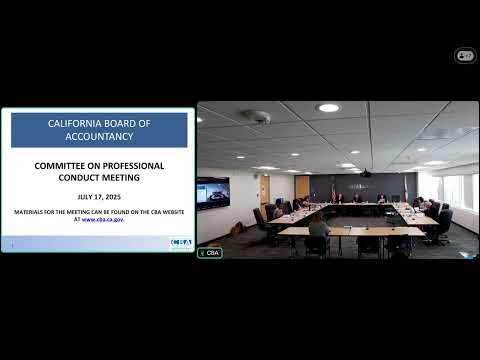
The California Board of Accountancy on July 17 approved staff- and committee-recommended policy directions for implementing parts of Assembly Bill 1175 and described a statewide outreach campaign aimed at students and educators.
The board’s Committee on Professional Conduct recommended, and the full board approved, a revised definition of the ethics subject area to explicitly include audit and fraud coursework and an expanded list of advanced-degree subjects that can substitute for one year of the two-year general accounting experience requirement described in AB 1175. Jennifer Huddy, manager of the initial licensing unit, told the board the changes are intended to be included in a future rulemaking package.
Why it matters: AB 1175 would change California’s CPA licensure pathway if enacted, including shifting the education and experience structure applicants must meet. The board’s policy approvals are not regulatory changes yet but are intended to inform the regulations staff will draft if AB 1175 becomes law.
What the board approved and why: Huddy summarized staff recommendations and the policy background, telling the board, “Staff recommends approving the revised definition of ethics study to include audit and fraud and the updated list of advanced degree fields of study that will substitute for 1 year of general accounting experience.” She said the recommended list expands related fields for applicants with an accounting bachelor’s degree to include business, computer science or information systems, data analytics, economics, finance, law, management, marketing, mathematics and statistics.
Outreach and timing: David Hemphill, information and planning officer, outlined an outreach program the CBA has run since AB 1175’s introduction and described plans for a large fall “CBA campus tour” focused on students and faculty. Hemphill said the CBA has created a dedicated web page, videos, podcasts and monthly live question-and-answer sessions. On legislative timing, staff told the board AB 1175 had passed the Assembly committee stages and was moving through the Senate—Hemphill said the bill “passed on a vote of 11 to 0” in the Senate Business, Professions and Economic Development Committee and was scheduled for Senate Appropriations on Aug. 18.
Board process and next steps: The board voted to approve the policy directions recommended by staff and the CPC; staff will use those policy approvals to prepare rulemaking language if and when AB 1175 is enacted. Huddy and Hemphill said staff would continue outreach while the bill progresses and that applicants who prefer the current requirements will be able to apply under the existing rules for a transition period (as summarized in CBA materials).
Context and limitations: The board’s approvals are policy directions for a future rulemaking package; they are not final regulations. Whether the policies take legal effect depends on AB 1175 becoming law and then on the formal regulatory process. Hemphill told the board the CBA page and materials are “regularly updated as the legislative process unfolds,” and urged stakeholders to consult the CBA website for the official timeline and materials.
Ending note: Staff said they will bring regulatory language for public review if AB 1175 is enacted, and they will continue campus-focused outreach beginning in September to explain changes to students and faculty.